Showing posts with label flowering shrubs. Show all posts

Tuesday, September 15, 2026

Garden Bloggers' Bloom Day & Foliage Follow-Up September: Late Summer Garden Tour

Welcome!
Welcome to my zone 7b Long Island garden! With fall approaching rapidly, the summer seems to have dwindled away so quickly. While the seasons are changing with cooler temperatures mostly in the 70's and much needed rain, the garden continues to produce interesting foliage and blooms. Join me for a tour and discover what there is to see!
Back Island Bed
Starting in the back island bed, the later blooming Hydrangea 'Limelight Prime' is still showing off its blooms, which turn in color from greenish-white to white and then to the pinkish tint, which you see here as we approach the fall season.
Patio Garden
Abelia 'Kaleidoscope' along the patio border is starting to produce its trumpet shaped white blooms in mid-September, which will continue into October. Since I introduced this relatively new addition to the garden, I have been enjoying the late summer interest and the foliage as well, as it remains mostly evergreen throughout the different seasons.
Abelia 'Kaleidoscope'
Here are the blooms up close!
Blue Globe Spruce and Echinacea (Coneflower)
Along the patio border, Blue Globe Spruce is in the distance with Echinacea Pow Wow 'Wild Berry' in the foreground. The American Goldfinches have really enjoyed the seed heads of the Echinacea this year!
Echinacea Late Summer
There are a couple of somewhat remaining blooms...
Echinacea Seed Head
and I am enjoying the interesting spiral structure of the seed heads.
Liriope 'Big Blue'
In the back shade border, Liriope 'Big Blue' (Lilyturf) is showing off its wonderful bright purple blooms... 
Jacob's Ladder
while variegated Jacob's Ladder is displaying its wonderful foliage! The plant itself stays a compact 12 to 18 inches tall and produces bluish-purple blooms in late spring.
Northern Fenceline
Along the northern fence-line, Kousa Dogwood is joined by miniature Black Eyed Susan (Rudbeckia 'Little Goldstar') and Hosta 'Patriot'.
Back Shade Border 'Secret Garden'
Following the stepping stone path around to the "secret garden" is where Weeping Norway Spruce can be seen along with Mountain Hydrangea, Heuchera 'Caramel' (Coral Bells) and Jacob's Ladder.
Endless Summer Hydrangea Almost Fall
There are still the remains of some blooms on Endless Summer Hydrangea, and on the other side of the yard, Crape Myrtle 'Sioux' continues to bloom as we approach the back perimeter garden.
Back Perimeter View
Here is a view of a section of the back gardens along the perimeter on the southern side of the property with the patio garden in the foreground. Crape Myrtle 'Sioux' starts its bloom at the end of July and continues into fall.
Hydrangea 'Firelight Tidbit'
Here is another relatively new addition (within the last three years). Meet Hydrangea 'Firelight Tidbit'. Its white blooms are now getting their wonderful pinkish tint.
Sedum 'Pure Joy'
Speaking of pink, Sedum 'Pure Joy' is still blooming away since August...
Knock Out Rose 'Radrazz'
and blooming all summer long with its bright red blooms is Knock Out Rose 'Radrazz'. 
Back Patio Garden
For a little foliage, here is Rhode Island Red Japanese Maple with variegated Osmanthus 'Goshiki' Weeping Blue Atlas Cedar, Dwarf Mugo Pine 'Slowmound' (left) and Dwarf Red Pine 'Low Glow' (right).
Front Island Bed with Moss Rock Boulder Wall
Follow me as we go around to the southeastern lawn where we see the newly added Nepeta 'Chartreuse' (Catmint) along the front of the new boulder wall. Since the large tree came down from the corner, the area is now receiving full sun and the Nepeta is doing well.
Front Eastern Border
Along the front foundation and facing directly east is golden Hinoki Cypress 'Verdoni', Juniperus 'Blue Star' and Japanese Variegated Sedge. With a slight cleaning out this past spring, the variegated sedge is exceptionally vibrant this season.
Hydrangea 'Tardiva' Front Northern Side
Hydrangea 'Tardiva' is one of the latest blooming hydrangea varieties and is blooming away for late summer through fall. I look forward to its large white panicle shaped flowers every year as the summer nears its end.
Hydrangea 'Tardiva' Blooms Up Close!
Here are the delicate blooms up close.
Starting to Look Like Fall!
As we near the end of the tour, you can see the changing foliage of Weeping Japanese Maple on the front lawn with Blue Atlas Cedar in the backdrop...
Tea Time!
and perhaps it is now time to enjoy a nice hot cup of tea!
Thanks for Visiting!
I hope you enjoyed your visit to my September garden. I so appreciate you being here, look forward to your comments and enjoy seeing what you have growing in your garden. Special thanks go out to our hostess Carol at May Dreams Gardens, who makes it possible to see blooms on the 15th of every month with her meme Garden Bloggers' Bloom Day. Also, special thanks to Pam Penick at Digging who had hosted Foliage Follow-Up, a meme I will continue to honor. I am also linking with some other wonderful hosts and hostesses at Floral Friday Fotos, Nature Notes at Rambling Woods, and Garden Affair at Jaipur Garden.

Connect With Me
🌼
It's time to plan your garden! Visit my Author Page 👈to learn about and purchase my books, each one focusing on different aspects of gardening, including landscape ideas, design principles, gardening by month for all-season interest, gardening tips and maintenance, shade gardening, gardening inspiration and more. And also be sure to check out my newest publication, The Houseplant Guide, to guide you on your houseplant journey! If you have read any of my books and have found them to be useful, reviews are very much appreciated!

Also, check out my newsletter Northeastern Gardening News for monthly updates all to do with gardening! It's free to subscribe or you can pledge a donation to show support for my work, or upgrade to receive extra perks monthly right into your inbox!   


Until we Meet Again...Happy Gardening!

Author: Lee @A Guide to Northeastern Gardening, © Copyright 2010-2026. All rights reserved. 

Monday, April 1, 2024

Feature Shrub Spirea Big Bang 'Candy Corn'

Feature Shrub Spirea Big Bang 'Candy Corn'

Welcome to This Month in the Garden! There is a new flowering shrub in town, and it is called Spirea Big Bang 'Candy Corn', scientific name Spirea japonica. While this shrub produces wonderful deep pinkish-lavender blooms in summer, in this designer's opinion it's all about the ever-changing medley of foliage! This new cultivar was developed by Dr. Tom Ranney of North Carolina State University and has become popular for several reasons, one of them being that it is considered sterile and non-invasive.

 Spirea Big Bang 'Candy Corn' Summer Foliage

Cold hardy to USDA zones 4-8, Double Play 'Candy Corn' thrives best in full sun and a well-drained soil and offers an ever-changing array of foliage color, from bright red to candy corn orange to yellow-green. Summer foliage color is determined by exposure. Leaves are darker in part shade, and a brighter yellow in sunny exposures. Pollinator friendly blooms offer another round of color in late spring and early summer. This dwarf form of Spirea stays compact and rounded at a height of 18-24 inches high by wide at maturity and is compact enough to grow in a container. I was also surprised to see this variety getting spring buds before any of the other Spirea.

Spirea Big Bang 'Candy Corn' Late Winter/Early Spring

This cultivar is adaptable to a wide range of soil conditions, including clay and is drought tolerant once established. With its small size, little to no pruning is required, making it perfect for low-maintenance gardens. This flowering shrub is also deer and  rabbit resistant.

Spirea Big Bang 'Candy Corn' Spring Foliage
I hope you enjoyed This Month in the Garden. Be sure to stop by on the 1st. and 15th. of each month as I continue to share gardening tips, information and horticultural adventures! Perhaps Spirea Big Bang 'Candy Corn' will go onto your wish list as a new garden addition!


"As Always...Happy Gardening!" 

Author: Lee @A Guide to Northeastern Gardening, © Copyright 2010-2024. All rights reserved. 

Tuesday, August 1, 2023

This Month in the Garden: St. John's Wort

Feature Flowering Shrub: St. John's Wort
Welcome to This Month in the Garden. This month we feature St. John's Wort. Hardy in USDA zones 5-8, St. John's Wort a semi-evergreen flowering shrub that comes in a variety of cultivars ranging in size from 2-3 feet tall by wide up to 6 feet tall with a spread of 3-6 feet in width. In its native form, Hypericum perforatum (St. John's Wort) is renowned for its medicinal properties and contains various active compounds, including hypericin, hyperforin and flavonoids, which are believed to possess unique antidepressant and anti-inflammatory qualities. As a topical, it is used to treat wounds, burns, muscle ache and bruising. St. John's Wort has been used throughout European medicine as far back as the ancient Greeks to treat a variety of conditions, including insomnia, depression, anxiety reduction, and nerve related pain. 
Hypericum x inodorum 'Magical Universe' (St. John's Wort) Summer
While the seeds and berries are considered toxic, the flowers, leaves and stems of the plant are typically harvested during the height of the bloom season. At that time they are dried thoroughly to remove moisture, extracted and infused in a solvent, such as alcohol or olive oil, then further filtered to obtain a clear liquid extract, which is then prepared as an herbal tea, tincture, capsule or tablet form. The final product is stored in dark glass bottles to protect the herb from light and preserve its medicinal properties.
Hypericum x inodorum 'Magical Universe' (St. John's Wort) Late-Summer
Today's feature variety, 'Magical Universe' is a hybrid, dwarf cultivar with deep green foliage and small, bright yellow blooms starting in June, followed by fruit that deepens to deep red in fall. Staying at a more compact size of 2-3 feet tall by wide, St. John's Wort 'Magical Universe' prefers a location with full sun to partial shade in well-drained soil with moderate watering. A location with bright morning sun and late afternoon shade is ideal. While this form of St. John's Wort is not considered medicinal, its lovely bright yellow blooms and red ornamental berries bring interest to the landscape throughout the seasons. As its foliage turns to a deeper burgundy in fall and the red berries dry, the plant adds a decorative touch even into winter. St. John's Wort is known to be drought tolerant once established, able to withstand a variety of soil types and is deer resistant. Other varieties of St. John's Wort include, but are not limited to, Hypericum 'Hidcote', 'Magical Midnight Glow' and 'Blue Velvet'.
Hypericum x inodorum 'Magical Universe' (St. John's Wort) Autumn

I hope you enjoyed This Month in the Garden for the month of August. Be sure to stop by on the 1st. and 15th. of each month as I continue to share gardening tips, information and horticultural adventures! Also, be sure to check out my author page and books, as I share a lifetime passion of gardening! 


Author: Lee @A Guide to Northeastern Gardening, © Copyright 2010-2023. All rights reserved. 

Thursday, June 1, 2023

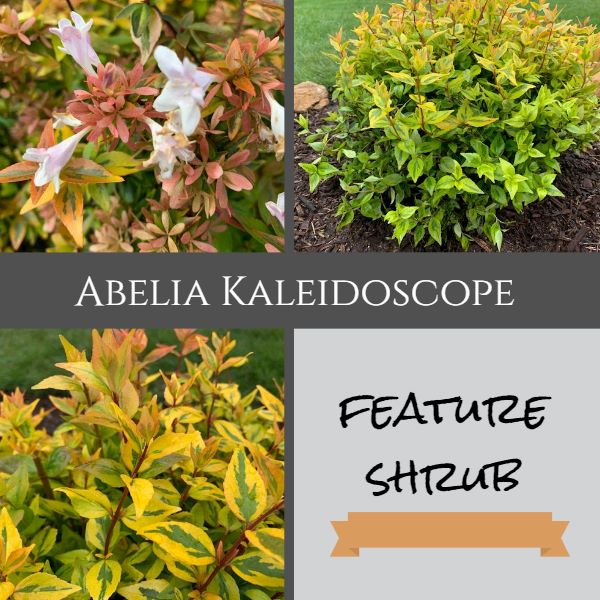
This Month in the Garden Feature Flowering Shrub: Abelia Kaleidoscope

This Month in the Garden: Feature Shrub Abelia Kaleidoscope
Welcome to This Month in the Garden! This month's feature plant selection is Abelia Kaleidoscope, an outstanding evergreen shrub known for its array of colorful bright golden and pink hues on a backdrop of medium green foliage, which changes color throughout the seasons. Starting in springtime as golden yellow to lime green, deeper orangey-red foliage develops as the season progresses. An additional attribute is the shrub's brilliant red stems, which along with colorful foliage, create a dramatic display of color throughout all four seasons. For even more interest, tubular fragrant pinkish-white blooms appear in summer and last into early fall. 

Abelia Kaleidoscope Springtime

Hardy in USDA zone 6-9, Abelia Kaleidoscope is a compact shrub, growing to just 2-3 feet high by 3-4 feet wide and is ideal for small spaces in the landscape, such as along a patio, foundation planting, or border planting. It prefers a location with full sun to partial shade and a moderately moist, well-drained soil.
Abelia Kaleidoscope Autumn
While little pruning is necessary, Abelia blooms on old wood; therefore, any pruning to shape the plant should take place after flowering. In late winter to early spring before new growth emerges, up to one third of the plant can be pruned to maintain a desired size. Abelia Kaleidoscope is pollinator friendly, attracts butterflies and hummingbirds, and is also known to be deer resistant. If you are looking for the perfect compact and colorful shrub for your landscape, that will provide interest in every season, Abelia Kaleidoscope may be the selection for you!
Abelia Kaleidoscope Blooms

I hope you enjoyed This Month in the Garden for the month of June. Be sure to stop by on the 1st. and 15th. of each month as I continue to share gardening tips, information and horticultural adventures! Also, be sure to check out my author page and books for gardening information and helpful advice, all based on my 27 years of experience as a landscape designer and ongoing involvement in the horticultural field. Until we meet again...Happy Gardening!


Author: Lee @A Guide to Northeastern Gardening, © Copyright 2010-2023. All rights reserved. 

Saturday, October 1, 2022

This Month in the Garden: Feature Flowering Shrub Hydrangea Let's Dance 'Big Band'

Feature Flowering Shrub: Hydrangea Let's Dance 'Big Band'
Welcome to This Month in the Garden! There's a new hydrangea in town and it is called Hydrangea Let's Dance 'Big Band'. I have been testing this Proven Winners cultivar for two years now and it has proven to be cold resistant enough to thrive in a planter on my back patio, while maintaining an abundance of long-lasting blooms on a compact plant. 
Hydrangea Let's Dance 'Big Band' Springtime/Summer
Growing to a mature size of just 2.6 feet tall by wide, this newer cultivar is hardy in USDA zones 5-9 and combines the best features of mophead flowers, displaying large colorful pink, blue or purple flowers (pink in alkaline soil, blue in acidic soil and purple in neutral soil) on a stronger plant that better withstands winter temperatures and reblooms from late spring until frost. 
Hydrangea Let's Dance 'Big Band' Late Summer
For best performance, plant Hydrangea Let's Dance 'Big Band' in a moist well-drained soil in partial shade. Morning sun and afternoon shade is ideal for this plant. This cultivar blooms on both old and new wood and may be shaped to keep more compact; however, all mophead hydrangea are best not to be pruned, as it can have a negative effect on the number of blooms. It is best to only prune out dead or damaged branches once the plant pushes out new growth in spring. To keep your plants healthy and to encourage more robust blooms, apply a slow-release fertilizer in early and late spring. Adding a layer of mulch around the base of the plant will help to conserve moisture and serve as protection from severe cold during the winter months.
Hydrangea Let's Dance 'Big Band' Autumn
The default color for most mophead hydrangea is pink in a neutral soil (pH 7.0) and higher and will turn towards blue in a more acidic soil containing aluminum sulfate. In a soil with a pH of 6.5 or under, a bluer tone is present. I presently have my hydrangea in a neutral potting soil and am loving blooms that start off as a vibrant pink in springtime, then slowly change to deeper tones of pinkish red to welcome in fall.
Hydrangea Let's Dance 'Big Band' Autumn
I hope you enjoyed This Month in the Garden for October and if you are looking for a new compact, long blooming hydrangea, this one is a winner in my zone 7a garden! 
Let's Dance Hydrangea Series Size Chart (Photo Credit: Proven Winners)

Be sure to stop by on the 1st. and 15th. of each month as I continue to share gardening tips, information and horticultural adventures! For more information on Hydrangea Let's Dance 'Big Band', visit the Proven Winners website. Until we meet again...be well, and as always...Happy Gardening!

 For gardening inspiration and design tips visit: My Author Page and Books

Author: Lee @A Guide to Northeastern Gardening, © Copyright 2010-2022. All rights reserved. 

Wednesday, September 1, 2021

Feature Shrub: Hydrangea Fire Light Tidbit-Compact, Long-Blooming and Fabulous!

This Month in the Garden
Welcome to This Month in the Garden! There's a new hydrangea in town and it's the tiniest panicle hydrangea yet! Developed by the growers at Proven Winners Color Choice Shrubs, this new dwarf cultivar, Hydrangea, Fire Light Tidbit, reaches a size of just 2-3' tall by wide! Hardy in USDA zones 3-8, 'Fire Light Tidbit' produces large, lush panicles of white mophead flowers from mid summer to fall on a compact plant that can fit into the smallest of spaces!

Hydrangea Fire Light Tidbit Mid-Summer

Initially, lime green blooms mature and turn to white. As the summer progresses, blooms begin to develop bright pinkish-red tones near the end of August, which keep the interest coming right on up until the first frost.
Hydrangea Fire Light Tidbit Late Summer (Photo Credit: Proven Winners Color Choice Shrubs)
Another special attribute is that this new cultivar produces an array of colorful autumn foliage, an unusual trait in panicle hydrangeas. Stems are sturdy, creating a neat, mounded shrub that's a perfect fit in foundation plantings, flower gardens, landscape borders and even containers!
Hydrangea Fire Light Tidbit Fall Foliage (Photo Credit: Proven Winners Color Choice Shrubs)
PLANTING & MAINTENANCE: Plant this cultivar in full sun to part shade in a moderately moist, well-drained soil. Blooms of the upcoming season form on new wood, so pruning can be performed by cutting back the main branches by one-third in late winter or early spring. Pruning can also be performed in late fall, once the plant has gone completely dormant. To encourage robust blooms and a healthy plant, it is recommended to feed your hydrangea in early spring using a slow release granular fertilizer. 
Hydrangea Size Comparison Chart (Photo Credit: Proven Winners Color Choice Shrubs)

I have this hydrangea growing in my garden and it was love at first sight! As a designer, I am always looking for new cultivars that are compact, colorful and low maintenance, and this shrub has it all.

I hope you enjoyed This Month in the Garden for September. Be sure to stop by on the 1st. and 15th. of each month as I continue to share gardening tips, information and horticultural adventures! (Linking with: Floral Fridays, Macro Monday 2, Ruby Tuesday and Image-in-ing Weekly Photo Link-Up.

 My Author Page and Books


Author: Lee @A Guide to Northeastern Gardening,© Copyright 2010-2021. All rights reserved.

Monday, February 1, 2021

Book Launching-Introducing Gardening by Month

Book Launching!
While the world has been in disarray, I have been spending more time in the garden than ever and decided to put some of my energy into writing again. I had been working on a personal reference for some time, which took off by storm during the pandemic. I had done research trying to find a gardening book that listed plant interest by month, and after much searching, I could not find anything that would do just that. There are references that list plants in alphabetical order or by type, but the search came up short when looking for interesting features by month. This resulted in my fourth book. 
Book Announcement!

I am very excited to announce the publication of Gardening by Month: A Monthly Guide to Planning the Northeastern & Mid-Atlantic Garden. As a landscape designer for over 25 years, my focus always is to create a garden that has something of interest twelve months a year. I have added elements that focus on blooms, bark, berries or foliage to my own garden over the years to create something to look forward to during every season, and I now have a 12-month garden to enjoy. I have created this book so that you too can experience continuing interest in your space throughout every month of the year.


Book Description
: 
Have you ever wondered if you could have interest in the garden twelve months a year? The answer is a definitive yes!  Through years of experience as a landscape designer, I have accumulated a list of plants which are hardy in the Northeastern and Mid-Atlantic regions that will provide ongoing interest for your outdoor space. Gardening by Month: A Monthly Guide to Planning the Northeastern and Mid-Atlantic Garden will take you on a journey through each month of the year, while providing that perfect mix of gardening interest along the way. Colorful photographs are followed by descriptions of each plant according to bloom time, foliage color or other notable characteristics, so that you can enjoy your outdoor space during every season. Additionally, environmental needs, plant care and maintenance tips are provided for each selection with any other important information. Finally, gardening tips and a summary of gardening chores are provided for each month. Are you ready for a twelve-month interest garden? Then come along and plan away!
  • Organizes plant interest by month for easy reference. 
  • Plan with over 120 plant selections to choose from. 
  • Colorful photographs are supplied with plant descriptions and care requirements. 
  • Monthly gardening chores are suggested for each month.
  • Plant maintenance and care tips are recommended to help you maintain a healthy garden. 
  • Helpful pointers on soil types, characteristics and identification are given.
  • Achieve the 12 month all season garden you have been looking for. 
So, now it is official and the Look Inside features are up and running, so you can get an idea of the book’s layout. I was also honored to be a guest on the Better Lawns and Gardens Radio Talk Show to discuss this newest book, along with offering some landscape design tips! Follow the link to listen to the interview and learn about my gardening adventures, and afterwards, come by and check out the new book!😊 That’s it for This Month in the Garden. Be sure to visit on the 1st and 15th of each month for gardening news, tips and updates in the horticultural world!

For book details and purchase, visit My Author Page & Books and thank you for your support.

“Anyone who thinks gardening begins in the spring and ends in the fall is missing the best part of the year; for gardening begins in January and ends with the dream.” ~Josephine Nuesse 

~As Always...Happy Gardening! ~

Author: Lee@ A Guide to Northeastern Gardening,© Copyright 2010-2021. All rights reserved.