Showing posts with label gold lace juniper. Show all posts

Friday, December 15, 2017

Garden Bloggers' Bloom Day & Foliage Follow Up December 2017: Snowflakes on Roses

December 2017 Garden
Welcome to Garden Bloggers' Bloom Day and Foliage Follow-Up for the month of December. After a relatively mild November, winter has arrived in the northeast with temperatures in the 30's-40's by day and 20's-30's by night, with a layer of snow covering our Long Island garden. The first snowfall arrived on the 9th with just enough covering to transform the landscape into a winter wonderland, with a refreshing on the 14th. At this time of year, it's all about colorful evergreens, texture and structure. Join me for a stroll to take in the view! 
Snowflakes on Roses
With the milder than usual temperatures, the rose bushes had still been pushing out new foliage, which is now covered with crystals of snow. Many of the deciduous trees and shrubs had just recently lost their leaves within the past couple of weeks, with some still not ready to fall. The seasonal changes have been noticeably behind by about three weeks until just recently.
White Covered Branches of Gold Lace Juniper
Evergreens are in the spotlight during December. Here is Juniperus 'Gold Lace' with its graceful golden branches all covered in snow.
Ice Crystals on Montgomery Blue Globe Spruce

Montgomery Blue Globe Spruce never ceases to amaze me with its vibrant blue foliage, that seems even more prominent during the late fall and into the winter months. The ice crystals make the shrub "glow" even more in the sunlight.
Pool Area December 2017
In the pool garden is Weeping Norway Spruce (Picea abies 'Pendula'). Behind it on top of the rock waterfall are spreading yew and to the left are Hinoki Cypress 'Nana', which reach a height of only about three feet tall at maturity.
Sedum Winter Interest
I often leave the dried seed heads of Sedum 'Brilliant' a little longer so that birds can enjoy them. They also look nice when snow covered, which adds interest to the garden.
Nandina domestica
Towards the northern area of the property is Nandina domestica, also known as Heavenly or False Bamboo. It is a clumping variety (non-invasive in our area) and the interesting looking foliage remains semi-evergreen over the winter. I have read recently from studies that the berries may be harmful to wildlife if eaten in large quantities. While I have never seen any sign of birds going near the Nandina, I still remove the berries as food supply becomes scarce and continue to enjoy the  lovely foliage.
Holly 'Nellie Stevens' Berries
Another berry producing plant in the garden is Holly 'Nellie Stevens'. The berries are a beautiful bright red against dark green shiny leaves and make an excellent food source for birds for a good portion of the year.
Weeping White Pine Reproductive Cones
Weeping White Pine is showing off its large seed cones. I really enjoy nature's artwork as the cones are in varying shades of brown with white accents.
Driveway Entry Garden (Photo taken in Between Two Snowfalls)
In the driveway entry garden, Coral Bark Maple and Weigela 'Spilled Wine' have lost their foliage, leaving evergreens to take on the role of supplying color. Here are Skyland's Oriental Spruce (to the left), Hinoki Cypress and Boxwood (to the right) and Blue Atlas Cedar (in the distance-center).
Skyland's Oriental Spruce
The female seed bearing cones of Skyland's Spruce start off purple in spring and mature to a deeper brown by winter.
Coral Bark Maple (Acer palmatum 'Sango-kaku) Bark in December
Coral Bark Maple 'Sango Kaku' is starting to show its glowing coral-red bark as the temperatures fall. Generally, the lower the temperatures, the more brilliant  the tree.
Hellebore Shooting Star Buds (Lenten Rose)
In the northern garden, Hellebore 'Shooting Star' is developing buds that will open in a month of so. Recently added is Hellebore 'Dark and Handsome', which was planted just this past summer. The goal is to add more interest to the winter garden and have more to look forward to. I am not sure about getting blooms this season, so I'll have to wait and see if it produces any buds.
Patio Garden
Along the patio (left to right) is Colorado Blue Globe Spruce, Weeping Norway Spruce, Blue Star Juniper and Dwarf Fountain Grass, the later being done for the season.
Snowflakes on Hydrangea
Along the fence are the snow tipped remains of hydrangea blooms. The flower heads will eventually disintegrate over the winter, but add interest for now.
Front Walkway Liriope and Juniper
Here is a snowy view of along the front walkway with Variegated Liriope and Japanese Garden Juniper, topped with a tinge of white frosting!
Baby...It's Cold Outside!
At this time of year, even gardening boy and girl look cold with piles of snow upon their heads!
Welcome!
I love the garden throughout all the seasons, each month of the year bringing something new to look forward to. No matter what the time of year, whether spring, summer winter or fall, the garden is my sanctuary...a place of thoughts, dreams and sweet memories.  
There's No Place Like Home!
Being that this is the last Bloom Day and Foliage Follow-Up post for the year of 2017, I would like to extend a sincere thank you to you, for being here throughout the year, with best wishes for a beautiful and peaceful holiday season. There's more to come with 'This Month in the Garden" on the 1st to bring in the new year, and a 2017 Gardening Year in Review on the 7th!
December 2017 Garden

I hope you enjoyed this month's tour through my garden. Special thanks go out to our hostesses Carol at May Dreams Gardens, who makes it possible to see blooms on the 15th of every month with her meme Garden Bloggers' Bloom Day and Pam at Digging for hosting Foliage Follow-Up. I am also linking with some other wonderful hosts and hostesses at Floral FridaysMacro Monday 2, and Nature Notes at Rambling Woods. Also check out Garden Bloggers' Foliage Day at Creating my own garden of the Hesperides, Wednesday Around the WorldDishing It & Digging It and Image-in-ing weekly photo share every Tuesday. 
Sharing My Passion and New Video Trailer:

<

~Enjoy the beauty of the season...and As Always...Happy Gardening!~


Author: Lee@A Guide to Northeastern Gardening, © Copyright 2017. All rights reserved.

Friday, January 20, 2012

Colorful Evergreens in the Landscape-Part I: Golden Evergreens

Golden Evergreens in the Landscape
When planning a garden design it is important to incorporate interesting structure and color into the landscape so that there is eye-catching interest all year long. Golden evergreens will not only add structure but will enhance the landscape with their outstanding show of color. There are a variety of golden evergreens available to the homeowner to implement into the landscape. There are six in particular that I will focus on in this article that have proven to be hardy in the zone 7 northeastern garden and that will thrive in zones ranging from 4 to 8.
Picea orientalis 'Skylands'


The first in this series is Picea Orientalis 'Skylands' or Skyland's Oriental Spuce.  'Skylands' is a slow growing coniferous tree that prefers full sun to partial shade and is hardy in USDA zones 5-8. It is true that younger specimens of this tree can be prone to sun scorch so ideally 4-8 hours of sun is best. I have been successful when planting 'Skylands' in a southeasterly exposure in zone 7. Grow this tree in a moist well-drained acidic soil and apply mulch around the tree to protect the roots.  After ten years of growth Skylands reaches a height of approximately ten feet and a width of four feet and can grow to a height of 35 feet over time in ideal conditions. Being a slow grower and having a narrow stature this tree is ideal for smaller spaces. Its beautiful yellow-chartreuse candles and densely arranged needles make this tree a conversation piece in the landscape.  Mature trees develop small reddish-purple cones that only add to the beauty of this tree. This tree is truly a favorite!
Chamaecyparis pisifera filifera 'Gold Mop'


The next of the gold series is Chamaecyparis pisifera filifera 'Gold Mop' or Gold Mop Cypress. Gold Mop Cypress is a small golden conifer with delicate thread-like textured foliage. This relatively hardy shrub is best grown in full sun in a well-drained acidic soil in zones 4-8. It displays a low mounding mop -like appearance and reaches a height and width of 3 feet making it an excellent accent plant along with other evergreens and perennials. Chamaecyparis 'Gold Mop' retains its yellow-golden color all winter and stays compact unlike its counterpart 'Gold Thread' Cypress which becomes more bronzed and reaches a height of 15 feet over time.

Euonymus japonica 'Aureo Marginata'


Another favorite addition for golden color is Euonymus japonica 'Aureo Marginata' or Golden Euonymus which is not a conifer but rather a broadleaved evergreen. Golden Euonymus is hardy in USDA zones 6-8 and prefers a moist, well-drained neutral-acidic soil and full sun to partial shade. This evergreen displays yellow-green shiny foliage all year round and is fairly slow growing. It reaches a maximum height and width of 4-6' but can be kept compact with regular maintenance pruning. These shrubs serve nicely as either foundation plantings or in an informal garden.

Chamaecyparis obtusa 'Aurea Nana'

Next on the list is Chamaecyapris obtusa 'Aurea' or Golden Hinoki Cypress.  Golden Hinoki Cypress ranges in a variety of sizes from the species 'Nana' which is dwarf in size (2-3' in height) to 'Compacta' which is medium height (10-20 ' in height) to 'Gracillis' (40-60' in height). Hinoki Cypress are hardy in USDA zones 4-8 and display luxurious golden twisted compact foliage throughout all the seasons. These evergreens prefer to be grown in full sun in a moist but well-drained acidic soil.  Some of the more popular varieties are Chamaecyparis obtusa 'Aurea Nana' (seen here), 'Verdoni' which displays a deeper yellow foliage and grows a bit taller to 6-8 feet and 'Confucious' which is a newer slower growing variety with broader yellow foliage on emerald green under layers and growing to 4-6 feet in height. 'Crippsi' is a popular golden variety growing to 15-30 feet and can be used as either a specimen or incorporated into a privacy screening. Each one of these varieties is more beautiful than the next and serve as excellent specimens in the landscape. Hinoki Cypress can be used as a focal point in a foundation planting or as a stand alone piece in a cottage garden, evergreen garden or perennial border. These magnificent beauties will add outstanding interest to just about any landscape.

Cedrus deodara 'Aurea'
Golden Deodara Cedar (Cedrus deodara 'Aurea') is another magnificent focal point in the landscape.  It is one of the larger golden evergreens ranging in size from 15-25 feet in height to 80-100 feet in height depending on the particular species. Deodara Cedar 'Aurea' displays a rich golden-yellow color on graceful wispy branches.  They prefer to be grown in full sun in a moist but well-drained soil and are hardy in USDA zones 6-8. Cedrus deodara 'Gold Cone' (shown here) grows to height of 20-30 feet and displays beautiful pendulous branches covered in green-yellow foliage and grows in a more vertical fashion thus taking up less space in the landscape than some other cedars. Golden Deodara Cedar is often used as an anchor plant or specimen planting in the landscape.


As Always...Happy Gardening.

Author:  Lee@A Guide To Northeastern Gardening, Copyright 2012.  All Rights Reserved.


Sunday, February 21, 2010

Thinking Spring-Color in the Garden Part I: Evergreens

Hinoki Cypress 'Crippsi'
The snow is finally starting to melt here in the northeast and thoughts of spring and returning to the garden are going through my mind.  Since evergreens are the "foundation" of the garden I am going to start with these wonderful all season interest plantings.  Evergreens of course are known for their ability to screen, add privacy to a spot and serve as the ultimate backbone of the garden.  Evergreens can sometimes be underestimated with the misunderstanding that they lack color and variety of texture but quite the opposite is true.  These dependable additions can add variety and color twelve months of the year.  The varieties I will be discussing do apply to zone 7 but are quite versatile and can be used in a number of climate zones.

Some of my favorite evergreens for brightening up any garden include the genus picea (spruce), chamaecyparis (cypress), juniperus (juniper) and cedrus (cedar).   In the spruce catergory-the Colorado Blue Spruce 'Hoopsi' is a favorite which grows to an average of fifteen feet in 10 years, stays at smaller size than an ordinary spruce and exhibits a characteristic  blue color throughout the year.  A smaller globe variety shrub form of the blue spruce is the 'Montgomery' Globe Spruce, another nice addition to any well lit garden. 

'Gold Mop' Cypress
The genus chamaecyparis includes my favorite golden additions to the garden including chamaecyparis pisifera 'Gold Mop'-an evergreen shrub growing to approximately three feet in height over time, much smaller than its predecessor the 'Gold Thread' cypress which can reach an eventual height of fifteen feet.   The 'Crippsi' Cypress is a lovely larger form of  chamaecyparis reaching fifteen to thirty feet over time and the dwarf golden form of hinoki cypress chamaecyparis obtusa 'Nana Aurea' only reaches about four feet and is a prize in the landscape.   I must not forget to mention another golden variety - a personal favorite of evergreen which is not a cypress but rather the genus picea (spruce) which I have recently added to my garden.   If you area a spruce enthusiast then the Oriental Gold Spruce, picea 'Skylands' is by all means one of the most beautiful evergreen trees imaginable and makes a grand stand alone statement to the evergreen-perennial garden.  

Juniperus 'Blue Star'
In the genus juniperus there are so many selections as well but the two I favor for instant color are juniperus 'blue star' - blue in color as the name indicates and juniperus 'gold lace'-not as golden as the 'gold mop' cypress but rather a mix of green and gold and bit more whispy in the garden.    Those of you who would like a little gold in the garden but not too much would prefer this particular evergreen. 


Deodara Cedar
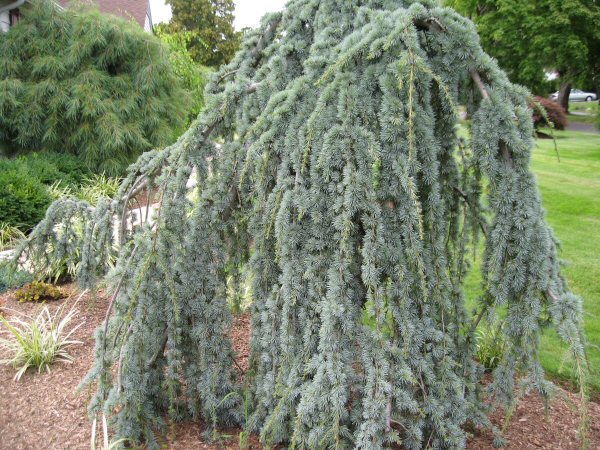
Last but by no means least are the Cedars.  Cedrus deodara 'Aurea' is  magnificiant golden cedar which steals the show for any area where you have good lighting and plenty of space. This beauty can serve as an "anchor' plant for a foundation planting but allow it enough area to grow and make sure the center portion of the tree is planted an average of seven to ten feet away from the foundation (the further the better) to ensure proper distance from the exterior of your home- then enjoy this beauty.  Two other stand alone pieces in the genus cedrus are cedrus atlantica 'Glauca Pendula'  and cedrus atlantica 'Glauca'-both blue in color similar to the blue spruce however less of a "bottle brush" look to the needles as in the genus picea.  The weeping form (pendula) can be used as a foundation planting or in any garden and the later upright form can be used as a stand alone piece where they is plenty or room as it can also reach up to eighty feet in height under optimum conditions.  
Cedrus atlantica 'Pendula'
 (Weeping Blue Atlas Cedar)


I am hoping you have found the information in the above segment both informative and useful. This is the first in a series of three articles on color in the garden.  Parts II and III will focus on the usage of flowering shrubs and perennials to add everlasting color and interest to your landscape.


Author:Lee@A Guide To Northeastern Gardening Copyright 2010. All Rights Reserved