Showing posts with label indoor gardening. Show all posts

Monday, December 15, 2025

Garden Bloggers' Bloom Day & Foliage Follow-Up: The Not So Hidden Inner Beauty of Winter

Welcome to my December Garden!
Welcome to my Long Island zone 7b December garden! As the temperatures plummet into the 30's and 40's by day and I venture outdoors, I search for the inner beauty of nature, especially now as the garden goes dormant. If you open your mind and allow your eyes to look deeply, it is possible to find beauty everywhere. There is mention of our first snow in the forecast, so I have been preparing. Join me as we venture out into the wintertime garden. 
Welcoming Committee!
As we start our tour, we first encounter the official welcoming committee and the Trombly’s Red Sentinel Japanese Maple that resides behind them. Now that the leaves have fallen, you can clearly see its inner structure of winding branches with a slight tint of burgundy.
Nellie Stevens Holly Berries
In the back garden the berries of Nellie Steven’s Holly are at their brightest red for the holiday season and are a delightful feast for the birds.
Back "Secret Garden"
Way in the back is the “secret garden”. Tucked away and only accessed through a path from the main lawn, a mature Weeping Norway Spruce can be seen along with Variegated Boxwood, Cherry Laurel and the remains of the caramel colored foliage of Coral Bells.
Leucothoe 'Axillaris'
To the south of the secret garden, evergreen Leucothoe ‘Axillaris’ has a burgundy tint to its foliage this time of year with flower buds setting for next year, adding interest to the back shade garden.
Patio Border
Along the patio border is a smaller Weeping Norway Spruce, which is accompanied by the bronzing wintertime color of Dwarf Cryptomeria and a dwarf form of Nandina called ‘Obsession’. This newer cultivar of Nandina stays evergreen in zone 7b, has been grown to not produce berries (which are believed to be harmful to birds) and it is non-invasive as compared to its original counterpart. It also gets this fiery pinkish-orange color in wintertime, which is a plus!
Northern Border
Here along the northern border, the foliage of Weeping Blue Atlas Cedar seems to be even more prominent in winter. Heuchera ‘Caramel’ lives beneath it along a moss rock border.
Stachys (Lamb' Ear) Wintertime
If you are looking for a touch of white in the garden, Lamb’s Ear fits the bill. Its fuzzy white foliage can be seen throughout the entire year and it gets stalks of pink blooms mid-way through the summer season.
Rose Hip Wintertime
As the Knock Out Roses go dormant for the winter months, the remaining rose hips bring some fun and interest to the landscape…
Weeping White Pine Seed Cone
while the seed cones of white pine add some interest too!
Winter Beauty
As I had mentioned earlier, if you look deeply enough you will see beauty everywhere. I find something as simple as the dried flowers of Hydrangea to catch the eye!
Front Raised  Bed
As we venture around to the front of the property you will notice another Weeping Norway Spruce along with the variegated foliage of Osmanthus 'Goshiki', deep green needles of Dwarf Norway Spruce and dwarf Cryptomeria way to the left. In the backdrop is a very mature Blue Atlas Cedar and two Weeping Japanese Maples.
Raised Bed Front Lawn-A New Look!
Here is the newest renovation of the raised bed. When a huge Beech Tree on the corner recently had met its demise and had to come down, I decided to add something new...a moss rock decorative wall. I am enjoying how it came out as it adds some interest and has given the bed a finished look. In the springtime, the existing perennials along the rock will fill in the gaps.
Driveway Border
It is December, so the branches of the Coral Bark Maple ‘Sangu Kaku’ are starting to develop their slightly coral-pink tinge. As the temperatures lower and as the possibility of snow arrives, the color of the branches will get only get deeper. The Maple is accompanied  by Golden ‘Skylands’ Oriental Spruce, which was planted back in 2008, and now towers to approximately 25 feet tall.
Container Planting
I have gotten into more container planting over the years and have created these all-season planters with mixtures of cold hardy evergreens. This one has a combination of Dwarf Alberta Spruce, Whipcord Arborvitae and Boxwood.
Awaiting Winter Blooms!
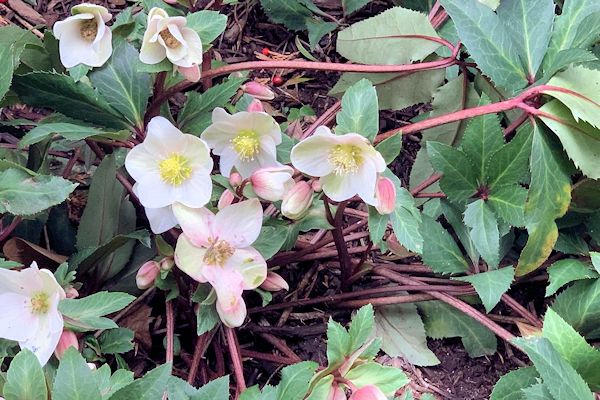
Just when most of the blooms have gone dormant for wintertime, there is always Hellebore (Lenten Rose) with its evergreen foliage and colorful bracts. This one is called ‘Shooting Star’ and will start blooming in January.
Our First Winter Snow
And what a difference a day makes! Just like that...on the morning of the 14th as we awoke, the weather predictions had became true. The snow had arrived and the once green landscape has turned into a snowy winter wonderland with six inches plus of snowfall. It is official...it is the largest December snowfall we have had in years.
Winter Wonderland
For now, I am staying inside warm and cozy and admiring the view from the window. The words, “It’s beginning to look a lot like Christmas” are going through my mind as the sound of snow plows can be heard in the street. Since this is the last post for 2025, I want to thank you, my readers, for being here each month. It means the world to me and whatever you celebrate, I wish you and yours all the best for a wonderful and happy holiday season!
The Indoor Garden!
While the weather outside is frightful (sorry, could not resist!) the blooms inside are delightful! Here is my favorite color of Thanksgiving Cactus blooming away. I also have red, light pink and salmon colored varieties and love them all! Some of them start blooming in October and just keep on going! Here is a little hint: Removing faded blooms right away and pinching back extra long branches will keep the plant fuller and the blooms coming!
Indoor Garden
The back room is what I call my jungle and I enjoy it all year long, but even more so in the wintertime. Here is ‘Golden Crocodile’ Philodendron and ‘Ring of Fire’ Philodendron. They are quite happy with their new grow light.
Indoor Garden
I got on a ‘Thai Constellation’ Monstera kick for the simple reason that it is a rare plant to find, so I was on a mission to find it. Well, I did and these two plants started off in four inch pots. They have grown into mature plants in little time and are very happy a couple of feet from the southern exposure window. 
Hope you Enjoyed the Visit!
I hope you enjoyed your visit to my December garden. I so appreciate you being here, look forward to your comments and enjoy seeing what you have growing in your garden. Special thanks go out to our hostess Carol at May Dreams Gardens, who makes it possible to see blooms on the 15th of every month with her meme Garden Bloggers' Bloom Day. Also, special thanks to Pam Penick at Digging who had hosted Foliage Follow-Up, a meme I will continue to honor. I am also linking with some other wonderful hosts and hostesses at Floral Friday Fotos, Nature Notes at Rambling Woods, Image-in-ing weekly photo share every Tuesday, Weekly Photo Link-Up at My Corner of the World on Wednesdays and Garden Affair at Jaipur Garden. 

Other Places to Find Me ðŸŒ¼
You can visit my Author Page ðŸ‘ˆto learn about and purchase my books, each one focusing on different aspects of gardening, including landscape ideas, design principles, gardening by month for all-season interest, gardening tips and maintenance, shade gardening, gardening inspiration and more. And also be sure to check out my newest publication, The Houseplant Guide, to guide you on your houseplant journey! If you have read any of my books and have found them to be useful, reviews are very much appreciated!

Also, check out my newsletter Northeastern Gardening News for monthly updates all to do with gardening! It's free to subscribe or you can pledge a donation to show support for my work and receive monthly updates right into your inbox!


Until we Meet Again...Wishing you a happy holiday season and Happy Gardening!

Author: Lee @A Guide to Northeastern Gardening, © Copyright 2010-2025. All rights reserved. 

Tuesday, January 7, 2025

Book Launching: The Houseplant Guide: How to Easily Select & Maintain Indoor Plants

Book Launching!!! 📚

I have been a gardener since the age of five and as I grew older, the desire to be surrounded by plants has expanded from the outdoors in. As my vast collection of common and rare houseplants has grown, it has rewarded me with a sense of joy and well being, as well as bringing a touch of the indoors inside. After writing five books pertaining to outdoor design, my friends, family and colleagues wanted to know why I had not written a book about indoor gardening. I am excited to finally say that I have! 

After two years of photographing my own houseplant collection as well as visiting nurseries, talking with owners, photographing and chatting about everything green, I have composed this comprehensive reference of over 120 selections of houseplants, including care requirements, maintenance tips and other important information. I am very excited to share my own experiences and to help others achieve the indoor collection of their dreams. Whether you have a green thumb or brown, and whatever your needs, there is likely a houseplant that is right for you!

Here is a little bit about the book:

Welcome to the world of indoor gardening! The Houseplant Guide: How to Easily Select & Maintain Indoor Plants is the definitive reference for both novice and seasoned plant enthusiasts. With over 120 in-depth listings of popular houseplants, each entry is arranged by common name and packed with key information, including botanical names, lighting preferences, soil, moisture and humidity needs and maintenance information, as well as expert tips on optimal care.

Designed to inspire and educate, this comprehensive guide also features dedicated chapters that cater to specific interests, such as flowering plants, trailing and climbing plants, cacti, succulents and epiphytes, low-maintenance options, pet-friendly plants, and air-purifying varieties. Whether you are looking for the perfect addition to a sunlit space, a safe plant for furry friends, or a resilient choice that thrives on minimal care, this book has you covered.

For plant owners facing common challenges, the book includes a vital chapter on identifying, managing, and preventing houseplant pests and diseases. With its rich, accessible layout and clear advice, The Houseplant Guide is the essential companion for a thriving indoor garden. 

Whether you have a green thumb or brown, houseplants are a wonderful way of bringing nature into your home, while improving overall air quality and health, and they are simple to grow, providing you have the proper knowledge. Join me as we begin our houseplant journey!

Thank you for being here and I hope to help you with your houseplant journey! Join me as we grow together!

AND ANNOUNCING!!!

As Always...Happy Gardening!

Author: Lee @A Guide to Northeastern Gardening, © Copyright 2010-2025. All rights reserved. 

Sunday, December 1, 2024

Poinsettia-the History, the Folklore...the Plant

Feature Plant: Poinsettia
Welcome to This Month in the Garden! With the month of December upon us, I thought it would be a good time to talk about Poinsettia (Euphorbia pulcherrima), one of the most recognizable symbols of the holiday season. Known for its vibrant colors, this plant has a rich history, fascinating folklore and unique botanical features. 

The History: The poinsettia is native to Mexico and Central America where it thrives in the tropical rainforests. Back to the 14th century, the Aztecs valued the plant for its vibrant red color and used the bracts to create dye and the milky sap for medicinal purposes, such as treating fevers. In the 17th century, the poinsettia became attached to Mexican Christmas traditions, as the Franciscan monks began using the flower in their nativity processions. Coincidentally, this occurred around the same time as a legend of the "Flowers of the Holy Night" began. The poinsettia's introduction to the United States was credited to the first U.S ambassador to Mexico, Joel Roberts Poinsett in 1828 when he took clippings of the plant to propagate in his South Carolina greenhouse. December 12th is now National Poinsettia Day in remembrance of Poinsett's death and the plant's cultural significance. 

The Folklore: According to the legend "Flowers of the Holy Night", a poor child named Pepita wanted to bring a gift to baby Jesus at a Christmas service and had no money to buy one, but was reminded by her cousin "that even the most humble gift if given in love, will be acceptable in his eyes". An angel appeared and encouraged Pepita to gather weeds from a roadside. When she placed the weeds on the alter, they transformed into beautiful red poinsettias. Because of this story, the poinsettia is often referred to as the "Christmas Eve Flower".
Poinsettia (Red)
The Plant:  An interesting fact about poinsettia is that the colorful parts are not at all flowers, but rather bracts, or modified leaves. The colorful bracts draw pollinators to the true flowers, which are the small yellow-green clusters called cyathia, located in the center of the bracts. While red is the most popular color, this plant has been cultivated into a range of shades from pink to white, marbled and variegated varieties. In its native habitat it can grow up to 10-15 feet tall, but indoors it remains as as compact potted plant. Care is relatively easy with the correct conditions. Place your plant in a location with bright light and avoid direct sunlight, as it can scorch the leaves. Also avoid cold drafts, which can cause the leaves to drop. Water when the top inch of soil feels dry and ensure that there is proper drainage. After the holiday season, feed your poinsettia with a balanced houseplant fertilizer every two to three weeks.
Poinsettia (Pink/Variegated)
How to Get Your Poinsettia to Rebloom: To get your poinsettia to rebloom for the next holiday season, prune the plant back to six inches in height after it stops blooming. During spring and summer, place it in a sunny spot outdoors or indoors and continue regular watering and feeding. Beginning in late September, provide 14-16 hours of total darkness each night and bright light during the day. This mimics the shorter days of winter and triggers the development of the colorful bracts.

Safety: Poinsettias have a reputation for being poisonous, but it is largely a myth. The sap can cause mild skin irritation or stomach discomfort if ingested in large quantities, but it is not considered highly toxic. To be on the safe side, it is still good practice to keep these plants out of the reach of pets and children.

In conclusion, besides being aesthetically appealing, Poinsettia have been a symbol of good will, purity, rebirth, peace and hope throughout history. They will bring lasting color and a touch of the holiday season to your home. 

I hope you enjoyed This Month in the Garden. Be sure to stop by on the 1st. and 15th. of each month as I continue to share gardening tips, information and horticultural adventures! Catch up on posts and other news with my newsletter, Northeastern Gardening News. Subscribe for free to receive monthly updates.

Exciting News:
 There is a new book in the works which covers over 120 selections of houseplants with detailed information on characteristics, care requirements, maintenance, propagation, common houseplant insects and diseases, treatment and more. Follow My Author Page for the release date, sometime in early 2025!

"As Always...Happy Gardening!" 

Author: Lee @A Guide to Northeastern Gardening, © Copyright 2010-2024. All rights reserved. 

Friday, March 1, 2024

Feature Indoor Plant Profile: African Violet

This Month in the Garden: Feature Indoor Plant
Welcome to This Month in the Garden! Today we talk about African Violet (Saintpaulia ionantha), one of the most common houseplants in the world known for their distinct rosette of fuzzy leaves, range of flower colors and ease of care. First discovered in 1892 in the tropical rainforests of the Usambara mountains near the border of Tanzania Africa, the first commercial varieties all with blue flowers were introduced into the market in 1927. In 1942, the first pink variety was introduced, followed by a white blooming variety, followed by the first single blooming crown cultivated in Germany. African Violet are also valued as being one of the best houseplants for purifying the air. These small, perennial plants have captured the hearts of plant enthusiasts worldwide. 

Types of African Violets:
 African Violets come in various flower forms, including single, semi-double, and double blossoms. They display an array of colors such as purple, pink, blue, and white, offering choices to suit different preferences. Leaf shapes vary in a number of forms from regular (plain) to round to ovate, scalloped, heart-shaped, and serrated to name a few and color of the foliage can range from light to dark green to silver, watermelon and deep pink depending on the variety. Sizes of African Violet range in diameter between 2 and 6 inches in width depending on the particular cultivar.

Soil Type & Potting: Proper soil is key to African Violet care. A well-draining, lightweight potting mix specifically formulated for these plants is recommended. African Violet prefer to be confined in their container, so use of a four- or six-inch pot is preferable. 

Temperature, Lighting & Watering: African Violet grow best at room temperature, between 75 to 85 degrees Fahrenheit and thrive in bright, indirect light, such as under a skylight or in a northern or eastern window, making them ideal for homes or offices with filtered sunlight. While they prefer a consistently moist environment, overwatering can lead to root rot. It's crucial to water them from the bottom or use a self-watering pot to prevent water from touching the leaves. Use of filtered or distilled water is best.

Propagation:
 Propagation is best achieved through leaf cuttings, and rooting usually takes between four and six weeks. Select a healthy, mature leaf, trim it, place the stem into rooting hormone and plant in a light potting mix. With proper care and patience, new plants will emerge, providing an opportunity to expand your collection or share with fellow plant enthusiasts.

Maintenance: While African Violets are generally low maintenance, they do benefit from occasional grooming. Regular deadheading promotes continuous blooming and keeps the plant looking tidy. Remove any yellow or damaged leaves, and periodically rotate the pot to ensure even growth. Keeping the plant's environment clean helps prevent common issues like pests and diseases. To promote healthy growth and blooms, fertilize regularly with a balanced, water-soluble fertilizer designed for African Violets.

Folklore: African violets are often associated with sentiments of faith, love, loyalty, devotion and commitment. They symbolize delicate beauty and are considered tokens of affection. The flowers come in various colors, each carrying its own meaning. Purple symbolizes spirituality, blue for peace and royalty and pink for innocence, while white signifies purity. Additionally, African violets are thought to bring good fortune and positive energy, making them popular as gifts to express care and appreciation. In many cultures, African Violet have been used as an amulet to promote protection and spirituality in the home.

African Violets are delightful, versatile plants that bring beauty to indoor spaces. With a bit of attention to light, water, and soil, these charming houseplants will reward you with a profusion of blooms. Whether you're a seasoned plant enthusiast or a beginner, African Violets are an excellent choice for adding color and elegance to your indoor space. 

I hope you enjoyed This Month in the Garden. Be sure to stop by on the 1st. and 15th. of each month as I continue to share gardening tips, information and horticultural adventures! 


"As Always...Happy Gardening!" 

Author: Lee @A Guide to Northeastern Gardening, © Copyright 2010-2024. All rights reserved. 

Sunday, January 15, 2023

Garden Bloggers' Bloom Day & Foliage Follow-Up January: Winter Views and Blooms!

Welcome!
Happy New Year and welcome to my Long Island garden for the first time in 2023! The month of January has been relatively uneventful weather wise, with temperatures in the upper 40's, and a chill in the air, but not too unbearable to venture out into the garden. On the milder days, I am able to get some exercise by getting rid of some of those enduring weeds, while observing what is around me. Come along and see the changing garden and we might just run into some winter blooms along the way!
A Little Bit of Whimsy!
As we start the tour, here is the newest addition to the garden. It makes me smile each time I pass it by.
Patio Garden
For some winter color, Nandina 'Obsession' is going through its first January in the garden with its brilliant pinkish-red foliage. Here it is in front of Weeping Norway Spruce, with Ajuga 'Black Scallop' behind the spruce to the right.
Patio Garden- Dwarf Red Pine and Juniper 'Goldstrike'
In the patio garden, the foliage of Juniper 'Goldstrike' turns from its golden hues in summertime to a more bronzed look in wintertime. Dwarf Red Pine, Ajuga 'Black Scallop' and Japanese Golden Sedge add some more evergreen foliage for interest.
Winter Foliage-Osmanthus (False Holly)
One thing I love about Osmanthus 'Goshiki' is its changing foliage. Here, in wintertime, the newer growth takes on a pinkish-golden hue above the more mature green foliage tipped with yellow highlights, making it ideal for winter viewing.
Mugo Pine
I strive to look for different attributes among plants throughout the seasons. In wintertime the seed cones of  this Mugo Pine become even more prominent.
Japanese Andromeda 'Cavatine'
The seed heads of Japanese Andromeda 'Cavatine' also stand out this time of year. In the backdrop is the foliage of Heuchera 'Caramel' (Coral Bells), which endures pretty well throughout the winter.
Osmanthus 'Goshiki' (False Holly) Winter foliage
As we pass by, here is another Osmanthus 'Goshiki' with its foliage up close.
Garden Love!
One always needs a little garden whimsy with some humor mixed in. Here is another one of my favorite statues!
Back Perimeter Garden
Following along to the back perimeter garden, Weeping Blue Atlas Cedar adds some color to the winter garden, accompanied by Coral Bells 'Palace Purple' and Japanese Golden Sedge along its base.
Patio Planter Horizontal
I got into making up container planters for the patio a few years back and am enjoying them throughout all the seasons. The first is a horizontal planter with Variegated Boxwood, Dwarf Alberta Spruce 'Jean's Dilly' and Dwarf Hinoki Cypress Nana 'Lutea'..
Patio Planter Vertical
and the second (vertical) planter has a centerpiece of Dwarf Alberta Spruce 'Jean's Dilly', with Whipcord Western Red Cedar (Thuga plica 'Whipcord') along the sides, and Dwarf Hinoki Cyress 'Nana' (Chamaecyparis obtusa 'Nana') front center. Helpful Tip: Dwarf Alberta Spruce 'Jean's Dilly' is a newer cultivar that grows even slower than the standard, making it excellent for planters.
Front Driveway Border
Now that we have ventured the backyard, let's stroll up to the front gardens. Here the reddish tinged branches of Coral Bark Maple can be seen in the distance with Skyland's Golden Oriental Spruce and Weeping Blue Atlas Cedar in the foreground.
Skyland's Oriental Spruce and Coral Bark Maple
Here is a closer view. The colder its gets, the brighter the color of the branches on the maple become. 
Hellebore 'Shooting Star'
Now, I did mention that we may come across some January blooms! Helleborous 'Shooting Star' never disappoints. Its foliage remains evergreen year round and buds appear in December, which open in January and last for months. The flowers are really not flowers at all, but bracts, which is why they last for so long.
Hellebore 'Shooting Star'
In the upcoming months, there will be other varieties of Hellebore in bloom, keeping the magic of the winter garden going!
Welcoming Bear!
As we come to the end of our stroll, welcoming bear greets us with his holiday display, as we venture to the indoor garden.
Flowering Jade Plant
While it's cold outside, indoor gardening keeps me busy. November and December brought a display of flowering Thanksgiving cactus, and as we get a few cold nights along the southern and western windowsills, Jade Plant produces blooms! Currently, I have two Jade Plants, which are each over 30 years old, along with several offspring from cuttings. I have passed on many plantings as gifts to keep its legacy going.
Thank you for Visiting!
I hope you enjoyed your visit to my January garden and as always, I look forward to your comments and seeing what you have growing in your garden! Special thanks go out to our hostess Carol at May Dreams Gardens, who makes it possible to see blooms on the 15th of every month with her meme Garden Bloggers' Bloom Day. Also, special thanks to Pam Penick at Digging who had hosted Foliage Follow-Up, a meme I will continue to honor. I am also linking with some other wonderful hosts and hostesses at Floral Friday Fotos, Friday Bliss at Floral Passions, Macro Monday 2, Mosaic Monday at Letting Go of the Bay Leaf, Nature Notes at Rambling Woods, Image-in-ing weekly photo share every Tuesday with NC Sue and Gardens Galore Link Up Party every other Monday with Everyday Living. I am also happy to join the Weekly Photo Link-Up at My Corner of the World on Wednesdays and Garden Affair at Jaipur Garden. Here is to a wonderful 2023 planting season and gardens that thrive!

IN THE NEWS!!! 

I am excited to announce that my fifth book, Shade Gardening for the Northeast and Mid-Atlantic: A Guide to Planning the Ultimate Shade Garden is now a reality! Published on January 3rd, an official launching post will be out on the 1st! In the meantime, go check it out! I am hoping I can share over 150 shade plants along with gardening tips with you!

I was recently asked to contribute to an article on Indoor Gardening-Experts Advice. Come check it out as I answer a question about growing Bonsai and be sure to check out the other articles Porch.com has to offer!