.jpg) |
| San Francisco Botanical Garden |
I recently had the opportunity of visiting the San Francisco Botanical Garden located within Golden Gate Park in the Bay Area of San Francisco, California. The gardens offer 55 acres of native plantings, landscaped regions and open spaces showcasing over 8,000 different kinds of plants from around the world. The San Francisco Bay Area's mild temperatures, wet winters, dry summers and famous coastal fog provide a range of climatic conditions that exist in few other botanical gardens and when combined make some of the most ideal growing conditions for a multitude of plants. I enjoyed the experience of observing a vast variety of plants, many which I had never seen before, all in one location. Come along for the tour!
 |
| San Francisco Botanical Garden: Succulent Garden |
There are several collections of gardens to visit including the Mesoamerican Cloud Forest, California Native Garden, Redwood Grove, Succulent Garden and the gardens of Central and South America, Temperate Asia, Australia, New Zealand and the Mediterranean region to name just a few. These plants are mostly unfamiliar to me and I tried to get as many names as I could so bear with me. I labeled the species that I was able to see tags for. Feel free to assist if you recognize any of the unlabeled plants.
 |
| San Francisco Botanical Garden |
These flowers were blooming all over the gardens in November. I am not sure of the name but is looks like Agapanthus, or Lily of the Nile. I only know of the blue and white varieties but these were beautiful!
 |
| San Francisco Botanical Garden |
This attractive yellow flower was blooming profusely in early November.
 |
| San Francisco Botanical Garden |
 |
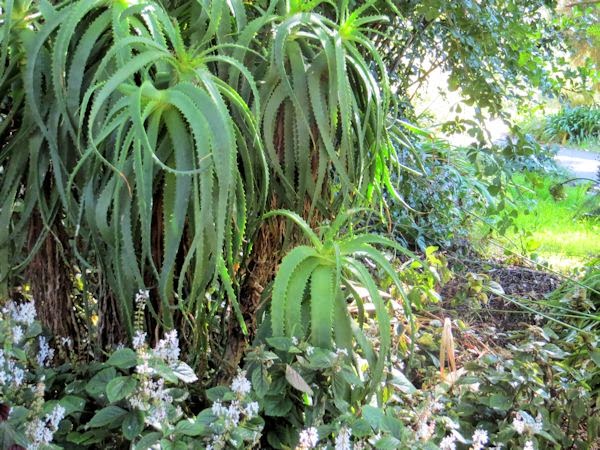
| San Francisco Botanical Garden: Aloe arborescens yellow form (South Africa) |
Aloe arborescens is sending up its stalks of yellow blooms in the South Africa collection.
 |
| San Francisco Botanical Garden: How Plants Conserve Water |
 |
| San Francisco Botanical Garden: Protea susannae Sugarbush (South Africa) |
This magnificent bloom really caught my eye! Protea is a beautiful winter blooming plant that is native to South Africa. Each large blossom is made up of hundreds of individual flowers. Also, Protea's leathery leaves are known to protect the plant from dehydration.
 |
| San Francisco Botanical Garden |
 |
| San Francisco Botanical Garden Aloe arborescens Close Up (South Africa) |
Here is a close up of Aloe arborescens (yellow form) along the garden path.
 |
| San Francisco Botanical Garden: Rhopalostylis sapida Nikau Palm (New Zealand) |
Rhopalostylis sapida known as Nikau Palm is New Zealand’s only palm making it one of the most easily recognized plants. Nikau Palm produces purple flowers in Spring that are followed by brilliant-red berries which hang from just below the base of the leaves that turn to seeds and are a food source for wildlife.
 |
| San Francisco Botanical Garden Cloud Forest |
 |
| San Francisco Botanical Garden: Spanish Moss (Cloud Forest) |
The Mesoamerican Cloud Forest features plants typical of high elevation plant communities in southern Mexico and Central America. It was initially planted in 1984 and has matured to represent a typical cloud forest with trees, shrubs, ferns, vines and epiphytes. As part of a preservation program seeds were collected from rare and endangered cloud forest species from around the globe over a period of thirty years. San Francisco's unique mild and foggy climate allows these plants to grow successfully outdoors.
 |
| San Francisco Botanical Garden: Lagoon and Palms |
 |
| San Francisco Botanical Garden |
 |
| San Francisco Botanical Garden |
This lovely plant had no tag on it but I believe it is Cordyline australis 'Red Sensation' from researching.
 |
| San Francisco Botanical Garden |
 |
| San Francisco Botanical Garden |
The gardens are full of these bright pink and orange blooms in November...
 |
| San Francisco Botanical Garden |
and tropical like foliage.
 |
| San Francisco Botanical Garden |
 |
| San Francisco Botanical Garden |
Steps and paths meander through this raised lush garden.
 |
| San Francisco Botanical Garden |
 |
| San Francisco Botanical Garden Conservatory of Flowers |
In Golden Gate Park the Conservatory of Flowers is the oldest public wood-and-glass conservatory in North America opening to the public in 1879. Declared as a city, state and national historic landmark, the Conservatory remains one of the most photographed and favored attractions in San Francisco.
 |
| San Francisco Botanical Garden Conservatory of Flowers |
 |
| San Francisco Botanical Garden Conservatory of Flowers: Tropical Rhododendrons (Vireya) |
In the greenhouse Tropical Rhododendron (Vireya) is in bloom...
 |
| San Francisco Botanical Garden Conservatory of Flowers: Anthurium |
as well as Anthurium.
 |
| San Francisco Botanical Garden Conservatory of Flowers: Aquatic Plants |
Water lilies are found in this aquatic garden.
 |
| San Francisco Botanical Garden Redwood Grove: Giant Redwood Sequoiadendron Giganteum |
Redwood Grove is one of
the many beautiful areas within the San Francisco Botanical Garden. This century old grove is full of fog-loving towering giants known as Coast Redwoods or Sequoia
sempervirens. Giant Redwood represent
the tallest living things on Earth and have been drastically reduced by
extensive logging during the past 150 years. The coast redwoods at San
Francisco Botanical Garden were planted around the turn of the 20th century and
are among the oldest trees in the Botanical Garden. Over the past forty years over 100 species of related plants have been added to create and preserve a typical
redwood forest.
 |
| San Francisco Botanical Garden |
I hope you enjoyed the virtual tour of the San Francisco Botanical Garden. I found the gardens to be both beautiful and educational and was amazed over the vast diversity of plants from all over the world contained in one location. The total 1,017 acre Golden Gate Park also includes the Conservatory of Flowers, Japanese Tea Garden, numerous museums, lakes, trails, playgrounds, picnic groves and monuments.
For more information on the San Francisco Botanical Gardens and Conservatory of Flowers visit here.
As Always...Happy Gardening!


