Showing posts with label wildlife preserve. Show all posts

Monday, December 1, 2025

La Montana Rainforest, province of Guanacaste Costa Rica: The Experience of a Lifetime!

La Montana Rainforest, province of Guanacaste Costa Rica
On a recent trip to Costa Rica, my husband and I had the experience of a lifetime exploring the flora and wildlife of the beautiful La Montana Rainforest located in the province of Guanacaste. The region is known for its biodiversity, history of conservation and unique ecological role. 
La Montana Rainforest
The history of Costa Rica’s rainforests, especially in areas like Monteverde and La Montana, stretches back to the mid-20th century. In the early 1950s, settlers from the United States moving to the Monteverde area to raise dairy cows quickly recognized the ecological significance of the surrounding rainforest and set aside large areas of land for preservation. La Montana is closely associated with the Monteverde Cloud Forest Reserve and other major sites for ecological preservation and wildlife, inhabiting over 755 species of trees, 2,500 tropical plants and hundreds of mammals and birds including two or three-toed sloths, howler monkeys, vultures and tree frogs, all which call this region home. 
Orchid
Costa Rica is known for its beautiful orchids. The National Plant is the Guaria Morada, a vibrant purple orchid which usually blooms from January to March. It is a symbol of the country's abundance, elegance, and beauty, and is deeply connected to its folklore and traditions.
Heliconia (Lobster Claw)
Heliconia, also referred to as 'Lobster Claw' is known for its vibrant red claw-like bracts with yellow tips, which protect the small true flowers. The bracts can display different colors in combinations of red, yellow, orange, pink and green depending on the plant. Heliconia is a symbol of pride, passion and success and they are an important food source for hummingbirds and used as shelter by some bats. The name Heliconia comes from Mount Helicon, the mythological home of Muses in Greek mythology. 
Ginger Plant
Costa Rica is the home to several species of Ginger, including the edible Zingiber officinale and ornamental varieties such as Torch Ginger, Red Ginger, and Butterfly/White Ginger. It is often cultivated for both its culinary use and aesthetic appeal. The Red Button Ginger (Costus woodsonii) is a species of flowering plant in the family Costaceae, native to Nicaragua, Costa Rica, Panama, and Colombia.
Dieffenbachia (Dumb Cane)
Dieffenbachia is a tropical plant native to Costa Rica and known for its ecological role as a habitat for the strawberry poison frog, which deposits its eggs in the axils of the plant's leaves. Specific species such as Dieffenbachia grayumiana and Dieffenbachia beachiana are found in specific regions of Costa Rica and Panama. Dieffenbachia is commonly referred to as Dumb Cane because its sap contains calcium oxalate crystals, which if ingested can cause temporary swelling of the mouth and throat, resulting in a difficultly to speak. 
Two-Toed Sloth
This was a once in a lifetime experience as we started to walk through the rainforest and the tour guide pointed out the trees Sloths prefer to feed on. As we looked up, there was the mother Sloth with her baby, a sight to behold. Two-toed Sloths are slow moving, nocturnal mammals that spend most of their time hanging upside down in the trees of Central and South America. They are herbivores with a very slow metabolism, requiring them to have 15-20 hours of sleep per day. Their favorite food is Cecropia leaves and various fruits like mangos. Their long claws are used for hanging and they are excellent swimmers, but their ground movement is limited. They are typically spotted snoozing in trees during the day and more active at night. 
Two-Toed Sloth
Sloths were declared a national symbol of Costa Rica's wildlife in 2021 and conservation measures are in place to protect their species from deforestation. Other Sloth species such as the Pygmy Three-Toed Sloth, which lives on a single island off the coast of Panama are critically endangered.
Red-Eyed Green Tree Frog
The Red-Eyed Green Tea Frog is the iconic symbol of Costa Rica with green skin and bright red eyes. It is not poisonous and lives among the trees in the rainforest. Although not poisonous, their skin does secrete mild toxins as a defense mechanism when feeling threatened. 
Searching for Strawberry Poison Tree Frog
The red strawberry poison dart frog's call is generally a series of high-pitched insect-like churrs or pings. The frog was not readily viewable, so our determined and excited tour guide decided to lure it out of hiding with sounds on his phone, and it worked! This was such a rare opportunity!
Strawberry Poison Tree Frog (Oophaga pumilio)
This extremely poisonous species of tree frog, and member of the Dart Frog family, has toxins in its skin and lives in the lowland rainforests of Costa Rica, Nicaragua, and Panama. They hide mainly among leaf litter but frequently climb up on trees and vines. It is active during the day and known for its loud calls. Females carry tadpoles on their backs to water-filled plants to complete metamorphosis. These frogs require terrestrial habitats with abundant water-filled plants for successful reproduction. In order to hold the frog for visitors to view, the tour guide must out a protective layer of mud on the palm of his hand to not allow any contact with the frogs skin.
Ficus Tree
This Ficus Tree, known as Matapolo in Costa Rica, thrives in its rainforests. It is known that a larger tree can wrap its roots around other trees and take over them over for their nutrients, leaving a hollow trunk behind. This is all part of nature and survival of the fittest.
Our Tour Guide!
Have you ever heard of the phrase, "Tree Hugging Dirt Worshiper"? Our tour guide with his love and enthusiasm for nature made the saying come true! The girth of this tree was amazing! The local residents refer to it as the Guanacaste Tree! 
Fungi
On the tour we learned that this particular fungi is a sign that the rainforest ecosystem is healthy and functioning properly. The fungi is a result of the poop left by healthy Sloths, and apparently the more fungi the better.

Termite Nest
This giant nest is the home of the forest termite, a vital insect who's role is to clean up the forest floor by breaking down dead wood and recycling nutrients. These large, complex nests are made of soil, saliva and feces and can be over 20 feet tall. While termites play a vital role in decomposition, the nests are built to have a sophisticated ventilation system to maintain a stable temperature and humidity.
Thank You to Our Tour Guides!
Today, La Montana and the broader Monteverde region are top global destinations for ecotourism with marked trails, hanging bridges, and night hikes offering glimpses of rare wildlife and endemic plants. Only select areas are open to visitors, ensuring protection for the most sensitive zones. La Montana Rainforest stands as a testament to the power of grassroots conservation, international collaboration, and the preservation of Costa Rica's biological diversity.

I hope you enjoyed This Month in the Garden and the virtual tour of this magnificent rainforest, its flora and inhabitants.


As Always...Happy Gardening!

Author: Lee @A Guide to Northeastern Gardening, © Copyright 2010-2025. All rights reserved.   

Saturday, August 1, 2020

Long Island Attractions Virtual Garden Tour

Welcome to This Month in the Garden. While many of us seek to take refuge in the garden, many of the public gardens are either closed, on a reservation only basis or limiting the numbers of visitors during these challenging times. Contemplating what to write about for my next post, and while dreaming of returning to these gardens myself, the thought of a virtual garden experience came to mind. I hope you enjoy your visit!
Old Westbury Gardens

The first garden we'll visit on our tour is Old Westbury Gardens. Old Westbury Gardens is located in the town of Old Westbury on the north shore of Long Island. The grounds were the former home of John S. Phipps along with his wife Margarita Grace Phipps and their four children. John Phipps (1874–1958) was an American lawyer and businessman and heir to the Phipps family fortune, along with being a shareholder of his father-in-law's Grace Shipping Lines. He was also director of the Hanover Bank United States Steel Corporation W. R. Grace Company. Phipps had purchased the 160-acre farm on Long Island where he built a large mansion surrounded by breathtaking gardens. The daughter of John and Margarita Phipps re-opened the vast estate following the death of her parents and it is currently run as a non-profit organization open to the public. 
Thatched Cottage
One of the highlights of the estate is this charming Thatched Cottage, which was constructed for the Phipps youngest daughter as a playhouse. The cottage style garden surrounding the cottage consists of an assortment of  blooms, timing a new display for each season.
Walled Garden

Another favorite attraction is the magnificent Walled Garden with its wrought iron gazebos and evergreens for structure, a beautiful lotus pond and an abundance of every kind of bloom you can imagine. The gardens are carefully planned to supply a constant and ever changing sequence of color.
Temple of Love
The "Temple of Love", a marble and wrought iron gazebo overlooking the main pond on the estate, makes for a romantic setting. If you look closely you can see the reflection of the mansion in the distance. 
Planting Fields Arboretum
The next visit on our tour is Planting Fields Arboretum, a 409-acre public arboretum and historic site that is one of the few remaining famous Gold Coast estates located on the north shore of Long Island. Located in the town of Oyster Bay, the estate including a mansion and meticulously kept grounds, was the former home of William Robertson Coe and his wife Mary (Mai) Huttleston Coe in 1913. Planting Fields retains its original historic buildings and landscapes and can be visited year-round.
Italian Garden Planting Fields

This is one of the reflecting pools on the estate known as the Italian Garden. Mai Rogers Coe originally created the site back in 1913 as one of her favorite places to stroll. There are over 40 varieties of perennials that bloom sequentially throughout the year to produce a vibrant display of color.
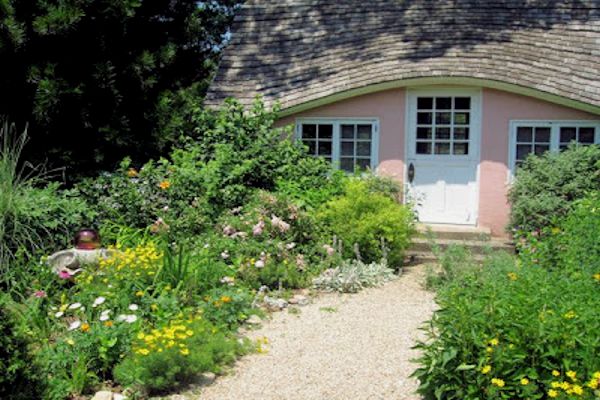
Play Cottage
This adorable pink playhouse surrounded by a cutting garden built for the youngest child and only daughter Natalie is one of the sights to be seen on the estate. 
Dahlia Garden

On the estate are many cutting gardens and the Dahlias are magnificent this time of year. William Coe had admired Dahlias because of their variety of texture and bold colors. The present day garden constructed in 1998 is maintained by the Mid Island Dahlia Society and is one of the largest and most spectacular dahlia gardens in the northeast. Over 400 varieties of dahlia are tended to and Dahlia Society members donate over 2000 hours a year maintaining the gardens.
Meet the Coe Family (Photo Credit: Planting Fields Arboretum)
Avalon Park & Preserve
Next is Avalon Park & Preserve, a private park and preserve located on the north shore of Long Island, across from the Grist Mill on Harbor Road in the town of Stony Brook. The park and preserve were created to celebrate the life of Paul Simons, a native Long Islander, hiking enthusiast and cyclist, who always had a deep appreciation for the outdoors. After his life was prematurely taken away in 1996, the Paul Simons Foundation was formed, and an abandoned 7.5 acres of residential land was purchased to become the future site of Avalon Park. The goal was to celebrate the life of Paul Simon's and his love of nature by creating a natural habitat for future generations to appreciate and enjoy. While the park is managed privately, it is available to the public.
Letters to The Sky

One of the main park trails leads to this giant mirrored sculpture. The phrase Cartas Al Cielo, which is printed by a mail slit on the front, is roughly translated as "letters to the sky". Visitors are supplied with note cards and pencils, allowing them to insert letters containing their deepest thoughts into the enclosed sculpture.
Labyrinth
In the center of the park is this labyrinth leading to a central circle, symbolizing wholeness and eternity, no beginning or end. Above the labyrinth is a sculpture of a "broken" man climbing the rock, an emotional tribute to life of Paul Simons.

Peconic River Herb Farm
Last on our tour is The Peconic River Herb Farm, established in 1986 along the Peconic River on the eastern end of Long Island in Calverton, New York. The farm consists of 14 acres of display gardens, eight greenhouses, a garden shop and picnic areas along the river for visitors to relax and enjoy the view. The farm is a huge draw to visitors from all over and as the name implies, they are known for their extensive variety of herbs, which you can purchase and grow. While there, you may want to take in all the beauty the location has to offer by strolling through the gardens. The story of the Herb Farm began in the late fall/winter of 1986 while the owner, Cristina Spindler was looking for a small farm/garden where she could set up a business selling garden related products. It all started with a small 14 x 24’ hoop house to grow vegetable and herb plants and the farm grew by leaps and bounds to what it is today. 
Potting Shed
Cristina and her husband Michael built this adorable potting shed along with several greenhouses to support all the plants on the farm. 
Hydrangea Walk
I hope you enjoyed This Month in the Garden for August, and be sure to stop by on the 1st. and 15th. of each month as I continue to share gardening tips, information and horticultural adventures! (Linking with: Floral Fridays, Macro Monday 2, Ruby Tuesday and Image-in-ing Weekly Photo Link-Up.

For gardening info and tips: Visit my Author Page/Purchase My Books  ðŸ˜Š
Author: Lee@A Guide to Northeastern Gardening,© Copyright 2010-2020. All rights reserved. 

Friday, November 1, 2019

This Month in the Garden: Autumn at Avalon Park & Preserve, Stony Brook, Long Island

Avalon Park And Preserve, Harbor Rd, Stony Brook, NY 11790, USA
Welcome to This Month in the Garden for November! The autumnal season here on Long Island brings forth comfortable walking temperatures and an opportunity to visit the local parks and preserves that are available to the public. One of these parks is Avalon Park & Preserve, a private park located on the north shore of Long Island, across from the Grist Mill on Harbor Road in the town of Stony Brook.
Avalon Park And Preserve-Paul Simons Foundation
The park and preserve was created to celebrate the life of Paul Simons, a native Long Islander, avid hiker and cyclist, who always had a deep appreciation for the outdoors. After his life was prematurely taken away in 1996, the Paul Simons Foundation was formed, and an abandoned 7.5 acres of residential land was purchased to become the future site of Avalon Park. The goal was to celebrate the life of Paul Simon's and his love of nature by creating a natural habitat for future generations to appreciate and enjoy. While the park is managed privately, it is available to the public.
Avalon Park And Preserve, Harbor Rd, Stony Brook, NY 
Avalon Park And Preserve Map
Here is a brief history of how the park came to be. In 1997, an ecologically oriented landscape group, Andropogon Associates, proposed to transform the neglected property into an array of woodland gardens and hiking paths with focus on the native flora and fauna of Long Island. As the project commenced, several invasive species such as multiflora rose, oriental bittersweet vine and Russian olive shrubs were cleared and Avalon Park started to materialize with the addition of thousands of native trees, shrubs and perennials. A labyrinth was constructed and hiking paths added to allow access to the different sections of the park. The property continues to evolve with future plans for more trails and better access to the harbor, while it continues to serve as an outdoor classroom and learning experience for students and adults alike.
Park Wildlife-Swan
Avalon Park and Preserve is the home to numerous forms of wildlife including swans, ducks, squirrels, rabbits, red fox, box turtle, toads and many species of birds.
Crossing the Bridge
Woodland forests include several native plants including oaks, red maple, hickory, dogwoods, Sassafrass, American Birch, Black Birch, American Chestnut and American spicebush.
Mallard Enjoying the Pond
Cranberry Viburnum
The under-story is comprised of species of native ferns, shrubs and wildflowers including purple coneflower and butterfly weed, each an attraction to pollinators and an important food source for birds. Along the way are a series of blue-stone and boardwalk paths, stone steps and hiking trails, all making for a comfortable stroll through the natural habitat.
Path Leading to Labyrinth
One of the main focal points on the property is this slate labyrinth. Based on the Chartres design, the labyrinth is approximately 50 feet in diameter with a sculptural feature highlighting the overlooking rock. It conveys a feeling of tranquility and peace to its visitors.
Labyrinth Avalon Park & Preserve
The paths of the labyrinth lead to a central circle, symbolizing wholeness and eternity, no beginning or end. 
Labyrinth Avalon Park & Preserve
The sculpture at the top of the labyrinth speaks much symbolism. One interpretation of the missing pieces of the climber could be a life torn apart, while there could be various meanings left to the imagination.
Along the Walking Path
Leaving the labyrinth and further along the path is one of the ponds on the property.
Around to the other side of the Pond
The autumn scenery is beautiful.
Signs of Autumn
A Glance of the Bridge in the Distance
In the distance is a bridge that crosses over the main pond, while one can encounter smaller pond areas along the way. 
A Visit to the Toad Pond
Cartas Al Cielo-Letters to Heaven
Following the "red path" to the preserve on the other side of Rhododendron Road is Cartas Al Cielo, a stainless steel sculpture by artist Alicia Frami, which was introduced into the preserve in 2015. Next to a description of the sculpture are note cards and pencils for visitors to write letters.
Cartas Al Cielo-Letters to Heaven
The idea behind the giant sculpture is that visitors can insert letters containing their deepest thoughts into the mail slit on the front of the ball. The phrase Cartas Al Cielo is roughly translated as letters to the sky. There is something about this place that relays a feeling of tranquility and peace and encourages the imagination to wander.
Leaving Cartas Al Cielo
Friendly Swan
This Long Island visit ends as the trail meanders back to the beginning of the park by the Stony Brook Grist Mill. Long Island has a wealth of beautiful places and Avalon Park & Preserve is one to put onto your list. I hope you enjoyed the visit!
Avalon Park And Preserve, Harbor Rd, Stony Brook, NY 11790, USA
I hope you enjoyed This Month in the Garden for November. Be sure to stop by on the 1st. of each month for This Month in the Garden, as I share gardening tips, information and horticultural adventures! (Linking with: Floral Fridays, Macro Monday 2, Friday Photo Journal, Image-in-ing Weekly Photo Link-Up and Dishing It & Digging It.)

For more information visit Avalon Park & Preserve.

For more gardening information and tips...Visit My Author Page and See My Books:

~As Always...Happy Gardening! ~

Author: Lee@A Guide to Northeastern Gardening,© Copyright 2010-2019. All rights reserved.