Showing posts with label viburnum. Show all posts

Wednesday, October 1, 2025

12 Landscape Plants for Fall & Winter Wildlife

This Month in the Garden: 12 Landscape Plants That Support Wildlife
Welcome to This Month in the Garden. A thriving landscape can also be a vital source of food, shelter, and nesting space for local wildlife. By thoughtfully choosing the plants we grow, we can create a landscape that is not only beautiful, but also play an important role in sustaining the natural world around us. With autumn upon us and winter on the way, here are twelve landscape plants that can help to support our local wildlife. 

American Holly (Ilex opaca)
American Holly: American Holly is an evergreen tree native to the eastern and southeastern regions of the United States and hardy in USDA zone 5-9. This species is found in moist woods, forest bottomlands, and swamp edges, and often serves as an understory tree. Female trees produce clusters of bright red berry-like fruits that are visually striking in winter and provide food for many bird species throughout winter. The flowers which appear in late spring to early summer are an important nectar source for bees and butterflies.  

Beautyberry (Callicarpa spp.)
American beautyberry: The most widely known cultivar is American beautyberry (Callicarpa americana), which is native to the southeastern United States and thrives in woodlands, meadows, and along water margins. Hardy in USDA zones 5-8, the American species displays clusters of magenta to violet berries tightly encircling stems, a trait distinguishing it from many non-native varieties. The vibrant purple-pink berries can linger throughout fall and into winter, supplying food for birds and small mammals including armadillos, raccoons, opossums, squirrels.

Arrowwood Viburnum (Viburnum dentatum)
Arrowwood Viburnum: Hardy in USDA zones 3-8, Arrowwood Viburnum (Viburnum dentatum) is a native deciduous shrub to northeastern America which is valued for its wildlife support. White blooms lead to bluish-black fruits  persisting into winter and providing food for a range of birds, including Northern cardinal, American Robin, Cedar Waxwing, and Mockingbird. The berries are also consumed by various mammals, such as Eastern gray squirrel, rabbits, and deer.
Winterberry Holly (Ilex verticillata)
Winterberry: Winterberry Holly (Ilex verticillata) is a deciduous holly shrub hardyin USDA zones 3-9 and native to eastern North America, including the United States and southeast Canada. It typically grows 3 to 15 feet tall, and often forms dense thickets, especially in wetland habitats like swamps, pond edges, and moist woods. The shrub is known for its bright red berries that persist throughout the winter, providing a feast for robins and mockingbirds. Winterberry is dioecious, meaning it must have male and female plants nearby for fruit to form.
Spicebush (Lindera benzoin)
Spicebush: 
Spicebush (Lindera benzoin) is a deciduous shrub in the laurel family (Lauraceae) and is native to central and eastern United States. It is typically found in moist woodlands, bottomlands, ravines, valleys, swamps, and along streams. Hardy in USDA zones 4-9, 
Spicebush produces red berries which attract thrushes and cardinals in late fall and early winter and serve as a food source.
American Elderberry (Sambucus canadensis)
American Elderberry:
Hardy in USDA zones 3-9, American Elderberry (Sambucus canadensis) 
provides ornamental value with its fragrant flowers and showy bluish-black fruits, while attracting butterflies, birds, and other pollinators. It grows fastest in rich soil but can spread aggressively by root suckers, so planting location and maintenance should be under consideration. Birds are particularly attracted not only to the berries but also to the dense foliage, which provides nesting opportunities and protection. The berries serve as a nutritious resource especially in late summer and early fall, benefiting migrating and resident birds alike.
American Cranberry Bush (Viburnum opulus var. americanum)
American Cranberry Bush: The American Cranberry Bush (Viburnum opulus var. americanum), also known as American Cranberry bush Viburnum or highbush cranberry, is a broadleaf deciduous shrub native to northern North America. Hardy in USDA zones 2-7, this shrub produces flat-topped clusters of white lacecap flowers in mid- spring, followed by bright red, cranberry-like edible berries in late summer to fall. The to be enjoyed by wildlife.
Juniper (Juniperus spp.)
Juniper: Juniper (Juniperus spp.) is hardy in USDA zones 2-6 and is known to provide an important source of food and shelter for wildlife.  The female juniper cones, commonly called berries, are a significant food source for many mammals and birds, especially during winter when other food is scarce. These berries contain carbohydrates and fats, making them valuable for energy. Birds such as American robins, cedar waxwings, and several jay species eat the berries, often consuming large quantities in harsh seasons. Small mammals like rabbits, rodents, and coyotes also feed on the berries, helping disperse the seeds. Junipers also provide shelter and nesting cover for birds and some mammals and the dense evergreen foliage offers protection from harsh weather conditions. The plant's strong scent and sharp needles also tend to discourage deer from browsing.
Eastern White Pine (Pinus strobus)
Eastern White Pine: Hardy in USDA zones 3-8, Pine offer both shelter and high-fat seeds for crossbills, chickadees, nuthatches, and squirrels, all through the coldest months. Its seeds, cones, foliage, buds, and bark are consumed by animals such as squirrels, rabbits, deer, beavers, black bears, and various small mammals. Many birds, including species like Red-breasted Nuthatches, woodpeckers, and grosbeaks, rely on the pine’s seeds and use it for nesting sites. Large Eastern White Pines also serve as important nesting trees for hawks, owls, and other cavity-nesting birds.
Black-eyed Susan (Rudbeckia hirta)
Black-eyed Susan: Black-eyed Susan (Rudbeckia hirta) is hardy in USDA zones 3-9 and serves as an excellent food source for American Goldfinches, Bobwhite Quail, and Wild Turkeys, once the flowers have matured and gone to seed. The nectar from the flowers is an important food source for pollinators, and a home for larval host for certain moths and butterflies.
Echinacea (Coneflower)
Echinacea: Echinacea, or coneflower are native to eastern and central North America and includes a vast selection of species, ranging in both size and color. Hardy in USDA zones 4-9, Echinacea prefers to be grown in full sun and in a well-drained soil. Flowers emerge from mid-summer to mid-fall which are a favorite feeding station for many butterflies. After blooming, seed heads are a huge attraction to a number of bird species, including Blue Jays, Cardinals and finches.
Bearberry (Arctostaphylos uva-ursi)
Bearberry: Bearberry (Arctostaphylos uva-ursi), hardy in USDA zones 2-6, is a low-growing, evergreen shrub native to northern North America, spreading horizontally to form a dense ground cover. The plant exhibits small, leathery, dark green leaves that turn reddish to bronze in fall and produce small, white to pink flowers in late spring. Bright red berries form that last into winter and are eaten by a variety of wildlife including birds, foxes, coyotes and bears. The plant's common name, bearberry, references to bears, which particularly enjoy the fruit, but many bird species also rely on the berries as a food source into late fall and winter. Additionally, the berries serve as an important food source for some small mammals. 

I hope you enjoyed This Month in the Garden and have found the information to be useful. Landscaping with wildlife in mind not only enhances the beauty of outdoor spaces but also strengthens local ecosystems. By incorporating certain plantings into your landscape you can play a major role in helping to support local wildlife, especially during the fall and winter months when food sources are scarce. 

Looking for some Garden Inspiration? Purchase My Books:


As Always...Happy Gardening!

Author: Lee @A Guide to Northeastern Gardening, © Copyright 2010-2025. All rights reserved.  

Thursday, May 15, 2025

Garden Bloggers' Bloom Day & Foliage Follow-Up May: Rainy Days and a Bounty of Blooms!

Welcome!
Welcome to my zone 7b Long Island garden! May is a busy month for blooms as the temperatures gradually warm up into the 70's by day, with frequent rain in the forecast, which now has us pretty much caught up from the lack of rain and drought conditions from last summer. Every day there is something new to explore in the garden, which makes May one of my favorite months for gardening and dreaming of what future blooms are in store. Join me for a tour!
Patio Border
As we pass by the patio border, new candles of growth can be seen on the Japanese Red Pine, along with the bright red new foliage on Rhode Island Red Japanese Maple. Juniper 'Gold Strike' is in the foreground and Osmanthus 'Goshiki' can be seen in the backdrop.
Perimeter Garden
In the perimeter garden, Weeping Blue Atlas Cedar is joined by Heuchera (Coral Bells) 'Caramel'...
Pool Border
and on the shadier side of the pool border is Golden Sweet Flag, Sky Pencil Holly and Leucothoe 'Axillaris'. Added just last summer is a new dwarf form of Nepeta called the 'Cat's Meow'.
Pool Border-Dwarf Nepeta 'Cat's Meow'
This variety has striking, long-lasting blooms and grows to seventeen to twenty inches tall, which is a little more compact when compared to other forms of catmint.
Backyard Island Berm
Along the back island berm, Hinoki Cypress 'Compacta' is joined by Mugo Pine, Hydrangea 'Limelight Prime' and  Weigela 'My Monet', which is now blooming.
Back yard Island Berm-Weigela 'My Monet'
Weigela 'My Monet' is a dwarf  form of Weigela growing to just one in a half to two feet tall by two and half feet wide with beautiful variegated foliage and pinkish-purple trumpet-shaped blooms in spring. This plant is beautiful for both its foliage and blooms. 
Patio Border
Upright Japanese Maple Twombly's Red Sentinel is going on its third season along the patio border and is joined by Spirea 'Candy Corn' and Stachys (Lamb's Ear).
Patio Border-Spirea 'Candy Corn' and Stachys (Lamb's Ear)
Here is the Spirea and Lamb's Ear up close!
Island Berm-Heuchera 'Caramel and Ajuga 'Burgundy Glow'
Here 'Caramel' Coral Bells are joined by Ajuga 'Burgundy Glow'... 
Pool Border-Encore Azalea
and Encore Azalea is blooming away!
Back "Secret Garden"
If you follow along a path behind the pool, you will find what I refer to as the "secret" garden. It is hidden around the bend and is a place where Azalea are in full bloom this time of year, along with the white blooms of Viburnum 'Summer Snowflake'.
Back Shade Garden-Viburnum 'Summer Snowflake'
Viburnum 'Summer Snowflake' is a more compact form of Viburnum which displays star-like white blooms in spring followed by a rebloom in late summer. 
Back Pool Border-Shade Garden
Also around the bend in the "secret garden" is this statue of two children playing a game of piggyback.
Allium 'Globemaster'
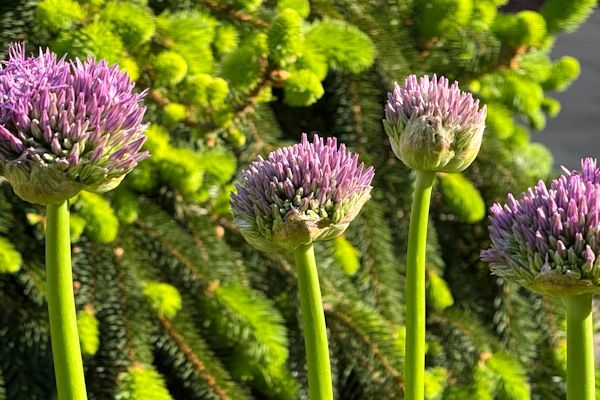
Here is Allium 'Globemaster' along the pool border, which will be in full bloom by June with flowers up to five inches in diameter...
Pool Border-Cherry Laurel 'Otto Luyken'
while Cherry Laurel 'Otto Luyken' produces its spring blooms.
Shade Garden-Jacob's Ladder ‘Golden Feathers’
In the shade border on the northwestern side of the property is Jacob’s Ladder ‘Golden Feathers’ with its golden variegated foliage and lavender blooms. I am enjoying this new addition from last summer.
Shade Garden-Pulmonaria 'Leopard'
Along with Jacob’s Ladder is Pulmonaria (Lungwort) with its leaves speckled in while and bluish-purple blooms that appear during the end of April and through the month of May.
Hellebore 'Champion'
Even the Hellebores are still chiming in. Although their peak time is over, their colorful bracts still add a touch to a shady spot beneath the Weeping White Pine. 
Front Main Lawn
As we approach the end of our tour for this month, here is a view of the front lawn with Weeping Japanese Maple ‘Viridis’ and Blue Atlas Cedar in the background…
Driveway Border
with Coral Bark Maple with Boxwood and Hinoki Cypress along the driveway border. 
Thanks for Visiting!
I hope you enjoyed your visit to my May garden. I so appreciate you being here, look forward to your comments and enjoy seeing what you have growing in your garden. Special thanks go out to our hostess Carol at May Dreams Gardens, who makes it possible to see blooms on the 15th of every month with her meme Garden Bloggers' Bloom Day. Also, special thanks to Pam Penick at Digging who had hosted Foliage Follow-Up, a meme I will continue to honor. I am also linking with some other wonderful hosts and hostesses at Floral Friday Fotos, Nature Notes at Rambling WoodsImage-in-ing weekly photo share every Tuesday, Weekly Photo Link-Up at My Corner of the World on Wednesdays and Garden Affair at Jaipur Garden

IN THE NEWS! Celebrating four months since The Houseplant Guide: How to Easily Select & Maintain Indoor Plants came to be! If you are into houseplants, this may be the book for you! I cover over 120 plant selections with full color photographs of each one and detailed descriptions on care and maintenance.

Other Places to Find Me:
You can visit my Author Page to learn about and Purchase My Books, each one focusing on different aspects of gardening, including landscape ideas, design principles, gardening by month for all-season interest, gardening tips and maintenance, shade gardening, gardening inspiration and more. And also be sure to check out my newest publication, The Houseplant Guide, to guide you on your houseplant journey!

Check out my newsletter Northeastern Gardening News for monthly updates all to do with gardening! It's free to subscribe and receive monthly updates right into your inbox!


Until we Meet Again...Happy Gardening!

Author: Lee @A Guide to Northeastern Gardening, © Copyright 2010-2025. All rights reserved. 

Sunday, October 1, 2023

This Month in the Garden: Autumn Interest

Welcome!
Welcome to This Month in the Garden! Autumn has arrived and the landscape is transiting into an array of color with each passing day. Starting with subtle hints, the garden becomes more of a work of art with color everywhere as the days grow shorter. In the words of Albert Camus, "Autumn is a second spring when every leaf is a flower." I couldn't agree more as the garden always keeps me anticipating the next wonder. Here are a few selections to incorporate into the landscape for interest during the fall season.
Coral Bark Maple 'Sangu Kaku' Autumn Color
The first, Coral Bark Maple, provides striking color in autumn, which is difficult to beat. As the temperatures cool, light green foliage turns to yellow then orange before the leaves drop. Afterwards, the newer growth of branches glows a bright coral-red in winter. Coral Bark Maple grows to a height and width of 20 feet tall by 15 feet wide and prefers full sun to partial shade.
Dwarf Maiden Grass 'Yaku Jima' 
Next is Miscanthus 'Yaku Jima', a dwarf variety of Maiden Grass that maintains a more compact, upright habit, which is perfect for smaller spaces. Displaying attractive fall plumes, this variety grows to a height and width of 3-4 foot tall by wide and is hardy in USDA zones 5-9. A similar variety is Miscanthus 'Adagio'. Note: The clumping nature and more compact size of these varieties make them less likely to be invasive.  It is best to leave grasses in winter to protect the roots from cold and to cut back in early spring just before new growth appears.
Montauk Daisy October
Next, and hardy in USDA zones 5-9, the white blooms and yellow centers of Montauk Daisy welcome fall. Montauk Daisy grows to a mature height and width of 2-3 feet and prefers full sun and a well-drained soil. Maintenance Tip: To promote fullness and to keep the plant more compact, it is recommended to prune back foliage tips in June.
Callicarpa (American Beautyberry) Autumn
Known for its beautiful purple berries that cover the plant in fall, Callicarpa, also known as Beauty Bush or American Beautyberry, provides a food source for birds and deer. American Beautyberry is hardy in USDA zones 7-11 and grows 3-5 feet tall by wide. Grow in full sun to partial shade.
Nellie Stevens Holly Berries Autumn
For attractive deep green glossy leaves and bright red berries in autumn, Nellie Stevens Holly (Ilex Nellie Stevens) is a large growing broad-leaved evergreen, which reaches 15-20 feet tall by 8-15 feet wide. Note: While the berries are attractive to the eye, they are edible for birds, but not humans or pets. Nellie Stevens Holly is hardy in USDA zones 6-9 and prefers a location with full sun to partial shade and a well-drained soil.
Japanese Kousa Dogwood Fruit Autumn
Japanese Kousa Dogwood is a beautiful small specimen tree for smaller spaces, displaying lovely white blooms in springtime-early summer, followed by bright red edible fruit in the fall, which can be made into jelly. Hardy in USDA zones 5-8, Kousa Dogwood reaches a height and width of 15-25 feet and prefers a location with full sun to partial shade. Maintenance Tip: Prune after bloom to maintain a more compact shape.
Echinacea (Coneflower) Seed Heads
A familiar sight in fall are the seed heads of perennials. Echinacea displays colorful blooms late summer into fall and provides an important food source for birds once it goes to seed. The seed heads also add interest to the fall landscape.
 Sedum 'Brilliant'
This more dwarf version of Sedum does not flop over like the taller varieties. The flowers also provide late season attraction for pollinators. Sedum is known to grow in zones 3-11 and prefers full sun, but will also grow in some shade. A nice combination for autumn is that of Dwarf Maiden Grass and Sedum 'Brilliant'.
Variegated Liriope (Lilyturf)
Known for its brilliant purple blooms in fall is Liriope. Hardy in USDA zones 4-10. Liriope grows best in partial shade or full sun with afternoon shade and reaches a height and width of 10-18 inches. Maintenance Tip: For best results, allow the foliage to remain during winter and prune back in early spring.
Lamb's Ear (Stachys)
For all season interest, Lamb's Ear displays soft grayish-white foliage that serves nicely along a perennial border. Hardy in USDA zone 4-8, Stachys (Lamb's Ear) grows to 6-8 inches tall, prefers full sun and a well-drained soil. The foliage can last into winter as the plant can tolerate temperatures below freezing. Spikes of pink blooms rise above the foliage in mid-late summer.
Hydrangea 'Tardivia'
For blooms later in the season, Hydrangea 'Tardivia' (hardy in USDA zone 3-8) produces massive fragrant panicle blooms in late summer which last in to fall. This 8-10 foot tree-sized shrub prefers an area of full sun to partial shade, as in an eastern exposure. 
Hydrangea 'Limelight Prime'
Another variety of late blooming hydrangea is 'Limelight Prime'. Hydrangea 'Limelight Prime' produces stunning greenish-white blooms that turn to pure white and then to a pinkish hue as they age in fall. This variety stays smaller than 'Limelight', growing to a maximum of 4-6 feet high by wide and is hardy in USDA zone 3-8.
St. John's Wort Berries 
Displaying interesting fruit after yellow blooms is St. John's Wort. Hardy in USDA zones 4-9, St. John's Wort grows 2-3 feet tall by wide, prefers full sun to partial shade and is known for its medicinal qualities. This plant provides several seasons of interest.
'Summer Snowflake' Viburnum Blooms in Autumn
Just when you think its blooms are done for the season, 'Summer Snowflake' Viburnum will shoot out a last round of interest. Hardy in USDA zones 5-8, 'Summer Snowflake' Viburnum reaches 5-6 feet high by wide, and prefers full sun to partial shade. The blooms resemble snowflakes, hence the name.
Monarch Butterfly Enjoying Fall Blooms
Autumn is also a time for Chrysanthemum and Dwarf Butterfly Bush blooms...
North Fork Sunflower Maze Autumn-Long Island
and of course sunflowers, as they bloom against the deep blue sky.
Thank You for Visiting!

I hope you enjoyed This Month in the Garden for the month of October. Be sure to stop by on the 1st. and 15th. of each month as I continue to share gardening tips, information and horticultural adventures! 

Also, Check out my Books!: