Showing posts with label sunflower. Show all posts

Sunday, October 1, 2023

This Month in the Garden: Autumn Interest

Welcome!
Welcome to This Month in the Garden! Autumn has arrived and the landscape is transiting into an array of color with each passing day. Starting with subtle hints, the garden becomes more of a work of art with color everywhere as the days grow shorter. In the words of Albert Camus, "Autumn is a second spring when every leaf is a flower." I couldn't agree more as the garden always keeps me anticipating the next wonder. Here are a few selections to incorporate into the landscape for interest during the fall season.
Coral Bark Maple 'Sangu Kaku' Autumn Color
The first, Coral Bark Maple, provides striking color in autumn, which is difficult to beat. As the temperatures cool, light green foliage turns to yellow then orange before the leaves drop. Afterwards, the newer growth of branches glows a bright coral-red in winter. Coral Bark Maple grows to a height and width of 20 feet tall by 15 feet wide and prefers full sun to partial shade.
Dwarf Maiden Grass 'Yaku Jima' 
Next is Miscanthus 'Yaku Jima', a dwarf variety of Maiden Grass that maintains a more compact, upright habit, which is perfect for smaller spaces. Displaying attractive fall plumes, this variety grows to a height and width of 3-4 foot tall by wide and is hardy in USDA zones 5-9. A similar variety is Miscanthus 'Adagio'. Note: The clumping nature and more compact size of these varieties make them less likely to be invasive.  It is best to leave grasses in winter to protect the roots from cold and to cut back in early spring just before new growth appears.
Montauk Daisy October
Next, and hardy in USDA zones 5-9, the white blooms and yellow centers of Montauk Daisy welcome fall. Montauk Daisy grows to a mature height and width of 2-3 feet and prefers full sun and a well-drained soil. Maintenance Tip: To promote fullness and to keep the plant more compact, it is recommended to prune back foliage tips in June.
Callicarpa (American Beautyberry) Autumn
Known for its beautiful purple berries that cover the plant in fall, Callicarpa, also known as Beauty Bush or American Beautyberry, provides a food source for birds and deer. American Beautyberry is hardy in USDA zones 7-11 and grows 3-5 feet tall by wide. Grow in full sun to partial shade.
Nellie Stevens Holly Berries Autumn
For attractive deep green glossy leaves and bright red berries in autumn, Nellie Stevens Holly (Ilex Nellie Stevens) is a large growing broad-leaved evergreen, which reaches 15-20 feet tall by 8-15 feet wide. Note: While the berries are attractive to the eye, they are edible for birds, but not humans or pets. Nellie Stevens Holly is hardy in USDA zones 6-9 and prefers a location with full sun to partial shade and a well-drained soil.
Japanese Kousa Dogwood Fruit Autumn
Japanese Kousa Dogwood is a beautiful small specimen tree for smaller spaces, displaying lovely white blooms in springtime-early summer, followed by bright red edible fruit in the fall, which can be made into jelly. Hardy in USDA zones 5-8, Kousa Dogwood reaches a height and width of 15-25 feet and prefers a location with full sun to partial shade. Maintenance Tip: Prune after bloom to maintain a more compact shape.
Echinacea (Coneflower) Seed Heads
A familiar sight in fall are the seed heads of perennials. Echinacea displays colorful blooms late summer into fall and provides an important food source for birds once it goes to seed. The seed heads also add interest to the fall landscape.
 Sedum 'Brilliant'
This more dwarf version of Sedum does not flop over like the taller varieties. The flowers also provide late season attraction for pollinators. Sedum is known to grow in zones 3-11 and prefers full sun, but will also grow in some shade. A nice combination for autumn is that of Dwarf Maiden Grass and Sedum 'Brilliant'.
Variegated Liriope (Lilyturf)
Known for its brilliant purple blooms in fall is Liriope. Hardy in USDA zones 4-10. Liriope grows best in partial shade or full sun with afternoon shade and reaches a height and width of 10-18 inches. Maintenance Tip: For best results, allow the foliage to remain during winter and prune back in early spring.
Lamb's Ear (Stachys)
For all season interest, Lamb's Ear displays soft grayish-white foliage that serves nicely along a perennial border. Hardy in USDA zone 4-8, Stachys (Lamb's Ear) grows to 6-8 inches tall, prefers full sun and a well-drained soil. The foliage can last into winter as the plant can tolerate temperatures below freezing. Spikes of pink blooms rise above the foliage in mid-late summer.
Hydrangea 'Tardivia'
For blooms later in the season, Hydrangea 'Tardivia' (hardy in USDA zone 3-8) produces massive fragrant panicle blooms in late summer which last in to fall. This 8-10 foot tree-sized shrub prefers an area of full sun to partial shade, as in an eastern exposure. 
Hydrangea 'Limelight Prime'
Another variety of late blooming hydrangea is 'Limelight Prime'. Hydrangea 'Limelight Prime' produces stunning greenish-white blooms that turn to pure white and then to a pinkish hue as they age in fall. This variety stays smaller than 'Limelight', growing to a maximum of 4-6 feet high by wide and is hardy in USDA zone 3-8.
St. John's Wort Berries 
Displaying interesting fruit after yellow blooms is St. John's Wort. Hardy in USDA zones 4-9, St. John's Wort grows 2-3 feet tall by wide, prefers full sun to partial shade and is known for its medicinal qualities. This plant provides several seasons of interest.
'Summer Snowflake' Viburnum Blooms in Autumn
Just when you think its blooms are done for the season, 'Summer Snowflake' Viburnum will shoot out a last round of interest. Hardy in USDA zones 5-8, 'Summer Snowflake' Viburnum reaches 5-6 feet high by wide, and prefers full sun to partial shade. The blooms resemble snowflakes, hence the name.
Monarch Butterfly Enjoying Fall Blooms
Autumn is also a time for Chrysanthemum and Dwarf Butterfly Bush blooms...
North Fork Sunflower Maze Autumn-Long Island
and of course sunflowers, as they bloom against the deep blue sky.
Thank You for Visiting!

I hope you enjoyed This Month in the Garden for the month of October. Be sure to stop by on the 1st. and 15th. of each month as I continue to share gardening tips, information and horticultural adventures! 

Also, Check out my Books!:

Tuesday, March 1, 2022

This Month in the Garden: Long Island Places and Garden Memories-A Few of my Favorite Things II

This Month in the Garden
Welcome to This Month in the Garden! Last March I was was feeling nostalgic and dug into my soul by sharing some of my favorite things that I had captured with photography over the years. The post was well received while generating lots of smiles, so I decided to post a Part 11 for this March to celebrate past memories and bring in spring. Come along on a photo tour of some special memories. It is said that a picture is worth a thousand words.
Spring Crocus
Nothing speaks spring more than the appearance of crocus. This was one of the nicest photo captures I have ever gotten that was taken last spring. Every time I look at it, it gives hope that spring is not too far away, so I am sharing some of that hope with you!
Garden Statuary
I have several garden statues throughout the property, but this one by far is my favorite. It is a reminder of when I was a little girl and playing in the garden would bring so much joy. We didn't have a kitten at that time but I would play with our dog Specky, who was so gentle that he allowed me ride on him like a pony, with not a care in the world on his part, except to make me happy and hear my laughter. In my more mature years, my husband and I are the parents of two Himalayan cats so this statue certainly touched my heart. 
Allium 'Globemaster'
Giant Globemaster Alliums speak for themselves. I started with three bulbs mainly as an experiment and now they have multiplied to make this perfect grouping of color in the late spring garden. They are positioned between clumps of golden Daylily with Spirea Magic Carpet in the backdrop, so I look forward to their display every year, but in the meantime I can enjoy this photo!
Monarch Butterfly
The late summer blooms of Butterfly Bush bring the Monarchs, something I treasure, as the population of Monarchs has been decreasing year by year. I was able to get this capture last season.
Iris Garden
This is a photo of my mother's iris garden, which she planted back in the 1960's and still exists today. I have never left my childhood home and while I have redesigned 99 percent of the property, this little piece of the past simply has to stay.
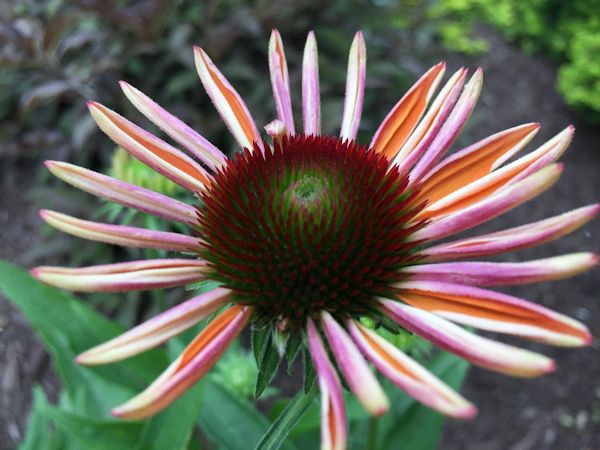
Echinacea 'Cheyenne Spirit'
This is Echinacea 'Cheyenne Spirit', which I discovered some years ago. The thing that is unique about this perennial is that it can have multiple colors of flowers on one plant. It's always a surprise to see which colors appear in late summer, and every so often, you get multi-colored petals like this one, which I was able to capture.
Mattituck Sunflower Maze, Long Island, NY
As you may know, sunflowers have a very special meaning to me. I will repeat the story just in case you hadn't seen the post from last March. If you are familiar with my third book, Dream, Garden, Grow, there is an entire chapter about the meaning of sunflowers, and it was sparked by a single visit to Mattituck, Long Island in 2018. I had childhood memories of taking car rides out east with my parents and seeing huge fields of sunflowers, and always felt a need to stand among the huge flowers. During the summer of 2018, the first sunflower maze became open to the public and a childhood dream came true. The emotions were so strong that it was something I wanted to share, so I started writing and the memories flowed out onto paper.
Mattituck Sunflower Maze, Long Island, NY
There is another special meaning to sunflowers which I was made aware of just this past week. Sunflower is the national flower of Ukraine.
Red-Headed Woodpecker
Sometimes you just need a Red Headed Woodpecker to make your day and this one appeared not to long ago on the feeder in the back garden. Every so often we can hear a continuous pecking sound, usually in the early hours of the morning right from the street median outside our window. Timing is everything!
Bayard Cutting Arboretum, Great River, Long Island, NY
This is a memory that just makes me smile. This photo was taken at the Bayard Cutting Arboretum this past fall. The vibrant colors of autumn foliage, a bridge which crosses over a small dappling brook and the silence, except for the sound of rippling water, was so calming. This moment which just whispered the true essence of the season, is now captured in time.
Autumn Landscape
Autumn this year was magnificent and resembled an artist's palette with an array of vibrant colors. Here is one of my favorite captures of the driveway garden with the yellowing foliage of Coral Bark Maple against evergreens Skyland's Spruce, Weeping Blue Atlas Cedar and Weeping White Pine.
Autumn Landscape-Weeping Japanese Maples
I do enjoy the changing seasons where we live on Long Island. In the front yard are the two Weeping Japanese Maples, each over 30 years old.  This is the view in late October-early November...
Winter Landscape
and here they are in January. Welcome to a winter wonderland!
Container Planter
Back to scenes of springtime, soon it will be time to bring out spring-summer bear with his basket of live plants. I can't believe how much I love this purchase from the local nursery last year, so it had to be included as one of  my favorite things!
Cottage Garden
There is a story behind this small cottage. This was one of my first clients when I started up my landscape design business. The lady had contacted me and explained that she had a cottagey looking shed that she wanted to plant a garden around. She also informed me that she didn't know much of anything about gardening. Well, twenty-six years later with a treasured friendship and a property which consists of gardens everywhere, she blames me every time she has to go outside and weed!
Canadian Geese
Life is full of adventures and it is always fun to run into some of the local wildlife. These Canadian Geese often occupy the nurseries I go to since they enjoy the plants and constant irrigation that supplies them with food and water. I always smile and chuckle when they feel so comfortable that they will not even move when a truck is passing through, so I just have to sit and wait and have a photo moment. This capture goes under the category of favorite creatures!
Sparrow Love
Another recent addition to favorites is this perfectly positioned pair of sparrows sitting upon the Weeping Pussy Willow by the back patio. This yearly tradition signals the time when they start seeking places for nesting and means that spring in on the way. I was happy to have this photo moment just a few days ago!
Sunflower Love
Sometimes it is that unexpected encounter with something as simple a garden ornament in the garden of a friend that can prompt a smile every time you look at it, so I captured it in a photo and revisit it often.
Helleborus 'Shooting Star'
Finally, my garden writing has been inspired more often by unexpected encounters than planned. Helleborus was the inspiration behind my fourth book, Gardening By Month. Seeing this garden addition blooming in the midst of wintertime sparked me to create a reference that could prove something to gardeners, that there can be interest during every month of the year. Yes...a picture is worth a thousand words.
Thank you for Visiting!
I hope you enjoyed This Month in the Garden for March. Be sure to stop by on the 1st. and 15th. of each month as I continue to share gardening tips, information and horticultural adventures! (Linking up with: Floral FridaysMacro Monday 2Ruby Tuesday and Image-in-ing Weekly Photo Link-Up.)

For gardening information: My Author Page and Books

Monday, August 7, 2017

This Month's Color in the Garden August: The History and Meaning of Sunflowers

Sunflower (Helianthus Annuus) 
Welcome to This Month's Color in the Garden! Primary colors, or the most natural of colors that exist on their own (such as yellow, red, and blue) are the focus for the month of August. Since have always had an admiration for sunflowers, I decided to look into their history and meaning. I am sharing a post I wrote about a year ago that I hope you will enjoy. 

The bright yellow, and sometimes red, sunflower has always had a remarkable resemblance to our sun, leading early Indian settlers to accept the flower as the "life-giving" force of the Great Spirit. Since a sunflower follows the rays of the sun, it was first looked upon as a symbol of spiritual faith, worship and fertility. Today, the sunflower still represents adoration, loyalty and longevity. Much of the meaning of sunflower stems from its namesake, the sun itself.
Sunflower (Helianthus Annuus ) Taken in Newport, Rhode Island
The first wild sunflower is known to be native to North America. Evidence shows that the first sunflower crops were cultivated by the American Indian around 3000 BC, but its first commercialization didn't take place until it reached Russia. Indian tribes crushed the seeds into flour for bread and cakes or combined with vegetables, and the oil from the seed was used for cooking. Parts of the plant were used medicinally for snakebites, oils for the skin and hair and also for dyes to be used in body painting and decoration. Around the year 1500, the plant was taken to Europe by Spanish explorers and sunflowers became widespread as an ornamental. By the 18th century, the sunflower became more popular as a cultivated plant, and by 1830 the production of sunflower oil was performed widely on a commercial scale.
Sunflower (Helianthus Annuus ) 
By the early 19th century, Russian farmers were growing over 2 million acres of sunflower, and by the late 19th century, the sunflower as we know it found its way to the United States. Canada started the first sunflower breeding program, which led to the construction of a crushing plant, and future production of sunflower oil. Today,Western Europe continues to be a large consumer of sunflower oil, but depends on its own production since the U.S. exports to Europe are limited. The sunflower itself is grown worldwide for ornamental uses and is known for its radiance and beauty.
(Photos by Lee Miller and Property of a Guide to Northeastern Gardening) 

Sunflowers are seen as symbols of good luck. Planting them around your home will bring good fortune and it is said that if you pick a sunflower at sunset, and wear it on your person, it will bring you good luck the following day. According to folklore, it is bad luck to cut down a sunflower, but if you sleep with a sunflower under your pillow, you will become wise. According to the language of flowers, dwarf sunflowers are a symbol of admiration and gratitude, while tall sunflowers represent pride and appreciation. 

 Linking with:Today's FlowersFloral Fridays, Macro Monday 2 and Friday Photo Journal

MY BOOKS ON AMAZON:


As Always...Happy Gardening!

Author: Lee@A Guide to Northeastern Gardening, © Copyright 2017. All rights reserved

Sunday, September 4, 2016

The History and Meaning of Sunflowers

Sunflower (Helianthus Annuus ) 
I have always had an admiration for sunflowers, as do many, so I decided to look into their history and meaning. Since the sunflower has a remarkable resemblance to our sun, early Indian settlers believed the flower to represent the "life-giving" force of the Great Spirit.  A sunflower follows the rays of the sun, so it was looked upon as a symbol of spiritual faith, worship and fertility. Today, the sunflower is still looked upon as a symbol of adoration, loyalty and longevity. Much of the meaning of sunflower stems from its namesake, the sun itself.
Sunflower (Helianthus Annuus ) Taken in Newport, Rhode Island
The first wild sunflower is known to be native to North America. Evidence shows that the first sunflower crops were cultivated by the American Indian around 3000 BC, but its first commercialization didn't take place until it reached Russia. Indian tribes crushed the seeds into flour for bread and cakes or combined with vegetables, and the oil from the seed was used for cooking. Parts of the plant were used medicinally for snakebites, oils for the skin and hair and also for dyes to be used in body painting and decoration. Around the year 1500, the plant was taken to Europe by Spanish explorers and sunflowers became widespread as an ornamental. By the 18th century, the sunflower became more popular as a cultivated plant, and by 1830 the production of sunflower oil was performed widely on a commercial scale.
Sunflower (Helianthus Annuus ) 
By the early 19th century, Russian farmers were growing over 2 million acres of sunflower, and by the late 19th century, the sunflower as we know it found its way to the United States. Canada started the first sunflower breeding program, which led to the construction of a crushing plant, and future production of sunflower oil. Today,Western Europe continues to be a large consumer of sunflower oil, but depends on its own production since the U.S. exports to Europe are limited. The sunflower itself is grown worldwide for ornamental uses and is known for its radiance and beauty.

(Photos by Lee Miller and Property of a Guide to Northeastern Gardening) 

Sunflowers are seen as symbols of good luck. Planting them around your home will bring good fortune and it is said that if you pick a sunflower at sunset, and wear it on your person, it will bring you good luck the following day. According to folklore, it is bad luck to cut down a sunflower, and if you sleep with a sunflower under your pillow, you will become wise. 

Links to More Gardening Information:
https://www.facebook.com/landscapedesignbylee 


Author: Lee@A Guide to Northeastern Gardening, © Copyright 2016. All rights reserved