Showing posts with label winterberry. Show all posts

Wednesday, October 1, 2025

12 Landscape Plants for Fall & Winter Wildlife

This Month in the Garden: 12 Landscape Plants That Support Wildlife
Welcome to This Month in the Garden. A thriving landscape can also be a vital source of food, shelter, and nesting space for local wildlife. By thoughtfully choosing the plants we grow, we can create a landscape that is not only beautiful, but also play an important role in sustaining the natural world around us. With autumn upon us and winter on the way, here are twelve landscape plants that can help to support our local wildlife. 

American Holly (Ilex opaca)
American Holly: American Holly is an evergreen tree native to the eastern and southeastern regions of the United States and hardy in USDA zone 5-9. This species is found in moist woods, forest bottomlands, and swamp edges, and often serves as an understory tree. Female trees produce clusters of bright red berry-like fruits that are visually striking in winter and provide food for many bird species throughout winter. The flowers which appear in late spring to early summer are an important nectar source for bees and butterflies.  

Beautyberry (Callicarpa spp.)
American beautyberry: The most widely known cultivar is American beautyberry (Callicarpa americana), which is native to the southeastern United States and thrives in woodlands, meadows, and along water margins. Hardy in USDA zones 5-8, the American species displays clusters of magenta to violet berries tightly encircling stems, a trait distinguishing it from many non-native varieties. The vibrant purple-pink berries can linger throughout fall and into winter, supplying food for birds and small mammals including armadillos, raccoons, opossums, squirrels.

Arrowwood Viburnum (Viburnum dentatum)
Arrowwood Viburnum: Hardy in USDA zones 3-8, Arrowwood Viburnum (Viburnum dentatum) is a native deciduous shrub to northeastern America which is valued for its wildlife support. White blooms lead to bluish-black fruits  persisting into winter and providing food for a range of birds, including Northern cardinal, American Robin, Cedar Waxwing, and Mockingbird. The berries are also consumed by various mammals, such as Eastern gray squirrel, rabbits, and deer.
Winterberry Holly (Ilex verticillata)
Winterberry: Winterberry Holly (Ilex verticillata) is a deciduous holly shrub hardyin USDA zones 3-9 and native to eastern North America, including the United States and southeast Canada. It typically grows 3 to 15 feet tall, and often forms dense thickets, especially in wetland habitats like swamps, pond edges, and moist woods. The shrub is known for its bright red berries that persist throughout the winter, providing a feast for robins and mockingbirds. Winterberry is dioecious, meaning it must have male and female plants nearby for fruit to form.
Spicebush (Lindera benzoin)
Spicebush: 
Spicebush (Lindera benzoin) is a deciduous shrub in the laurel family (Lauraceae) and is native to central and eastern United States. It is typically found in moist woodlands, bottomlands, ravines, valleys, swamps, and along streams. Hardy in USDA zones 4-9, 
Spicebush produces red berries which attract thrushes and cardinals in late fall and early winter and serve as a food source.
American Elderberry (Sambucus canadensis)
American Elderberry:
Hardy in USDA zones 3-9, American Elderberry (Sambucus canadensis) 
provides ornamental value with its fragrant flowers and showy bluish-black fruits, while attracting butterflies, birds, and other pollinators. It grows fastest in rich soil but can spread aggressively by root suckers, so planting location and maintenance should be under consideration. Birds are particularly attracted not only to the berries but also to the dense foliage, which provides nesting opportunities and protection. The berries serve as a nutritious resource especially in late summer and early fall, benefiting migrating and resident birds alike.
American Cranberry Bush (Viburnum opulus var. americanum)
American Cranberry Bush: The American Cranberry Bush (Viburnum opulus var. americanum), also known as American Cranberry bush Viburnum or highbush cranberry, is a broadleaf deciduous shrub native to northern North America. Hardy in USDA zones 2-7, this shrub produces flat-topped clusters of white lacecap flowers in mid- spring, followed by bright red, cranberry-like edible berries in late summer to fall. The to be enjoyed by wildlife.
Juniper (Juniperus spp.)
Juniper: Juniper (Juniperus spp.) is hardy in USDA zones 2-6 and is known to provide an important source of food and shelter for wildlife.  The female juniper cones, commonly called berries, are a significant food source for many mammals and birds, especially during winter when other food is scarce. These berries contain carbohydrates and fats, making them valuable for energy. Birds such as American robins, cedar waxwings, and several jay species eat the berries, often consuming large quantities in harsh seasons. Small mammals like rabbits, rodents, and coyotes also feed on the berries, helping disperse the seeds. Junipers also provide shelter and nesting cover for birds and some mammals and the dense evergreen foliage offers protection from harsh weather conditions. The plant's strong scent and sharp needles also tend to discourage deer from browsing.
Eastern White Pine (Pinus strobus)
Eastern White Pine: Hardy in USDA zones 3-8, Pine offer both shelter and high-fat seeds for crossbills, chickadees, nuthatches, and squirrels, all through the coldest months. Its seeds, cones, foliage, buds, and bark are consumed by animals such as squirrels, rabbits, deer, beavers, black bears, and various small mammals. Many birds, including species like Red-breasted Nuthatches, woodpeckers, and grosbeaks, rely on the pine’s seeds and use it for nesting sites. Large Eastern White Pines also serve as important nesting trees for hawks, owls, and other cavity-nesting birds.
Black-eyed Susan (Rudbeckia hirta)
Black-eyed Susan: Black-eyed Susan (Rudbeckia hirta) is hardy in USDA zones 3-9 and serves as an excellent food source for American Goldfinches, Bobwhite Quail, and Wild Turkeys, once the flowers have matured and gone to seed. The nectar from the flowers is an important food source for pollinators, and a home for larval host for certain moths and butterflies.
Echinacea (Coneflower)
Echinacea: Echinacea, or coneflower are native to eastern and central North America and includes a vast selection of species, ranging in both size and color. Hardy in USDA zones 4-9, Echinacea prefers to be grown in full sun and in a well-drained soil. Flowers emerge from mid-summer to mid-fall which are a favorite feeding station for many butterflies. After blooming, seed heads are a huge attraction to a number of bird species, including Blue Jays, Cardinals and finches.
Bearberry (Arctostaphylos uva-ursi)
Bearberry: Bearberry (Arctostaphylos uva-ursi), hardy in USDA zones 2-6, is a low-growing, evergreen shrub native to northern North America, spreading horizontally to form a dense ground cover. The plant exhibits small, leathery, dark green leaves that turn reddish to bronze in fall and produce small, white to pink flowers in late spring. Bright red berries form that last into winter and are eaten by a variety of wildlife including birds, foxes, coyotes and bears. The plant's common name, bearberry, references to bears, which particularly enjoy the fruit, but many bird species also rely on the berries as a food source into late fall and winter. Additionally, the berries serve as an important food source for some small mammals. 

I hope you enjoyed This Month in the Garden and have found the information to be useful. Landscaping with wildlife in mind not only enhances the beauty of outdoor spaces but also strengthens local ecosystems. By incorporating certain plantings into your landscape you can play a major role in helping to support local wildlife, especially during the fall and winter months when food sources are scarce. 

Looking for some Garden Inspiration? Purchase My Books:


As Always...Happy Gardening!

Author: Lee @A Guide to Northeastern Gardening, © Copyright 2010-2025. All rights reserved.  

Tuesday, December 1, 2020

Bayard Cutting Arboretum New York State Park

Welcome to Bayard Cutting Arboretum!
Bayard Cutting Arboretum: The Country Home

Bayard Cutting Arboretum is a 691 acre state park, established in 1886, and located in Great River, Long Island, New York. William Bayard Cutting (1850-1912) was the son of Fulton Cutting and Elise Justine Bayard. At the age of two, he and his younger brother Fulton lost their mother and were taken under the care of their grandparents, Robert and Elizabeth (Mc Evers) Bayard. Educated in a private school in New York, William graduated from Columbia College at the age of nineteen, and the Columbia Law School in 1871, with a Bachelor of Arts, Master of Arts, and Doctorate of Law. He was immediately accepted into the New York Bar but did not practice, as his time was consumed as a businessman and philanthropist in the railroad, banking, insurance and real estate industries and involvement in sugar refineries. William married Olivia Peyton Murray, daughter of Bronson Murray and Ann Eliza Peyton in 1877, and had four children, William Bayard Cutting, Jr., Justine Bayard Ward, Bronson Murray Cutting, and Olivia James. Upon William's death in 1912, the Bayard Cutting Arboretum was donated to the Long Island State Park Region by his wife and daughter, Mrs. Olivia James. Mrs. William Bayard Cutting remained at the mansion until her death in 1949.
The Country Home
The beautiful 68 room mansion, called Westbrook, was designed by architect Charles C. Haight, and built for William Bayard Cutting in 1886 as a country home. The family's main residence was in New York City. 
Mansion Plaque
The park area, designed by Frederick Law Olmsted for William Bayard Cutting in 1886, consists of several points of interest including the Great Lawn, Conifer Garden, Holly Walk, Oak Park, Royce Rhododendron Garden, Four Season Garden, Breezy Island and the River Walk along the Connetquot waterway. The park continues to expand as new gardens are donated and is the home of the well-known Dahlia garden, maintained by the Long Island Dahlia Society, and a three acre community sponsored Agricultural Farm, started in 2012.
 Amsonia hubrichtii (Hubricht's bluestar)
There is a huge assortment of ornamental, unusual and native plants along the walking paths at Bayard. One of the first plants encountered at the arboretum is this Amsonia hubrichtii (Hubricht's bluestar). Amsonia is a clumping perennial, hardy in USDA zones 5-8, that produces light blue flowers in spring, green foliage in summer and this vibrant yellow-orange foliage in fall, which is a real eye-catcher! 
Platanus acerifolia (London Plane Tree)
Towering above is London Plane Tree, which reaches a height of 75-100 feet tall and a spread of approximately 80 feet at maturity. London Plane Tree is hardy in USDA zones 5-9.
Cornus sanguinea 'Compressa' (Dwarf Bloodstem Dogwood)
Another eye-catcher, this Dwarf Bloodstem Dogwood is hardy in USDA zones 4-8, and widely admired for its interesting deep green multi-veined foliage. Cornus sanguinea 'Compressa' displays a narrow columnar stature, reaching 6-8 feet high by 1-3 feet in width. In autumn, foliage turns to a burgundy red, followed by bright burgundy-red stems in winter.
 Holly Walk: Ilex verticillata 'Afterglow' (Afterglow Winterberry)
Along the Holly Walk is Ilex verticillata 'Afterglow'. Afterglow winterberry is a compact winterberry native to Eastern North America, that reaches a mature height and width of 3-6 feet tall by wide. Hardy in USDA zones 3-9, this deciduous shrub displays glossy dark green leaves in summer and orange-red fruit in fall on female plants. Afterglow Winterberry requires a male pollinator, such as Ilex 'Jim Dandy' to produce fruit. The berries of winterberry are an important food source for birds, but not edible by humans and pets.
Ilex opaca xanthocarpa (Yellow Berry American Holly)
Here is Ilex opaca xanthocarpa, Yellow Berry American Holly. This slow growing dense evergreen, hardy in USDA zones 5-9, grows to a mature height and width of 20-30 feet tall by 15-20 feet wide. It is known for its display of golden-yellow berries produced in fall.
Ilex meserveae 'Golden Girl'  (Gold Fruited Blue Holly)
Ilex meserveae 'Golden Girl', otherwise known as Golden Girl Meserveae Holly or Gold Fruited Blue Holly, is a hybrid evergreen holly, hardy in USDA zones 5-9. It grows to a mature height of 8-10 feet tall by 5-8 feet wide, and is known for its beautiful golden-yellow berries. An interesting note is that Golden Girl is thought to be the first ever patented holly with yellow berries in the world. Ilex meserveae 'Golden Girl' requires a male pollinator near by, such as Ilex 'Blue Boy', 'Blue Prince' or Blue Stallion' to produce its autumn fruit.
Acer shirasawanum 'Aureum' (Full Moon Maple)
Full Moon Maple, hardy in USDA zones 5-7, is an outstanding compact deciduous tree known for its beautiful, eye-catching foliage. New growth in spring is yellow to burnt orange with tones of salmon and chartreuse appearing for the summer months. Autumn foliage turns to a vibrant golden-orange as seen here. Full moon Maple grows 8-12 feet high by 6-8 feet wide.
Edgeworthia chrysantha (Chinese Paperbush) 
This interesting shrub is near the entry to the Four Season's Garden. It is called Edgeworthia chrysantha, or  Chinese Paperbush. This rounded shrub grows to 4’ x 4’ in our region and begins in spring with a flush of dark green foliage followed by flower buds that form in late summer. As winter approaches, leaves drop to expose smooth cinnamon colored stems. Buds form in December/January, that burst open to expose fragrant, tubular-shaped yellow flowers in February. 
Acer palmatum fluctuans 'Variegata' (Variegated Maple)
This Variegated Maple along the Four Season's Garden Trail is outstanding with its autumn foliage. Hardy in USDA zones 4-7, is an outstanding compact deciduous tree known for its beautiful, eye-catching foliage during three of the four seasons.
River Walk: Taxodium distichum (Common Bald Cypress )
Common Bald Cypress (USDA zones 4-10) is a long-lived pyramidal conifer, reaching 70-100 feet tall and possessing an unusual root system. Living in swampy areas, this tree produces knobby growths above the surface, known as "knees", which are thought to help the roots get oxygen. A close up of one of the "knees" is shown in the lower left portion of the photo above. These trees are growing right along the Connetquot River on the Bayard River Walk.
Bridge Crossing to Breezy Island and Tea House
Follow a bridge that crosses the waterway to Breezy Island. Breezy Island was constructed in the early 1900's with soil dredged from the Connetquot River to help with the passage of William Bayard Cutting's ship to his Idle Hour estate further upstream. The views of the river are beautiful from this site where much wildlife can be encountered.
Canal (and Swan passing) 
Mrs. Cutting's Tea House
This charming Tea House was constructed on on Breezy Island for Mrs. Cutting back in 1887 as a place for her to enjoy her morning cup of tea. It was rebuilt in 2016, keeping its integrity in place. It is now a lovely place to sit and overlook the river.
Daphne 'Eternal Fragrance'
While walking along the various paths, you may encounter Daphne with its autumn blooms. Hardy in USDA zones 6-9, Daphne 'Eternal Fragrance' produces a profusion of showy fragrant pink blooms over many months, starting in spring and re-blooming through summer and fall. Daphne is evergreen in temperatures above 0 degrees Fahrenheit and possesses a compact habit, reaching a mature size of 2-3 feet tall by wide.
Ajania pacifica (Pacific Chrysanthemum)
This beautiful Chrysanthemum in the perennial garden, Ajania pacifica, forms mounds of dark green foliage with small button-like yellow blooms that appear in autumn. This species of hardy mum is really beautiful and the pollinators seem to love it too!

Ilex verticillata 'Winter Bounty' ('Winter Bounty' Holly)
Hardy in USDA zones 6-8, Winterberry 'Winter Bounty' is known for its enormous display of deep red berries during late fall and winter, more than most other hollies. 'Winter Bounty' grows to a height and width of 14-20 feet high by 6-10 feet wide. Here is a close up!
Weeping European Beech Tree
On the Great Lawn at Bayard is this 130 year old Weeping European Beech, which is a favorite photo spot of many. It is one of the original trees on the property and has become an icon.
The Dwarf Conifer Collection
A newer addition to the park is the Dwarf Conifer Garden. It was donated by the Rezek family in 2018 in honor of Long Islander and horticultural pioneer Ed Rezek. Ed always had a fondness for unusual dwarf evergreens and helped to popularize dwarf evergreens as we know them today. This garden is a wonderful tribute to his accomplishments.
The Dwarf Conifer Collection
The collection consists mainly of unusual dwarf conifers along with some flowering shrubs and perennials mixed in. Some of the conifer selections in the garden include dwarf Norway spruce, dwarf blue spruce, dwarf cryptomeria, Hinoki cypress, Juniperus 'Gold Strike', Mugo Pine and Japanese Garden Juniper.
The Dwarf Conifer Collection
The conifers are complemented by selections with interesting foliage, including Japanese Forest Grass, and Sedum.
The Dwarf Conifer Collection Walking Path

Four Seasons Walk: Oakleaf Hydrangea Autumn Color
Along the Four Seasons Walk is Oakleaf Hydrangea. While this shrub produces beautiful panicle white blooms in late spring to early summer, its autumn foliage is just as spectacular!
Mahonia Media ‘Marvel’ (Hybrid Mahonia)
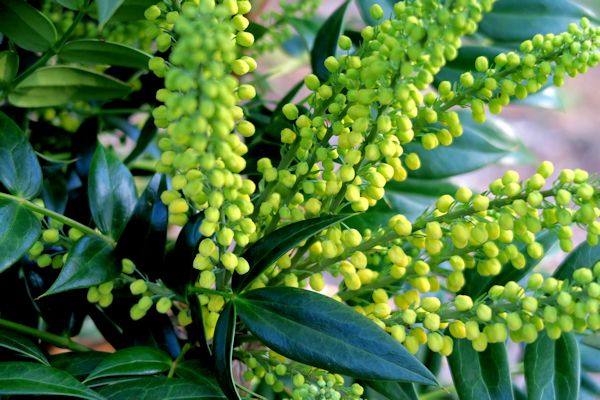
This hybrid Mahonia is actually formed from a cross between Mahonia aquifolia and Berberis sargentii, with improved flower spikes and fruit. It cold hardy in USDA zones 6-9, and produces fragrant bright yellow blooms from late November into December.
White Barked Birch
'Whitespire' Clumping Birch (USDA zones 3-7) is even more attractive during the autumn and winter months when its beautiful white bark is prominent.
Bayard Cutting Arboretum State Park,


I hope you enjoyed This Month in the Garden for December. Be sure to stop by on the 1st. of each month as I share gardening tips, information and horticultural adventures! (Linking with: Floral FridaysMacro Monday 2Our World TuesdayTravel Tuesday, Pictorial TuesdayMy Corner of the World, Friday Photo Journal, and Image-in-ing Weekly Photo Link-Up )
~As Always...Happy Gardening! ~

Author: Lee@A Guide to Northeastern Gardening,© Copyright 2010-2020. All rights reserved.