Saturday, April 15, 2017

Garden Bloggers' Bloom Day & Foliage Follow-Up April 2017: Welcome Spring!

April 2017 Garden
April showers bring May flowers and at last the garden is alive with colorful blooms! After one of the coldest arrivals of spring, early April has brought in some rainy days, followed by sunny blue skies and 70 degree temperatures, just in time to bring the garden out of its dormancy. It is time for another Garden Bloggers' Bloom Day and Foliage Follow-up, so come along with me on a tour of my Long Island garden!
Perennial Border April
The perennial border by the back patio comes a little more to life with every passing day with the arrival of new foliage and blooms. While Crocus, Hyacinth and Daffodils are in bloom, Allium, Astilbe, Lilies, Coneflowers, Hosta and Peony start to show their new spring foliage.
Purple Crocus
Crocus is one of my favorite introductions to spring with their beautiful purple, white or yellow blooms that close by night and open by day.
Purple Crocus
The morning sunshine warms and opens the blooms, bringing cheer to start the day.
White Crocus
These white crocus are so pure and beautiful and are a welcomed sight in the spring garden. The pollen lined anthers emerge from the centers of each bloom.
Pink Hyacinth
Hyacinth blooms in shades of pink and purple become fuller with each passing day and last for weeks. As you can see, these two are right next to each other in the perennial border.
Purple Hyacinth
The hyacinths had a slow start this spring with colder than usual March temperatures, but the sudden warmer temperatures we have been experiencing have put them right back on schedule.
Miniature Daffodils
The miniature daffodils are now fully opened as they display their bright yellow, cheery blooms! The pollinators love them too!
Itoh Peony Foliage
Itoh Peony 'Bartella' is right on schedule with its sturdy new foliage which glows a pinkish-red. Voluminous yellow blooms will appear in May as foliage turns to green.
Hellebore 'Shooting Star' April
These Hellebores have been blooming non-stop in the northern garden since February. The blooms of 'Shooting Star' turn from shades of greenish white to pink.
Hellebore 'Shooting Star' April
I just planted a new member of the Hellebore family...Helleborus 'Dark and Handsome' in my garden for more winter interest. I am looking forward to it maturing and producing the unusual purplish-black blooms it is known for. Hellebores are a new favorite in the garden, for they provide interest in the wintertime as well as in early spring.
Salix caprea Pendula (Weeping Pussy Willow) April
Springtime is a delight with Salix caprea 'Pendula' (Weeping Pussy Willow). I look forward to its lovely silvery catkins that burst open, exposing yellow pollen covered anthers.
Weeping Pussy Willow April
Here is a long view of the tree and gardens behind it. The upright Western Arborvitae in the backdrop have really matured and are now approximately twenty five feet tall.
Magnolia Tree
As we move along to the northwestern section of the backyard, we approach the pool area and the Star Magnolia tree, which was planted in 1996. It has matured into quite a beauty and is filled with blooms in April.
Magnolia 'Royal Star' Bloom
The creamy white delicate blooms are magnificent against the blue sky and the sweet fragrance is evident while close up.
Magnolia 'Royal Star' Bloom
Magnolia 'Royal Star' is a hardy, cold tolerant form of Magnolia which thrives in zones 4-8 and requires full sun to partial shade. The tree stays compact when compared to others, reaching a height and width of about 10-15 feet tall by 10-12 feet wide.
Front Driveway Garden (Skylands' Golden Oriental Spruce, Coral Bark Maple, Golden Hinoki Cypress and Weeping Blue Atlas Cedar)
As we approach the front driveway garden, Golden Oriental Spruce 'Skylands' and Coral Bark Maple take front stage. The bark on the Maple can still be seen glowing red, and light green foliage will be appearing soon as the temperatures warm.
Spirea 'Magic Carpet'  Spring Foliage
Spirea 'Magic Carpet' has its foliage starting to appear! Magic Carpet Spirea is hardy in zones 4-9 and displays colorful foliage that starts off as a burnished red in spring and fades to a bright golden hue  in summer. In fall, the foliage turns to russet red and finally bronze. Bright pink blooms adorn the shrub throughout the summer months.
Forthysia
As we move along the front yard, across on the median is the Forthysia I planted years ago. It has now matured and I enjoy looking out the front window at its vibrant yellow blooms each spring.
Violas for April
Violas are a sign that spring has arrived and of course every year I visit the local nursery on opening day to purchase these lovely little blooms. They will even re-seed themselves in my garden occasionally when the conditions are right.

Welcome to Our Garden!
Every garden needs a little whimsy. This little welcome sign resides in the herb garden...and this garden helper tends to the back pool area, bringing joy to all who encounter him.

Garden Whimsy
Spring Planter
Spring is bountiful with all its colorful blooms. Author Barbara Winkler quotes, "Every gardener knows under the cloak of winter lies a miracle...a seed waiting to sprout, a bulb opening to light, a bud straining to unfurl. And the anticipation nurtures our dreams." Part of the beauty of winter is the anticipation of spring and the excitement of awaiting its first blooms!
First Spring Robin!
April 2017 Garden

I hope you enjoyed your stroll through my April garden. Special thanks go out to our hostesses Carol at May Dreams Gardens, who makes it possible to see blooms on the 15th of every month with her meme Garden Bloggers' Bloom Day and Pam at Digging for hosting Foliage Follow-Up. I am also linking with some other wonderful hosts and hostesses at Today's Flowers, Floral Fridays, Macro Monday 2, and Nature Notes at Rambling Woods. Also check out Garden Bloggers' Foliage Day at Creating my own garden of the Hesperides.

Gardening season is here! Have you had a chance to check out my books? If not, you can see my author page with links to previews of both books here. The first, A Guide to Northeastern Gardening focuses on specific types of gardens with plant recommendations and maintenance tips to keep your garden looking its best. The second book, Landscape Design Combinations goes into greater detail, teaching the concepts of design, while offering a multitude of garden plans with numbering and detailed descriptions of each plant suggested. If you have read either A Guide to Northeastern Gardening or Landscape Design Combinations and found them to be useful, please consider leaving a brief review. Reviews help a book get noticed and I would really appreciate your help! Best wishes for a wonderful and successful gardening season, and I hope to inspire you!
Author: Lee@A Guide to Northeastern Gardening, © Copyright 2017. All rights reserved

Thursday, March 30, 2017

Color Our World Round-Up March: The Many Roles of Green in the Garden!

Banner Credit: Terri Steffes from Our Good Life
Welcome! It's time for another Color Our World Round-Up post. Each month the knowledgeable bloggers from Project Beautiful get creative by writing articles with focus on a particular color. Posts cover a multitude of topics including gardening, home remedies, decor and culinary delights. March is the month of "green", which is very fitting with the arrival of St. Patrick's Day and spring! The authors are sharing their thoughts on all the possibilities and uses of green in the garden, and not just for spring, but all year round. Simply click on the links to read each article in full.

First up for our March Round-Up is Lynee Cherot from Sensible Gardening with her delightful post on the Unexpected Green Flower. "As much as I love the riot of color in a garden, I’ve lately become intrigued and attracted to the sophistication of the uncommon green flower. The color green is prominent in nature, usually in foliage, but quite unusual as a flower color. The green of plants is produced by chlorophyll, which converts light into energy the plant can use for growth. Colorful blooms serve as attractors for pollinators which will spread the plants pollen for reproduction. Green flowers have no need for bright colors as they reproduce themselves through asexual reproduction or rely on the wind to spread themselves around." See all the various types of green blooms with their descriptions here...

Next is Susan Brandt from Blooming Secrets, who brings thoughts of green all year round with The Year in Color: Wearing of the Green. "Green seems like a most appropriate color for the month of March. In many areas of the country the grass starts growing and by the end of the month, the first official “mowing of the lawn” occurs. The Daffodils that we planted last fall begin to make an appearance and the first green shoots on many trees and shrubs become the first leaves of spring. Finally, the “wearing of the green” on St. Patrick’s Day lets us know that spring is literally right around the corner and that the “long winter’s nap” for our garden is coming to an end. Green truly takes “center stage” in the spring; the lawn and leaves dominate the early landscape, but there are other signs that green isn’t just limited to grass, shrubs and trees." Read more about the use of green in the garden here...

Garden and food blogger Terri Steffes from the Good Life shares her knowledge of how to plant a Salad Bowl Garden with her post Time to Plant the Salad Bowl! "One of my favorite spring activities is to plant the Salad Bowl.  The Salad Bowl is a huge planter that I sow several kinds of lettuce, spinach, kale and swiss chard.  It is time to plant it and I am looking forward to eating fresh greens in a few weeks! Tip #1  To speed up the process, I plant a few plants as well as seeds.  That way my crop is spread out and I get a longer run of greens.  Last year's crop was wonderful, as you can see in the picture below. Tip # 2  Use good seeds!  This year we are planting using heirloom seeds that we purchased from the Missouri Botanical Gardens.  They have a wonderful seed selection and I am eager to see if we can tell the difference between the seeds we get at the Dollar Store and the seeds were purchased from MoBot. Tip #3 We will plant 2 or so weeks before the last frost.  The soil does best when it is above 60 degrees. Sometimes we've guessed wrong about the last frost and still have had a good crop of greens. When someone tells me that they want to start gardening, this is what I tell them to start with! The seeds germinate quickly (usually within 5-10 days) and you can eat the ones that you thin out in a salad!" Read up on more salad bowl gardening tips here...

Green is a major color in Japanese Garden design. Here is my post, This Month's Color in the Garden: The Role of Green in Japanese Garden Design. "When I think of a predominately green garden, Japanese Garden style comes to mind. The color green has been a basic element in Japanese garden design over the centuries and has also been an element found in both formal and informal gardens throughout horticultural history. Greenery provides architecture in the landscape in the form of hedges, trees, shrubs, grass and moss. The color green is a neutral color, one that can be used with any other color without changing the desired effect for a space. It is the perfect combination of the basic primary colors yellow (warm, energizing) and blue (cool, calming) creating a perfect balance. Conifers which are commonly used in Japanese Garden design provide soothing shades of green and grow in a variety of structural forms for year-round interest. In Japanese Garden design, evergreens are used for their simplicity, ability to mimic the natural landscape, and to provide structure all year round. Typical plant species used in Japanese Gardens are juniper, Hinoki Cypress, pine, bamboo, maple, cherry, azalea, camellia, and iris. Moss is another element that has especially played a major role in Japanese garden design, and is regarded as a symbol of harmony, age, and tradition." Read more about Japanese Garden design here...

My Author Page
Thank you for visiting and I hope you enjoyed #PB Color Our World Round-Up for the month of March. If you are enjoying these monthly Round-Ups, please leave a comment, and do share your thoughts about the color GREEN!

Also, be sure to visit these wonderful bloggers regularly for their inspiring articles on gardening, home remedies, DIY projects, decorating, culinary delights and more! I am also linking to Floral Friday Fotos. Be sure to check out their weekly meme!

NEXT UP is This Month's Color in the Garden on the 7th, where it's all about the color yellow. Then, join me for Garden Bloggers' Bloom Day and Foliage Follow-Up each month on the 15th, and Round Up posts at the end of the month! 

Author: Lee@A Guide to Northeastern Gardening, © Copyright 2017. All rights reserved

Thursday, March 23, 2017

The Beautiful and Romantic Fern Grotto Kauai, HI

Fern Grotto, Kauai, HI
This past year my husband and I had the pleasure of re-visiting one of the most beautiful and romantic places we have ever experienced, the Fern Grotto, on the island of Kauai in Hawaii. There was a time when the Grotto was a sacred place only to be seen by Hawaiian royalty, but for the past 50 years, visitors have been allowed to travel to the site by river boat. Unusual tropical ferns grow upside down from the roof of a lava rock grotto, which was formed millions of years ago, a true geological wonder. Native Hawaiian plants and colorful exotic tropical plants provide a rain-forest atmosphere, which is cooled by the remains of an ancient waterfall. The concave rock formation forms a natural amphitheater, which is the location of many wedding ceremonies. 
Fern Grotto Kauai, HI
The Fern Grotto is part of the Wailua River State Park and access is by boat on the Wailua River. More than 60 years ago, Walter Smith, Sr. started taking visitors up the river on a small rowboat, powered by an outboard motor. Seeing the need for something better, he came up with the idea of a rear-engine system river boat, which is used by the Smith’s family Wailua River tours today. The spacious, open-air boats provide excellent views from either side during the trip upstream. The Wailua River is known as “the only navigable river” in all of Hawaii.
Smith's Family Tours, Fern Grotto Kauai, HI
The river’s fresh water pours down from Mt. Wai‘ale‘ale, one of the wettest spots on the planet. The land along the river makes up the sacred capital of ancient Kauai and the was the birthplace of the island’s royalty. The two mile ride up the Wailua River is a peaceful one in which tropical foliage and wildlife can be explored.
Rear-engine System River boat, Fern Grotto Kauai, HI
Along the way, kayaking tours can be seen, as well as an ancient Hawaiian Village.
Kayakers along Wailua River Kauai, HI
The Kamokila Hawaiian Village is a 4 acre reconstructed ancient Hawaiian village along the banks of the river. The village consists of thatched huts and houses, including an ancient canoe house, chief's assembly and doctor's house. Story boards and artifacts are located around the grounds to explain ancient Hawaiian life. Our destination is just a few minutes away.
Kamokila Hawaiian Village Along Wailua River Kauai, HI
Once docked, a short walk through the tropical rain forest leads visitors to the beautiful Fern Grotto. Already, the memories started to come back.
Fern Grotto Kauai, HI
There is an abundance of both indigenous and introduced tropical plants along the walk, including Hawaiian Ti Plant, Torch Ginger, Shampoo Ginger, Bird of Paradise, philodendron, bamboo and a variety of palms. Magnificent aerial roots came down from the trees above.
Fern Grotto, Kauai, HI
A non-invasive form of clumping bamboo can be seen along the path. This type of bamboo exists in many of the gardens on the island.
Clumping Bamboo, Fern Grotto Kauai, HI
Tropical plants surrounded the walkway from all directions. Red Torch Ginger is a popular plant on the island. This beautiful flower is grown for its ornamental value.
Red Torch Ginger, Fern Grotto, Kauai, HI
While following the path, even more beauty can be admired. Grown for its ornamental value, Beehive Ginger can grow to over 6 feet in height with one foot long leaves. 
Beehive Ginger, Fern Grotto, Kauai, HI

Its bracts arise from the ground and can range in color from chocolate to golden and pink, resembling the shape of a beehive. The true flowers are insignificant white blooms that appear in between the bracts.
Shampoo Ginger, Fern Grotto, Kauai, HI
Near the end of the path is Zingiber zerumbet (Awapuhi).  It is named Shampoo ginger, or 'awapuhi kuahiwi' and may be recognized as the name of a familiar brand of shampoo made by Paul Mitchell. Awapuhi was introduced to Hawaii by early Polynesians and includes earlier uses with the leaves being used as flavoring for foods and rhizomes and leaves being used for medicinal purposes. 
Path through rain forest to Fern Grotto Kauai, HI
As we approached the grotto, a joyous feeling came upon me, as we had finally made it back to this wonderful place after so many years.
Fern Grotto Kauai, HI

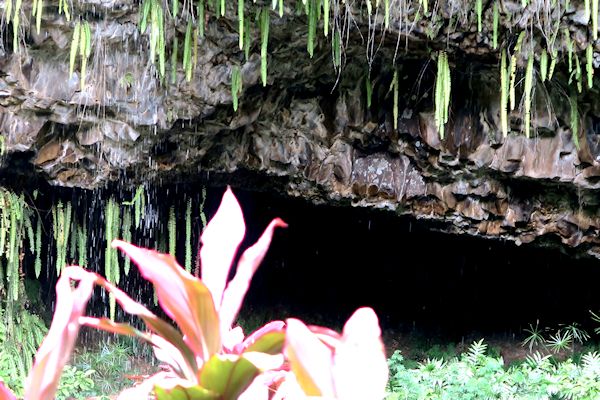
We have arrived! To give a little background, the Fern Grotto is one of nature's wonders. Native tropical Sword ferns grow upside down from the top of the 80 foot opening, with water streaming down from the top of the cave where a waterfall used to exist. The plant life in the grotto is nurtured by rainwater, which feeds from the river, beginning on the slopes of Mount Waialeale, 20 miles inland. The 5,000-foot mountain averages 450 inches of rain per year, which comes down into the grotto.
Sword Fern and Ti Plant Fern Grotto Kauai, HI

The falling water from the river can be seen from the visitor platform facing the grotto.
Fern Grotto Kauai, HI

In 1992, the Fern Grotto was nearly destroyed when the island of Kauai was hit by Hurricane Iniki. Most of the ferns hanging from the grotto were torn from the rocks and the grotto is still rebounding. We were pleased to see that much of the vegetation had returned over the years and the grotto still remains one of the most popular and beautiful spots on the island. Even though visitors can no longer stand inside the grotto, today it can be viewed from the designated observation deck. 

Hawaiian Wedding Song, Fern Grotto Kauai, HI
In April of 2006, the grotto was hit again by severe rains that caused rocks to fall from the ceiling onto the viewing area below, causing the area to have to close. The Grotto was reopened in 2007 following artificial reinforcement of the rock walls and installation of ramps to access to the area.
Hawaiian Wedding Song, Fern Grotto Kauai, HI
Up until 2006, weddings were performed within the grotto, but due to the damage, they now they take place on the observation deck facing the amazing feature. We got a feel for how a wedding ceremony would be there, as we listened to water falling from the top of the fern-lined cave, while being serenaded by the beautiful and well known Hawaiian Wedding song.
Aerial Roots Fern Grotto Kauai, HI

While standing in silent awe, we could not get over the beauty of this magical place. It was as we had remembered, with cascading aerial roots and three to five foot long tropical ferns descending from the roof of the grotto. Close to the platform were Hawaiian Ti Plants, believed to bring good luck
Fern Grotto Kauai, HI 2016

It started to gently rain, which seemed to make the grotto even more magical. We were signaled by the tour guide that is was time to go. I could have stood there all day.
Ravenala madagascariensis (Traveler's palm or Peacock Palm) Fern Grotto Kauai, HI


One the way back, we viewed Peacock Palm, a favorite of mine. Peacock Palm is not really a palm at all, but rather belongs to the genus Strelitzia, which is a relative of the Bird of Paradise. If you have ever seen a Bird of Paradise flower, the resemblance is remarkable.
Philodendron along path at Fern Grotto Kauai, HI

Philodendron, introduced to the islands many years ago, have grown freely and become invasive due to the perfect conditions of temperature and rainfall. Philodendron can be seen along this pathway to the left, climbing up the trees.
Fern Grotto Kauai, HI

I believe this is another variety of ginger. The color is striking and adds to the beauty of this place!
Departing Fern Grotto Kauai, HI

We have now arrived back to the river boat and the captain is ready for the trip back. 
Boat Ride Back from Fern Grotto Kauai, HI


On the boat ride back, Hawaiian singers play a variety of island songs, including Blue Hawaii, as Hula dancers sway to the music. Even a fun hula lesson was taught to the passengers as we approached the shore. After a fun day, we say "A hui hou", or good-bye and until we meet again.
Fern Grotto, Kauai, HI

It was a very special day as memories flooded our minds...memories of our honeymoon vacation to this very spot back in 1982, when the grotto was lush and undamaged from the dangerous winds of hurricane Iniki. We were part of a privileged group who had the experience of standing inside the actual grotto and feeling the mist from the water that came from above. We had heard stories that the grotto just wasn't the same after the storm, but it has recovered quite well, and the whole experience was just as wonderful as we had remembered.

For more information on the Fern Grotto visit Smith's Family Tours, Hawaii.

Linking with Our World TuesdayFloral Friday Photos and Image-in-ing Photo Link-Up.

As Always...Happy Gardening!

Author: Lee@A Guide to Northeastern Gardening, © Copyright 2017. All rights reserved