Showing posts with label perennials. Show all posts

Saturday, January 1, 2022

2021 Long Island Garden: Year in Review

2021 Long Island Garden Year in Review
As you read this, it is a new year...that of 2022! It is a time for reflection, memories of times past and new adventures to look forward to. As I look back, I am a thankful for the support of family and friends and also for the relationships I have built over the years with you...my colleagues. As with many, the garden has become an even more important necessity of life, bringing purpose, tranquility and peace. Here is a quick look back of the year past in my zone 7 Long Island garden with hopes and dreams for the future. For full posts, click on the individual links under each photo. I hope you enjoy your visit.
January
The new gardening year came in like a lamb with some of the mildest temperatures I can remember for January. While the structure of evergreens and deciduous trees, berries and seed heads added interest to the landscape, blooms of Hellebore 'Shooting Star' were already underway to get the gardening season to a start. It appeared like it was going to be a mild winter.
February
Like flipping a light switch, the mild temperatures of January turned to cold in February, and the garden transformed into a winter wonderland through a series of snowfalls, followed by periods of thawing and more snow. The first significant snowfall of the year came on the 1st, lasted into the 2nd and dwindled off to flurries on the 3rd, bringing  a foot of snow to the island. Another storm came on the 7th (Super Bowl Sunday) bringing another 6-8 inches. There have been two more snowfalls, keeping the garden under a cloak of white, with more on the way. 
March
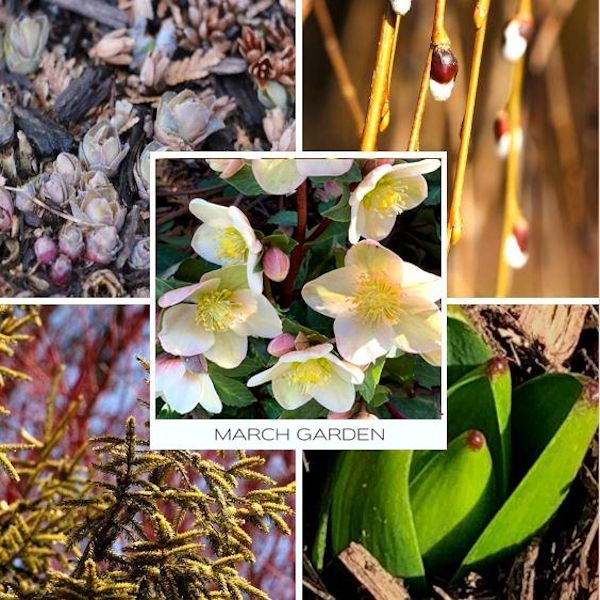
What a difference a month makes! While the month of February was one snow storm after another, the month of March came in like a lamb on the 1st. The announcement of the "windy month" here in the northeast was made on the 2nd and 3rd as winds gusted up to 50 mph, reminding us that March is an unpredictable month weather wise. The remainder of the month brought back thoughts of winter, followed by temperatures in the upper 50's to low 60's by the end of  the month, and the Hellebores kept right on blooming, while Pussy Willow catkins started to appear!
April
The month of April started of cooler than usual, bringing welcomed sunny skies and temperatures in the upper 50's, reaching into the lower 60's by the end of the month. Blooms of Crocus, Hyacinths, Daffodils, Magnolia, Flowering Plum and Forsythia graced the garden along with the remaining blooms of Hellebores. Despite the cooler temperatures, Spring had arrived!
May
The long awaited month of May brought the garden to life with blooms and color everywhere. After a cold and snowy winter and cool spring, May brought temperatures in the mid-60's to low 70's, which is ideal for working outdoors and spending time in the garden. The horticultural industry also came to life, bringing long hours, so the perfect way to start or end the day would be to take a stroll in the garden to take in the blooms of  Kwanzan Cherry, Azalea, Eastern Redbud, Viburnum, and Salvia. One could say...life was good.
June
As June rolled around, daytime temperatures settled into the mid to upper 70's to mid-80's, and the garden was alive with blooms everywhere! It was a time for Flowering Dogwood, Irises, Knock Out Roses, Viburnum, Rhododendron, Weigela, Peony, Spirea, Daylilies, Veronica and Allium to be in their element. It was one of the most plentiful spring gardens I can remember, which continued right into autumn. The garden continued to thrive and bring so much joy.
July
The garden continued to thrive as the month of July added the blooms of Hydrangea, Hosta, Rudbeckia, Echibeckia, Sammy Russell Daylily and Stargazer Lily, along with continuing blooms of Knock Out Roses, Coreopsis, Salvia and Nepeta. Temperatures continued to be comfortable for the most part, remaining in the mid-80's with a few days here and there in the 90's. 
August
By August the "dog days" of summer had arrived, with temperatures in the 80's to 90's accompanied by lots of humidity. The gardens did love it though, because the conditions were optimal for keeping the blooms coming. It was time for Crape Myrtle, panicle Hydrangea 'Tardiva', Platycodon and Sedum to join in. 
September
By September, the temperatures had started moderating into a comfortable mid to upper 70's, with a slight feeling of autumn in the air. While some of the mid-summer blooms continued their display, the next set of seasonal interest was underway. Sedum, Liriope and panicle hydrangea now took center stage while Dogwood had produced its bright red fruit and St. John's Wort its colorful berries. Montauk Daisy had set its buds for blooms the following month. 
October
Autumn had arrived and the October garden had started to change as temperatures moderated into the upper 60's to low 70's, with a true feeling of fall in the air. As blooms of Knock Out Rose, Platycodon, Salvia, Echinacea and Liriope continued to hang on, Montauk Daisies had started their display and ornamental grasses showed their plumes. The surrounding foliage displayed shades of golden and orange accents. 
November
Autumn is a wonderful time of year, as the daytime temperatures in November had moderated into the 50's and 60's. With a few rainfalls and morning frosts, the landscape had transitioned into an array of autumn colors. Blooms still continued in the garden since it had been unusually mild for this time of year.
December
It's been a long time since I remember a December which had been so mild, but that doesn't mean that nature can't throw us some surprises! The month of December brought unusually warm temperatures in the 50's all the way up until just a week before Christmas and then on Christmas Eve morning, we woke up to a coating of glistening white snow covering the landscape. I had the whole month for venturing out into the garden without a winter coat, which I treasure, and now it's starting to look like winter. Now that it got colder, the walks will be much shorter, but I will continue to venture outwards until spring comes. On that note...here's to new beginnings and to a very happy and healthy 2022 to you and your family! 

Thursday, October 1, 2020

Indoor and Outdoor Gardening With Succulents

Gardening with Succulents
Welcome to This Month in the Garden! If you are looking for a drought tolerant, easy to grow, low maintenance plant for your indoor or outdoor garden, the world of succulents can open up a whole new avenue for you. Over the years as an avid gardener and landscape designer, I have discovered the limitless number of varieties of succulents available in today's market, with many new cultivars emerging yearly. While some of these may already be familiar to you, I am hoping to introduce some new species along the way! 
 Sempervivum Kalinda

The first on the list is Sempervivum Kalinda, also referred to as Hens & Chicks. Hardy in USDA zones 5a-9b, this mat-forming succulent displays tight, evergreen rosettes of apple-green leaves highlighted by a pinkish-red hue at their base.  During summer, showy starry, pink flowers rise on a stalk above the plant. Sempervivum Kalinda prefers to be planted in full sunlight in a well-drained soil and will withstand temperatures to 20 degrees Fahrenheit (28.9 Celsius).

Sedum Nusabaumerianum 

Sedum Nusabaumerianum (otherwise known as Coppertone Sedum) is perfect for a rock garden in warmer climates or can be used as an annual or houseplant in cooler climates. Hardy in USDA zone 10a, this variety of sedum will withstand temperatures at a minimum of 30 degrees Fahrenheit (-1 degrees Celsius). Sedum Nusabaumerianum grows to a height and width of 3 inches high by up to 24 inches wide. Plant this variety of sedum in full sun and a well-drained soil. It can easily be propagated through seed, leaf and stem cuttings. 

Sedum morganianum (Burro's Tail)

Sedum morganianum (otherwise known as the donkey tail or burro's tail) is a species of flowering plant in the family Crassulaceae, native to southern Mexico and Honduras. This succulent is recognized by its pale blue-green trailing stems which can grow up to 60 centimeters in length and production of  terminal pink to red flowers in summer when grown outside.The leaves overlap on the stems in such a way that they look as though they have been braided, reminiscent of a donkey’s tail, which is how this plant gained its common name. Sedum morganianum is hardy in USDA zones 9-11 and can be grown in full sun and a well-drained soil indoors or outdoors in warmer climates. Plant in a container to allow the interesting foliage to cascade over the side.
Sempervivum Commander

Sempervivum Commander, another variety of Hens & Chicks is a hardy perennial, cold hardy in USDA zones 4-9. This mat-forming perennial forms attractive purplish-green rosettes on a 4 inch (10 centimeter) wide plant. The mother plant spreads in all directions to produce offsets (chicks). Plant Sempervivum Commander in full sun in a well-drained soil.

Succulent Planter 

Sempervivum and Sedum can be planted outdoors (depending on the species and hardiness) or indoors or in a decorative planter such as the one shown here. This colorful display adds interest on the patio throughout the summer season and can be overwintered indoors in a southern exposure location. The four varieties of Sempervivum and Sedum mentioned above are just a handful of the numerous colorful and low maintenance cultivars available.

Sedum seleboldii 'Mediovariegatum' 

This attractive perennial is Sedum seleboldii 'Mediovariegatum'. Hardy is USDA zones 4-9, this outstanding plant displays slate green foliage with creamy white centers on a 4-inch high by 8-inch wide plant. Plant Sedum seleboldii 'Mediovariegatum' in full sun to partial shade in a fertile, well-drained soil. This low-lying perennial grows as a rounded mound, sending out horizontal branches in all directions from a central crown. Bright pink star-shaped flowers are produced in summer. 

  Sempervivum tectorum (Hens & Chicks)
Sempervivum tectorum (another variety of Hens & Chicks) are a versatile perennial hardy in USDA zones 3-11 that form clusters of rosettes with the parent rosette being the referred to as the "hen" and baby offsets being refereed to as the "chicks". Sempervivum tectorum can be planted in alpine and rock gardens or in a planter as seen here. Plant Hens & Chicks in full sun and in a well-drained soil for best results. In late summer, mature plants will send up stalks of large pink and white blooms.
Succulent Planter
Here is another planter with a variety of succulents for summer interest. I enjoy changing the combinations around each season.
Sedum rupestre 'Angelina' 
Hardy in USDA zones 5-8, Sedum rupestre 'Angelina' produces a low growing carpet of chartruse-yellow needle-like foliage that reaches 4-6 inches high by 1-2 feet wide. Plant Sedum rupestre 'Angelina' is full sun and a well-drained soil. This evergreen groundcover or edging plant is drought tolerant and virtually maintenance free.
Sedum tatarinowii 'Thundercloud'

Sedum tatarinowii 'Thundercloud' is a variety of groundcover sedum I discovered just two years ago. Native to the Far East, Sedum tatarinowii 'Thundercloud' is hardy in USDA zones 4-9 and displays heavily serrated gray-green foliage with an abundance of white cloud-like blooms in late summer. Plant this perennial in full sun and a well-drained soil in an alpine garden or drought tolerant border. Sedum tatarinowii 'Thundercloud' grows 8-10 inches high by 14-16 inches wide.

Sedum Sunsparkler Lime Twister
This attractive succulent is Sedum Sunsparkler Lime Twister. Sedum Sunsparkler Lime Twister is hardy in USDA zones 4-9 and displays a dense carpet of cream and green variegated foliage with rose flower clusters which are produced in late summer. Plant this perennial in full to partial sun in a well-drained soil. Sedum Sunsparkler Lime Twister is suitable for alpine and rock gardens and is known to attract butterflies and hummingbirds.
Succulent Planter
This planter is all about combining shades of green and is awaiting some new additions. Occasionally, I will add cuttings that will quickly root themselves. 
Sedum acre aurea

Sedum acre aurea (also known as Golden Stonecrop) forms a low lying (2-3 inch high) mat of golden foliage that is ideal for planting in crevices and rock gardens. Hardy in USDA zones 4-9b, this perennial will grow in the most adverse conditions, tolerating a range of soil types. Sedum acre aurea thrives in full sun and a well-drained soil and requires little to no maintenance.

Gardening with Succulents

I hope you enjoyed This Month in the Garden for October, and be sure to stop by on the 1st. and 15th. of each month as I continue to share gardening tips, information and horticultural adventures! (Linking with: Floral Fridays, Macro Monday 2, Ruby Tuesday and Image-in-ing Weekly Photo Link-Up.

For more information on succulents, there is a very informative site called Succulent Market. Visit their various collections and blog for everything you need to know about growing these beautiful plants.

 For gardening info and tips: Visit my Author Page/Purchase My Books  ðŸ˜Š
Author: Lee@A Guide to Northeastern Gardening,© Copyright 2010-2020. All rights reserved. 

Monday, April 1, 2019

This Month in the Garden: Proven Winners Harvest Edibles New for 2019-Better Than Ever!

Proven Winners Harvest Edible Collection New for 2019
Proven Winners has a new line of edibles coming out in 2019, which are a must have! The first, 'Garden Gem' Tomato (Lycopersicon esculentum), is one of the most productive and delicious tomatoes I have ever experienced. Developed by an accomplished scientist, this semi-determinate, snack-size tomato has been a breakthrough. It was developed to have a traditional taste, with modern disease resistance and high fruit yield. The plants produce a firm, juicy fruit with the sweetness of a cherry tomato at a size equivalent to that of a plum-tomato. This cultivar will continue to produce tomatoes for the entire season, while thriving in both heat and humidity. Fruit ripens in about 55 days.
Garden Gem' Tomato (Lycopersicon esculentum) Photo By Proven Winners
TIPS: While this variety will grow to be a large plant (30-42") in the landscape, when grown in a container they will maintain a compact size, while producing an endless supply of fruit. I would recommend at least a twelve-inch container with drainage holes per plant, using either a cage or stakes to keep the plant upright. Grow in full sun in a well-drained soil and do not allow the plant to dry out. During the heat of summer, I would recommend watering daily. Apply a well-balanced fertilizer regularly.
Next is Strawberry 'Berried Treasure' (Red Fragaria ananassa). This new cultivar of strawberry is highly ornamental with a more compact appearance, while producing tasty fruit. Plants grow to a height and width of approximately 12-16 inches tall by 18-24 inches wide and should be grown in full sun. The semi-double red flowers that cover the plant are attractive and will add a nice touch to the garden. 'Berried Treasure' can be grown as a perennial in USDA hardiness zones 4-9 as either a container plant or in the garden. I enjoyed the lovely flowers on this cultivar as much as the fruit!
Strawberry Berried Treasure(Red Fragaria ananassa) Photo by Proven Winners
TIPS: To keep your 'Berried Treasure' Strawberries looking their best, it is recommended to remove spent flowers. Soil should be kept evenly moist and a regular fertilization program will produce the most prolific crop.

The third new edible I found to be a hit is Basil 'Amazel' (Ocimum hybrid) with its aromatic leaves and excellent flavor. Unlike most Basil, which are susceptible to downy mildew, 'Amazel' is the first Italian sweet basil that has excellent resistance. Amazel is seed sterile variety that continues to produce leaves and shoots even after flower initiation, keeping it going for the entire season. Plants grow to approximately 20-36 inches high by 12-20 inches wide and can be grown in containers or in the garden. I found this variety to be more prolific, hardier and longer lasting.
Basil 'Amazel' (Ocimum hybrid) Photo by Proven Winners
TIPS: For best flavor and leaf production, grow Basil in full sun and keep moderately moist. Harvest or pinch back regularly to keep full and promote fresh tender growth. Harvest sprays of leaves by cutting stems just above two new sprouting lateral branches.

For more information and purchase, visit the Proven Winners website for a huge selection of perennials, annuals, edibles and shrubs. Be on the look out for these new selections in 2019!


Be sure to stop by on the 1st. of each month for This Month in the Garden, as I share gardening tips, information and horticultural adventures! 

As Always...Happy Gardening!

Author: Lee@A Guide to Northeastern Gardening,©Copyright 2010-2019. All rights reserved.

Saturday, December 1, 2018

This Month in the Garden: Growing Air Plants

Growing and Maintaining Air Plants 
Air plants, known as Tillandsia, have become a preferred plant for those leading a busy lifestyle, while looking for a low maintenance houseplant to enjoy. Tillandsia is the largest genus in the bromeliad family, consisting of approximately 650 species of flowering evergreen plants, native to the forests, mountains and deserts of Central and South America, southern United States and the West Indies. Tillandsia are ephiphytes, meaning that they grow without soil. In their native environment, air plants find footing on tree branches, where their roots act as an anchor to give the plant support. The leaves of Tillandsia are covered with specialized scales known as trichomes, which are responsible for absorbing moisture and nutrients from the atmosphere, decaying bark and insect matter. All healthy Tillandsias have the potential to bloom with flowers that are as interesting as the plants themselves. 
Air Plant  Terrarium Garden
LOCATION: Tillandsia prefer temperatures somewhere between 60-90 degrees with high humidity and bright, filtered sunlight, as in an east or west-facing window, or beneath a skylight. When growing air plants indoors, many homeowners take advantage of the moisture in a bathroom setting to locate their humidity loving plants. If growing Tillandsia outdoors, a screened porch or lanai can provide the filtered sunlight they prefer. These plants are often grown in a terrarium-like setting, as in a glass vase or ball, which is specifically designed with openings for air circulation. For a decorative look, Tillandsia are also grown attached to a piece of driftwood, in a rock bed or inside a sea shell. You can enjoy creating an arrangement for your plants and the design possibilities are endless!
Tillandsia Bloom
WATERING: Proper watering is very important with these plants. While they are very low maintenance, it is important to provide moisture to prevent drying out. The most successful practice has been to completely submerge your plant in a dish of water for several hours every 7-10 days. During this time, the plant will only absorb the amount of water that it needs. When removing the plant from its soaking, gently shake off excess water from the center of the plant to prevent rotting. Daily misting provides moisture as well, but not enough for survival, and excess water lying on the foliage can rot out the plant. When watering, use rain water, bottled or distilled water. Hard water from the tap contains elements that can eventually clog the trichomes on air plant leaves. When you first get your plant, develop a watering schedule by monitoring the plant's color and appearance before and after watering and be observant of changes. Leaves on a drought-stressed plant may curl under, fade in color or turn brown, while browning on the bottom of a plant indicates over-watering. Rinse plants verses soaking when flowering to protect their delicate blooms.
Tillandsia Foliage 
FERTILIZING: To fertilize your Tillandsia, use a water-soluble fertilizer that is meant for ephiphytes, bromeliads or air plants and fertilize once or twice monthly. These fertilizers contain nitrogen in a form that air plant leaves can absorb. Before submerging your air plant, add the fertilizer to the water first following the dosage amount on the packaging. Generally, air plants with smooth, glossy leaves are "mesic" types that originate from shaded rain and cloud forests, where water is abundant. They have less pronounced trichomes to protect them from drying and require more frequent watering and fertilization. Leaves appearing "fuzzy" with feathery white, silvery or dusty coatings indicate "xeric" types that come from sunny, dry climates. Their more pronounced trichomes collect maximum water and hold it for use during dry periods; therefore, less watering and fertilization are required. Through basic observation, you will get to know your plants. Next time you are seeking something different, with no soil involved, try some air plants. By following these simple guidelines, Tillandsia can be an interesting, low maintenance and fun plant addition for your indoor or outdoor space.

As Always...Happy Gardening!

Author: Lee@A Guide to Northeastern Gardening, © Copyright 2018. All rights reserved

Friday, December 1, 2017

This Month in the Garden: Winter is Coming: Tips to Preserve Your Garden During the Cold Months

It has been a spookidly warm autumn but do not be lulled into a false sense of security; irrespective of what went before, winter brings wild winds and cold weather. So late autumn is a good time to take some elementary, precautionary measures. In doing so, come spring, you and your garden will be ahead of the game.

It is worth pondering the fate of birds and insects in your garden during these inhospitable months. Keep the water in your birdbath clean and topped off, ditto the bird feeders. If there is a quiet spot out of sight of tidy-minded passers-by, you could consider making it hibernation city. Just collect old logs, bundles of sticks, leaves and branches into an untidy heap to encourage hibernating wildlife. This heap will then act as a magnet for pollinating insects and pest predators. At the end of winter, they wake up and supplement the population of good guys in the garden.

There is also cutting down and tidying to be done. Most urgent is to rake up leaves that make paths slippery and kill patches of lawn. You might want to think about pressure washing concrete/stone paths – they may become slippery if you don’t. Small leaves from deciduous trees can be put in a heap where they turn into leaf mould.  Rose and fruit tree leaves tend to harbour disease and need to be binned or burned. Any structural shrubs or trees which have grown wayward branches need pruning back into the shape you want. Branches should not cross, otherwise they may rub and create a wound. At the same time remove any diseased, damaged or dead growth.

Never prune when the weather is freezing or when sub-zero temperatures are expected within 48 hours. Subject to this overriding rule, hedges can have a very tiny trim where they have sprouted before the frosts come, but allow enough time for new growth to harden off. While you are clipping your hedging, whenever your arms get tired, have a little weeding moment at the base.

Cut back perennials that look lost and faded but keep the ones that look good shrouded in frost. Compost all these trimmings, but before you do so, empty your compost bins of last year's well-rotted compost and use that on the beds once you have cut everything back. The soil looks much better with a layer of black compost as mulch, weed suppressant and joy for worms all at the same time - how is that for multi-tasking?

Cut large rose bushes back by about a third. Don't bother with careful pruning, if you have lots you can do this with a hedge trimmer.  Proper rose pruning happens in early spring.  This quick 'haircut' is to reduce the chance of your roses being rocked around by the winds.  Stray shoots from climbers and ramblers should be tied in while they remain pliant.

Soft fruit bushes (such as currants and gooseberry) will need pruning as well.  This is a fair-sized topic that you can find a good article on the subject here which will guide you through the intricacies of old and new wood and fruiting spurs.  While speaking about fruit, nothing will ripen any further so any remaining fruit on the trees should be picked and stored, fed to the birds, or composted.

Some fruit trees will need pruning in winter. The golden rule here is you can prune any fruit that has a pip (apples, pears etc) and you cannot prune any fruit that has stones (plums, cherries etc). While you are there, check stakes and ties on your trees to prevent strangulation and apply tree grease. November is the best time to prune walnut trees- they bleed less. 

Evergreens are the ones to watch in winter. They continue to transpire and need watering if young or newly planted. 3 cm (1.18 inches) of rainfall a week is necessary, and you need to supply the shortfall. It is the drying wind that is so pernicious. A protective, temporary barrier will stop this. Such a windbreak is an idea for any newly planted hedge in an exposed position.

Pots can be planted with pansies, ornamental cabbage and dwarf boxwood for winter interest. Any pot that you leave outside which is not truly frost proof may need wrapping in bubble wrap in severe frosts.

The virtue of all this tidying is that you actually get to see your fences/ trellis/ greenhouse again, presenting the perfect opportunity for repairs, cleaning of glass (don't forget the roof), seed trays, application of wood preservative to exposed timber and decking-and crucially clearing leaves from gutters and down-pipes. If these empty into water butts then these should (I know, I know) have an annual scrub to remove algae. Winter is the time because they have a chance to fill again before dry weather next year. Outdoor furniture needs to be taken indoors or wrapped with tarpaulin. Genuinely outdoor furniture can be titivated with a clean and, where relevant, a generous application of reviving teak or furniture oil. Machinery can be serviced and tools oiled and sharpened before being put away.

All that is done you can go inside and, instead of putting your feet up, start wrapping Christmas presents!

The contributing author of this article, Julian de Bosdari is a garden writer and owner of Ashridge Trees, a UK based gardening site that specializes in hedging and hedging plants. The site is full of valuable information, and if your visit their advice page, you will encounter numerous articles on all facets of gardening.

As Always...Happy Gardening!

Lee@A Guide to Northeastern Gardening, © Copyright 2017. All rights reserved

Thursday, March 30, 2017

Color Our World Round-Up March: The Many Roles of Green in the Garden!

Banner Credit: Terri Steffes from Our Good Life
Welcome! It's time for another Color Our World Round-Up post. Each month the knowledgeable bloggers from Project Beautiful get creative by writing articles with focus on a particular color. Posts cover a multitude of topics including gardening, home remedies, decor and culinary delights. March is the month of "green", which is very fitting with the arrival of St. Patrick's Day and spring! The authors are sharing their thoughts on all the possibilities and uses of green in the garden, and not just for spring, but all year round. Simply click on the links to read each article in full.

First up for our March Round-Up is Lynee Cherot from Sensible Gardening with her delightful post on the Unexpected Green Flower. "As much as I love the riot of color in a garden, I’ve lately become intrigued and attracted to the sophistication of the uncommon green flower. The color green is prominent in nature, usually in foliage, but quite unusual as a flower color. The green of plants is produced by chlorophyll, which converts light into energy the plant can use for growth. Colorful blooms serve as attractors for pollinators which will spread the plants pollen for reproduction. Green flowers have no need for bright colors as they reproduce themselves through asexual reproduction or rely on the wind to spread themselves around." See all the various types of green blooms with their descriptions here...

Next is Susan Brandt from Blooming Secrets, who brings thoughts of green all year round with The Year in Color: Wearing of the Green. "Green seems like a most appropriate color for the month of March. In many areas of the country the grass starts growing and by the end of the month, the first official “mowing of the lawn” occurs. The Daffodils that we planted last fall begin to make an appearance and the first green shoots on many trees and shrubs become the first leaves of spring. Finally, the “wearing of the green” on St. Patrick’s Day lets us know that spring is literally right around the corner and that the “long winter’s nap” for our garden is coming to an end. Green truly takes “center stage” in the spring; the lawn and leaves dominate the early landscape, but there are other signs that green isn’t just limited to grass, shrubs and trees." Read more about the use of green in the garden here...

Garden and food blogger Terri Steffes from the Good Life shares her knowledge of how to plant a Salad Bowl Garden with her post Time to Plant the Salad Bowl! "One of my favorite spring activities is to plant the Salad Bowl.  The Salad Bowl is a huge planter that I sow several kinds of lettuce, spinach, kale and swiss chard.  It is time to plant it and I am looking forward to eating fresh greens in a few weeks! Tip #1  To speed up the process, I plant a few plants as well as seeds.  That way my crop is spread out and I get a longer run of greens.  Last year's crop was wonderful, as you can see in the picture below. Tip # 2  Use good seeds!  This year we are planting using heirloom seeds that we purchased from the Missouri Botanical Gardens.  They have a wonderful seed selection and I am eager to see if we can tell the difference between the seeds we get at the Dollar Store and the seeds were purchased from MoBot. Tip #3 We will plant 2 or so weeks before the last frost.  The soil does best when it is above 60 degrees. Sometimes we've guessed wrong about the last frost and still have had a good crop of greens. When someone tells me that they want to start gardening, this is what I tell them to start with! The seeds germinate quickly (usually within 5-10 days) and you can eat the ones that you thin out in a salad!" Read up on more salad bowl gardening tips here...

Green is a major color in Japanese Garden design. Here is my post, This Month's Color in the Garden: The Role of Green in Japanese Garden Design. "When I think of a predominately green garden, Japanese Garden style comes to mind. The color green has been a basic element in Japanese garden design over the centuries and has also been an element found in both formal and informal gardens throughout horticultural history. Greenery provides architecture in the landscape in the form of hedges, trees, shrubs, grass and moss. The color green is a neutral color, one that can be used with any other color without changing the desired effect for a space. It is the perfect combination of the basic primary colors yellow (warm, energizing) and blue (cool, calming) creating a perfect balance. Conifers which are commonly used in Japanese Garden design provide soothing shades of green and grow in a variety of structural forms for year-round interest. In Japanese Garden design, evergreens are used for their simplicity, ability to mimic the natural landscape, and to provide structure all year round. Typical plant species used in Japanese Gardens are juniper, Hinoki Cypress, pine, bamboo, maple, cherry, azalea, camellia, and iris. Moss is another element that has especially played a major role in Japanese garden design, and is regarded as a symbol of harmony, age, and tradition." Read more about Japanese Garden design here...

My Author Page
Thank you for visiting and I hope you enjoyed #PB Color Our World Round-Up for the month of March. If you are enjoying these monthly Round-Ups, please leave a comment, and do share your thoughts about the color GREEN!

Also, be sure to visit these wonderful bloggers regularly for their inspiring articles on gardening, home remedies, DIY projects, decorating, culinary delights and more! I am also linking to Floral Friday Fotos. Be sure to check out their weekly meme!

NEXT UP is This Month's Color in the Garden on the 7th, where it's all about the color yellow. Then, join me for Garden Bloggers' Bloom Day and Foliage Follow-Up each month on the 15th, and Round Up posts at the end of the month! 

Author: Lee@A Guide to Northeastern Gardening, © Copyright 2017. All rights reserved