Showing posts with label deer resistant trees. Show all posts

Friday, July 1, 2011

Deer Resistant Plants in the Landscape

Deer Resistant Plants
While no plant is completely deer resistant there are several species that you can choose from that are attractive in the garden and are less desired by our four legged friends. While some plants such as hosta, arborvitae and yew are referred to as "deer candy" other selections are often avoided due to their taste, texture or aroma. The selections that I will mention are plants that provide color and interest all season long in the garden and are hardy in USDA zone 7. Many of these plants are also drought tolerant.
Spirea 'Gold Flame'
The first two "deer resistant' plants I would like to mention are Spirea and Barberry. These deciduous shrubs are both very popular for their colorful foliage, and in the case of Spirea, for its summer blooms. Barberry and Spirea are frequently used in foundation plantings, raised island beds, rock gardens and border gardens.
Barberry 'Rosy Glow'
Each cultivar comes in a variety of sizes including Barberry 'Royal Burgundy' (smaller 2-3'), Barberry 'Rosy Glow' (larger 5-6'), Spirea 'Gold Flame' (2-3'), Spirea 'Limemound'(2-3'), and Spirea 'Little Princess' (1-2') among others. These plants are also drought tolerant once established.
Buddleia 'davidii'
Our next candidate for a "deer resistant" garden is Buddleia or Butterfly Bush. A deciduous shrub, Buddleia davidii is hardy to zone 5 and produces prolific purple blooms throughout mid to late summer. There is also now a new dwarf variety 'Lo and Behold'.
Coreopsis 'Zagreb'
On the "deer resistant" perennials list is coreopsis. Coreopsis or 'Tick seed' displays beautiful daisy-like flowers throughout the entire summer and is drought tolerant once established.  It is hardy in USDA zones 4-8.
Nepeta 'Little Titch'
Nepeta 'Walkers Low' is another favorite long blooming perennial that deer do not forage on. It comes in a variety of different heights ranging from 'Mussinii' which is taller to 'Little Titch' which is a dwarf form.
Astilbe 'Sprite'
If you have a shaded area with deer try Astilbe.  Astilbe is a popular perennial that comes in a variety of sizes and colors and thrives in low light. There are many varieties of Astilbe ranging from white to pink to red and salmon. The one shown here is Astilbe 'Sprite' which is hardy in USDA zones 4-8.
Salvia 'Maynight'
Next is perennial Salvia or sage. Salvia thrives best in USDA zones 4-8, is "deer resistant" and blooms throughout the summer with regular dead-heading. There are many varieties of sage to choose from.
Peony 'Karl Rosenfeld'
Peony are another favorite of many a gardener, displaying magnificent large blooms in early spring.  Put them onto your list. They are not desired by deer and our four legged friends usually pass this one by.  Peony are hardy in USDA zones 2-8. 
Dwarf Fountain Grass 'Little Bunny'
If you enjoy having ornamental grasses in your garden they are also "deer resistant". There are many varieties of grasses to choose from including the well-known Fountain Grasses Pennisetum Alopecuroides 'Hameln' or 'Little Bunny' as well as the Maiden Grasses Miscanthus Sinensis 'Gracillimus' or 'Morning Light' among others.
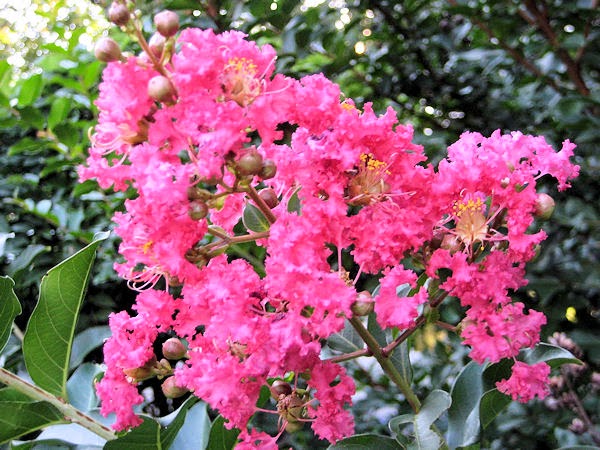
Crape Myrtle 'Sioux'
Crape Myrtle, a favorite tree in the landscape also happens to be on the deer do not eat list. Crape Myrtle once more popular in the Carolina's is now also popular in the northeast and is hardy in USDA zones 7-9. Crape Myrtle come in a variety of colors and sizes. Shown here is Crape Myrtle 'Sioux'.
Chamaecyparis 'Gold Mop'
There are various evergreens that are that can also be grown in the "deer resistant" garden. The one shown here is Chamaecyparis obtusa 'Gold Mop'. Gold Mop Cypress is a lovely golden evergreen that retains its color all year long, grows 2-3 feet in height and is hardy in zones 4-8.
Deodara Cedar 'Aurea'
Deodara Cedar is also unfavored by deer and is a beautiful focal point in the landscape. Deodara Cedar is a large pyramidal evergreen with graceful cascading branches and golden needles hardy to USDA zone 6.
Cryptomeria japonica
A beautiful evergreen for a privacy screening is Cryptomeria japonica. Shown here in the backdrop, Cryptomeria japonica 'Yoshino' is known for its soft delicate foliage (not liked by deer) and golden-green coloring. Cryptomeria is hardy to USDA zone 5 and is available in many varieties ranging from dark green to golden.
Ilex 'Nellie Stevens' (Nellie Stevens Holly)
Next on the list are Ilex or the hollies. For the most part deer do not prefer most hollies. I have seen cases where the deer are hungry enough that they will nibble on the new spring growth of  the plant but will not touch the more mature inner growth. The more jagged the leaf on the variety of holly you choose the better.
Vibernum 'Carlcephalum'
Another lovely plant, Vibernum, displays white flowers in early spring and is a nice addition to the woodland garden. Vibernum are hardy to USDA zones 4-8 and come in a variety of types and sizes.

As mentioned in the beginning of this article, no plant is completely "deer resistant". If the deer are hungry enough they will tend to nibble on plants in the landscape, but there are some plants that are much less attractive to deer for various reasons. The species of plants I have mentioned in this article are the plants I have found to be most successful in the garden over the years as a designer. I hope you find this list to be helpful and informative. 

*Update (2015):  Barberry has been labeled as invasive in some states. Alternatives for dwarf barberry are Dwarf Weigela 'Spilled Wine', 'Wine and Roses'', 'Midnight Wine' or 'Fine Wine'. Alternatives for regular sized Barberry are Eastern Ninebark 'Summer Wine' or Purple Smoke Bush. 


As Always...Happy Gardening!


Author: Lee@A Guide to Northeastern Gardening,© Copyright 2011, All rights reserved.

Wednesday, February 9, 2011

Weeping Blue Atlas Cedar-Focal Point in the Garden

Weeping Blue Atlas Cedar (Cedrus atlantica 'Glauca Pendula') 
One of my all time favorite evergreens in the landscape is Weeping Blue Atlas Cedar, Cedrus atlantica ‘Glauca Pendula’. Weeping Blue Atlas Cedar is a conical evergreen known for its graceful flowing nature and beautiful silvery blue-green needles.  It is a focal point and specimen in the garden and quite the conversation piece for its shape and irregular weeping pattern resembling a cascading waterfall. Cedrus atlantica ‘Glauca Pendula’ is hardy to USDA Zones 6-8, prefers an acidic-slightly alkaline well-drained loam soil and location in full sun (6-8 hours sunlight). They are tolerant of many soil types but will not fair well in soils with poor drainage such as clay.  
Weeping Blue Atlas Cedar Zones 6-8
Use this beautiful evergreen as a specimen planting where it will not be crowded and has plenty of room to spread. Depending on the structure of your tree it can reach a height of 10-15 feet and a width of 8-10 feet across and would be difficult to transplant once established. As your tree matures its cascading branches will drape down to the ground giving your tree grace and charm.

Weeping Blue Atlas Cedar (Cedrus atlantica 'Glauca Pendula')
Generally the trunk of a Weeping Blue Atlas Cedar can be trained as a spiral, grown horizontally or in a more upright form; therefore, they can be purchased at a variety of heights and shapes and will stay around the height at which they were trained. To prune the tree wait until late October-early November (mid-Fall) to clip off any weak or bent branches which are resting on the ground to an inch or two above the soil. The branches look best when cascading to the ground but it is recommended to perform this routine pruning in order to prevent any fungal disease that may result from the branches resting on soil. Branches that reach out beyond a desired point can also be pruned back to give fullness and strength to the structure of the tree. Other than that Weeping Blue Atlas Cedar do not require much pruning.  

 Weeping Blue Atlas Cedar takes on its own unique shape.


Weeping Blue Atlas Cedar is not prone to any particular pests or diseases. Another plus is that they are also deer resistant! They do benefit from an early spring feeding and should be protected from strong winter winds. If you have clay soil break up the soil and add gypsum, which will help to improve drainage, or if the clay is very compact use a post-hole digger to dig down and add gravel to help water flow. When planting, allow this specimen plenty of room to grow so that it can reach its full potential.

If you are looking for something different, this specimen tree will highlight your landscape and bring you many years of enjoyment. Its silvery-blue needles and beautiful weeping habit make it an excellent addition as a focal point in the garden…an attribute that will only improve as your tree matures in age.  


Author: Lee@A Guide to Northeastern Gardening, © Copyright 2011. All rights reserved

Wednesday, August 4, 2010

Crape Myrtle-A Personal Favorite For Long Blooming Time and Lasting Color


Crape Myrtle Varieties
Known more as a familiar planting of the Southeast the new hybridized form of Crape Myrtle (Lagerstroemia indica) can be successfully grown here in the Northeast as well as in the Northwest where the winters are harsher.  These showy trees are a personal favorite of mine due to their beautiful long lasting blooms that start at the end of the summer and last well into Fall, a bloom period of approximately 120 days!   Just as other flowering trees and shrubs are reaching the end of their bloom cycle the stately Crape Myrtle 'Lagerstroemia indica' starts its spectacular show. I often use these beautiful trees as an eye catching element in my designs as they serve nicely as an anchor plant in a foundation planting or as a focal point in an island bed or backyard garden.

Lagerstromeia indica 'Sioux'
There are many varieties of this beautiful tree ranging in size from ‘Pocomoke’ and ’Chickasaw’, which are dwarf varieties topping off at approximately 5 feet to ‘Natchez’ (White),‘Tuscarora’ (Coral Pink),‘Muskogee' (Lavender) and 'Catawba' (Purple) ranging at a height between 12-20 feet. A personal favorite of mine is Crape Myrtle ’Sioux’, a medium variety that ranges in height to approximately 12-15 feet. The medium-pink flowers of the ‘Sioux’ Crepe Myrtle begin late in July and last well into October and are an elegant display not to be missed. Three other varieties of Lagerstroemia worth mentioning are ‘Tonto’ and ‘Dynamite’, both known for their vibrant red flowers and medium height of 12-15 feet and 'Zuni' (Purple) at a smaller 8-9 feet in stature.


Lagerstroemia indica 'Muskogee'


HARDINESS & PRUNING: Lagerstroemia are a hardy to zones 7-9 and are “deer resistant”, meaning that deer will most likely avoid them in their diet. They grow best in full sunlight in a well-drained soil with a pH of 5.0-6.5. These trees require little to no pruning but can be pruned to maintain a more compact shape or to remove any dead branches that may result from a harsh winter.  If you are going to prune wait until late winter or early spring after the last frost. The plants are dormant in winter and any flowering occurs on new growth so pruning will encourage new flower producing branches. Remove any dead branches, suckers growing from the base or weak twiggy branches and allow strong leader branches to keep the framework of the tree.

Lagerstroemia indica 'Natchez'
TRANSPLANTING:  If you are planning on transplanting your Crape Myrtle tree the best time to transplant in the northeast is in mid April or mid September through mid October.  Roots need time to become established before the summer heat or winter cold set in. Dig a hole slightly wider than the root ball and make sure the tree sits at the height of the surface or slightly above.  Apply a layer of mulch around the tree to protect the roots and keep well watered until established.  Crape Myrtle are somewhat sensitive to cold so there may be some branch die back in the first season until the plant becomes well established. 

Lagerstroemia indica 'Tuscarora'
Depending on the preference of the grower Crape Myrtle can be planted as either a multi -trunk or singular-trunk form and can be displayed as either a shrub or tree in the landscape.  An important note worth mentioning is that Crape Myrtle (Lagerstroemia) are among the last plants to push out their new growth so if they appear to be dead at the end of winter going into spring just give them some time to come into their glory. Since they are later to push out their leaves they do benefit from an early spring feeding of a high phosphorus-lower nitrogen 5-10-5 formula to promote good foliar growth and an abundance of blooms in July-August. Crape Myrtles are not susceptible to insects or disease but as in any landscape planting they should be monitored and properly maintained to keep them in good health. 

If you are looking for a long blooming, deer resistant, low maintenance tree to add color to your garden then Crape Myrtle may be the tree for you. I for one would highly recommend this beautiful plant as a welcome addition to any formal or informal landscape.
Author: Lee@A Guide To Northeastern Gardening © Copyright 2010. All Rights Reserved.