 |
| Crape Myrtle Varieties |
Known more as a familiar planting of the Southeast the new hybridized form of Crape Myrtle (Lagerstroemia indica) can be successfully grown here in the Northeast as well as in the Northwest where the winters are harsher. These showy trees are a personal favorite of mine due to their beautiful long lasting blooms that start at the end of the summer and last well into Fall, a bloom period of approximately 120 days! Just as other flowering trees and shrubs are reaching the end of their bloom cycle the stately Crape Myrtle 'Lagerstroemia indica' starts its spectacular show. I often use these beautiful trees as an eye catching element in my designs as they serve nicely as an anchor plant in a foundation planting or as a focal point in an island bed or backyard garden.
 |
| Lagerstromeia indica 'Sioux' |
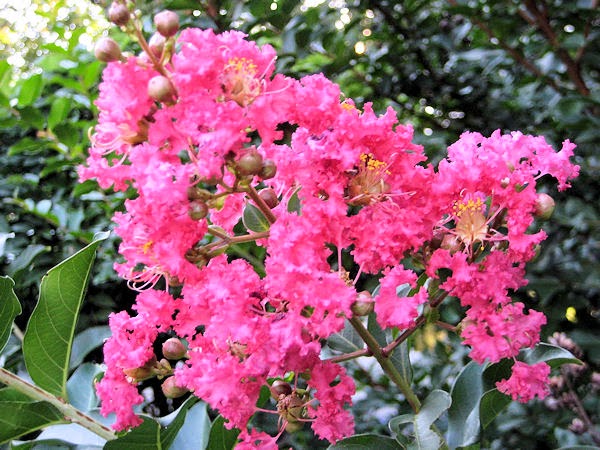
There are many varieties of this beautiful tree ranging in size from ‘Pocomoke’ and ’Chickasaw’, which are dwarf varieties topping off at approximately 5 feet to ‘Natchez’ (White),‘Tuscarora’ (Coral Pink),‘Muskogee' (Lavender) and 'Catawba' (Purple) ranging at a height between 12-20 feet. A personal favorite of mine is Crape Myrtle ’Sioux’, a medium variety that ranges in height to approximately 12-15 feet. The medium-pink flowers of the ‘Sioux’ Crepe Myrtle begin late in July and last well into October and are an elegant display not to be missed. Three other varieties of Lagerstroemia worth mentioning are ‘Tonto’ and ‘Dynamite’, both known for their vibrant red flowers and medium height of 12-15 feet and 'Zuni' (Purple) at a smaller 8-9 feet in stature.
 |
| Lagerstroemia indica 'Muskogee' |
HARDINESS & PRUNING: Lagerstroemia are a hardy to zones 7-9 and are “deer resistant”, meaning that deer will most likely avoid them in their diet. They grow best in full sunlight in a well-drained soil with a pH of 5.0-6.5. These trees require little to no pruning but can be pruned to maintain a more compact shape or to remove any dead branches that may result from a harsh winter. If you are going to prune wait until late winter or early spring after the last frost. The plants are dormant in winter and any flowering occurs on new growth so pruning will encourage new flower producing branches. Remove any dead branches, suckers growing from the base or weak twiggy branches and allow strong leader branches to keep the framework of the tree.
 |
| Lagerstroemia indica 'Natchez' |
TRANSPLANTING: If you are planning on transplanting your Crape Myrtle tree the best time to transplant in the northeast is in mid April or mid September through mid October. Roots need time to become established before the summer heat or winter cold set in. Dig a hole slightly wider than the root ball and make sure the tree sits at the height of the surface or slightly above. Apply a layer of mulch around the tree to protect the roots and keep well watered until established. Crape Myrtle are somewhat sensitive to cold so there may be some branch die back in the first season until the plant becomes well established.
 |
| Lagerstroemia indica 'Tuscarora' |
Depending on the preference of the grower Crape Myrtle can be planted as either a multi -trunk or singular-trunk form and can be displayed as either a shrub or tree in the landscape. An important note worth mentioning is that Crape Myrtle (Lagerstroemia) are among the last plants to push out their new growth so if they appear to be dead at the end of winter going into spring just give them some time to come into their glory. Since they are later to push out their leaves they do benefit from an early spring feeding of a high phosphorus-lower nitrogen 5-10-5 formula to promote good foliar growth and an abundance of blooms in July-August. Crape Myrtles are not susceptible to insects or disease but as in any landscape planting they should be monitored and properly maintained to keep them in good health.
If you are looking for a long blooming, deer resistant, low maintenance tree to add color to your garden then Crape Myrtle may be the tree for you. I for one would highly recommend this beautiful plant as a welcome addition to any formal or informal landscape.
For gardening info and tips: Visit my Author Page/Purchase My Books Be sure to check out my newest book: Gardening by Month for 12-months of interest in the landscape!😊 |
Author: Lee@A Guide To Northeastern Gardening © Copyright 2010. All Rights Reserved.


Thanks for the wonderful post. It inspires people.
ReplyDeletegrass varieties
Nice post. Some good info on crapes-thank you.
ReplyDeleteThank you for visiting and for your comments. I've been a fan of crape myrtle for the past several years. They do nicely here in Zone 7, Long Island.
ReplyDeleteawesome site... really enjoying it
ReplyDeleteIm moving to Holland Michigan from Alberta Canada.... is Holland considered in the Northeast?
Thanks so much for visiting! Michigan is considered the northeast. You have many zones there from 3-6 so you have to be careful when selecting plants. Crape Myrtle is hardy in zones 7-9,but many of the plants I talk about are hardy to zone 4. Happy gardening!
ReplyDeleteI bought a Crape Myrtle several years ago at one of my "go to" nurseries. So, after planting, in a sunny area, I sat back and waited, and waited, and waited. After 3 years, the "tree" was not much taller than it was when I brought it home. But, it was getting wider! So, I dug it up, and moved it to another sunny area, where it would be a bit of a backdrop "tree". After much research and reading, I figured it must be a really slow grower, or not happy on Long Island. Only in your blog did I see that there are dwarf varieties!! Believe me, I have looked for info. Well, it is thriving where it is. Long blooms, very wide branches, and still less than 5 feet tall! Love it just the same!
ReplyDeleteI wanted to know how to prune for northeast. I know there is a certain way in the south and if not done right they call it myrtle murder! My tree is fushia so I'm thinking it is the Sioux. The blooms are way up high. I would like the tree to be fuller. Can I just hedge trim or do I have to worry about where joints are. Thanks.
ReplyDeleteYour Crape Myrtle should only need pruning to cut out dead wood or increase fullness. The best time to prune is when the tree is dormant in late winter/early spring and the cuts should be made with a sharp pruning sheer/lopper at the joints (where the smaller side branches meet. Do not "hedge trim" the tree for it can open up an invitation to disease and can also be unsightly. The tree can also be pruned in late summer/early fall while the temperatures are above 50 degrees at nightime. This will allow the tree to harden off before winter.
Delete