Showing posts with label designing with evergreens. Show all posts

Monday, September 1, 2025

Feature Plant: Japanese Red Pine ‘Low Glow’-A Compact Evergreen for Year-Round Appeal

 Japanese Red Pine (Pinus densiflora ‘Low Glow’)
Welcome to This Month in the Garden! Today we feature a slow growing evergreen with an abundance of landscape appeal. If you’re looking for a compact, low-maintenance evergreen that adds year-round structure and rich green texture to the landscape, Japanese Red Pine Low Glow (Pinus densiflora ‘Low Glow’) is a standout choice! Pinus densiflora ‘Low Glow’ is native to North America and is cold hardy in USDA zones 3-7.

This dwarf cultivar of the North American native Red Pine offers all the beauty of its full-sized relative in a garden-friendly form that’s ideal for small spaces, rock gardens, and foundation plantings. The parent species, Red Pine (Pinus resinosa), is native to northern North America, stretching across the Great Lakes region into Canada and the northeastern United States. Known for its tall, straight growth and resilience in cold climates, Red Pine is often used in reforestation projects. ‘Low Glow’ is a dwarf selection, discovered and cultivated for its compact, mounded habit and adaptability to gardens and landscapes where full-sized Red Pines would be far too large.


Characteristics: Low Glow Red Pine is a small evergreen coniferous shrub displaying a compact, rounded habit and is slow growing. It typically reaches 2 to 3 feet tall by 3 to 4 feet wide after ten years, and in optimum conditions, a maximum of 6 feet wide at maturity. In springtime, clusters of vibrant yellow-green or chartreuse needles create a glowing effect against its dense, rounded form and prominent, white-pointed buds. Needles mature to a deeper green which remain vibrant throughout the year, while providing reliable winter color. Growth Rate is slow, adding only one to two inches of new growth per year, making it ideal for smaller spaces.


Care Requirements: Low Glow Red Pine is remarkably easy to grow with just a few key needs. Locate in full sun in a well-draining, sandy or loamy soil for best performance. Low Glow Red Pine tolerates partial shade but may lose its dense shape if it doesn’t receive enough light. Once established, it will tolerate poorer soils but does not thrive in heavy, wet, or clay conditions. Water regularly when young to establish strong roots. Once established, it is drought-tolerant and requires only occasional watering during extended dry spells. Generally, Low Glow Red Pine requires low to moderate feeding. If growth is slow or needles appear pale, apply a balanced, slow-release fertilizer for evergreens in early spring.


Pruning and Maintenance: Minimal pruning required. Low Glow Red Pine maintains its natural rounded shape without much intervention. If shaping is desired, light pruning can be done in late spring by “candling” (pinching back the new growth on candles before they harden). Remove any dead or damaged branches as needed.

Landscape Uses: Because of its compact habit and adaptability, Low Glow Red Pine is especially popular among collectors of dwarf and unusual conifers. Use in rock gardens and alpine plantings, foundation or border accents, mixed conifer gardens, low-maintenance landscapes and small urban gardens where space is limited.

I hope you enjoyed This Month in the Garden and have found the information to be useful. Low Glow Red Pine is a dependable, attractive, and easy-to-grow evergreen that offers year round interest with the charm of  being a compact, landscape-friendly form. Whether you’re looking to add structure to a rock garden, year-round interest to a foundation planting, or just a hardy, low-care shrub to your landscape, this dwarf pine is an excellent choice.

Looking for some Garden Inspiration? Check Out My Books:


As Always...Happy Gardening!

Author: Lee @A Guide to Northeastern Gardening, © Copyright 2010-2025. All rights reserved.  

Wednesday, January 15, 2025

Garden Bloggers' Bloom Day & Foliage Follow-Up: The Beauty of January & Exciting News!

Welcome!

Happy New Year and welcome to my zone 7b Long Island garden!  It's nice to see you here! It has been an exciting beginning to the new year, starting with the launching of my sixth book, The Houseplant Guide: How to Easily Select & Maintain Indoor Plants. See my post from January 7th (link above) telling about the journey as I share a collection of over 120 indoor plants with care tips and maintenance advice. It has been a labor of love, so I hope you will check out the book and perhaps even read it!
Patio Border Garden- Osmanthus 'Goshiki' and Dwarf Red Pine (front)
Now onto our outdoor garden tour! The month of January quickly diminished any thoughts of the warm winter we had been experiencing. With daytime temperatures below freezing and dropping into the teens at night with high winds and a chill factor in the single digits, it made for a cold start to the month. Long Island received two small dustings of snowfall so far, one on the 6th and another on the morning of the 11th, but this gardener senses that there will be more! Everywhere around us, including north, west and even south as received significant snowfall. I think the month of February may tell another story, and only time will tell.
Shade Border
As we start the tour, there is finally a one-on-one with a visitor that is not too shy. I have been keeping the feeder filled during the cold temperatures, and the birds seem to depend on it. The huge evergreen in the background is Weeping Norway Spruce, with the golden foliage of Hinoki Cypress 'Fernspray'.
Foundation Planting
For some winter brightness is Nandina 'Obsession', a non-invasive hybrid dwarf form of Nandina that has no berries and is safe for wildlife. The newer foliage is a pinkish-red all year long, but becomes even more vibrant in wintertime.
Winter Interest with St. John's Wort
You can have interest in the garden all year round, even with something as simple as the dried berries of St. John's Wort. The dried berries are the remains of the yellow flowers in summer, followed by red fruits in autumn. Note:  While other parts of the plant have been used in medicine, the berries are considered toxic and not edible.
Pool Border
In the summertime there are perennials in this space, but for wintertime it is the foliage of Weeping White Pine that stands out, along with the large boulders that exist throughout the garden, which are so much easier to spot at this time of year.
Pool Raised Garden
The newest planting along the pool with Weeping Norway Spruce, Variegated Upright Boxwood, Cherry Laurel and Golden Pacific Juniper is starting to fill in nicely, with hopes of abundant growth on year three. As the saying goes...first year sleep, second year creep...third year leap!
Patio Border
The Abelia 'Kaleidoscope' along the back walkway is in winter mode with its foliage deepening to an orangey-golden color, while Spirea 'Candy Corn' and Japanese Maple Twombly's 'Red Sentinel' are now dormant. The Lamb's Ear that borders the garden continues to share its white soft foliage throughout winter.
Winter Interest-Nellie Stevens Holly Berries
In the back shade border, the red berries of Nellie Steven's Holly give some winter interest and are enjoyed by wildlife.
Shade Garden-Pool Border
Along with the berries of Nellie Stevens' Holly, the newer foliage of Leucothoe 'Axillaris' deepens to a maroon color. Joining the Leucothoe are Sky Pencil Holly and Golden Sweet Flag.
Butterfly Bush Winter Interest
Even the remaining final growth of Butterfly Bush can add some interest to the landscape...
Heather (Calluna vulgaris 'Firefly')
along with the foliage and dried blooms of summer Heather.
Driveway Border
As the temperatures get colder, the magnificent bark of Coral Bark Maple gets brighter. It is a sight I look forward to every winter. Here the Coral Bark Maple is joined by Skyland's Oriental Spruce.
Front Lawn
When it comes to structure, the twisted trunk of Weeping Japanese Maple is a work of nature...
Front Foundation Planting
while the golden evergreen foliage of Hinoki Cypress 'Verdoni' with Golden Variegated Sedge adds some color and structure to the garden.
Herb Garden Winter
In the herb garden is Rosemary, which my husband uses to cook with all winter. This one is close to the foundation, which shields it somewhat from the winds.
Front Walkway Winter
As we venture to the front of the property, here is a view along the walkway with a variety of evergreens and Liriope (Lilyturf) tucked in between for continuous yearly interest. Helpful Tip: It is important to not cut back your Lilyturf in fall, especially if you are in a colder zone. The foliage adds interest and protects it over the winter. I cut mine back here in zone 7b around mid to late April after any threat of frost is gone and before new growth starts to sprout. 
Front Lawn Winter
As we near the end of the tour, here is a view of the front lawn in wintertime with Weeping Norway Spruce, Osmanthus 'Goshiki' and Dwarf Norway Spruce, joined by Weeping Japanese Maple and Blue Atlas Cedar in the distance...
Hellebore 'Shooting Star'
while on the north side of the property there are buds on Hellebore 'Shooting Star' with blooms soon to follow!
All-Season Planter
By the back entry, the all season planter with a variety of Lemon Cypress, Spruce, Juniper and Dwarf Osmanthus continues to greet visitors. This is the second year for this combination and it has been doing nicely. Since the Lemon Cypress is hardy to zone 7 and is in a container, I do protect it with covering on those really cold nights.
A Little Dusting of Snow!
Speaking of cold nights, it was less than a week ago that we woke up to a dusting of snow covering the garden. It lasted just long enough to enjoy before it all melted away as the temperatures finally warmed above freezing.
Indoor Garden
And while the weather outside is frightful, the indoor garden is so delightful! Here is a small section of my collection of common and rare houseplants, which I do enjoy all year long! As we wrap up the month of January, thoughts from garden author Josephine Neuse ring in my mind, “Anyone who thinks that gardening begins in the spring and ends in the fall is missing the best part of the whole year; for gardening begins in January with the dream."
Thank you for Visiting!
I hope you enjoyed your visit to my January garden. I so appreciate you being here, look forward to your comments and enjoy seeing what you have growing in your garden. Special thanks go out to our hostess Carol at May Dreams Gardens, who makes it possible to see blooms on the 15th of every month with her meme Garden Bloggers' Bloom Day. Also, special thanks to Pam Penick at Digging who had hosted Foliage Follow-Up, a meme I will continue to honor. I am also linking with some other wonderful hosts and hostesses at Floral Friday Fotos, Nature Notes at Rambling Woods, Image-in-ing weekly photo share every Tuesday, Weekly Photo Link-Up at My Corner of the World on Wednesdays and Garden Affair at Jaipur Garden. 

Friday, September 1, 2023

This Month in the Garden: Ilex crenata 'Sky Pencil'

This Month in the Garden: Feature Shrub: 'Sky Pencil' Holly
Ilex crenata 'Sky Pencil' (Sky Pencil Holly)
Welcome to This Month in the Garden. For the month of September, we feature Ilex crenata 'Sky Pencil', a versatile selection which adds dimension and intermediate height to the garden. Hardy in USDA zones 5-9, 'Sky Pencil' Holly displays a narrow, columnar habit with dark green evergreen foliage which adds interest throughout the year. In springtime, insignificant small white flowers that attract pollinators lead to small purple berries in fall, if a male holly is nearby. Growing to just 2-3 feet wide by 6-8 feet in height, this shrub adds a dramatic vertical accent to the landscape. 
Ilex crenata 'Sky Pencil' (Sky Pencil Holly)
Plant 'Sky Pencil' Holly in full sun to partial shade (in warmer climates) and water when the top two inches of soil is dry. Ideally, a location with morning sun and afternoon shade is best. Holly are best if watered at the base of  the roots rather than from above and prefer a moderately moist, well-drained soil. If leaves yellow, it is most likely an indication of too much moisture. The height of this broad-leaved evergreen can be easily maintained by pruning in springtime after new growth pushes out and again in late summer if desired, as this selection grows approximately six to twelve inches a year when conditions are ideal. Since this is a broad-leaved evergreen, it is recommended to mulch around the base of the plant to protect it from temperature changes and to spray the foliage with an anti-desiccant in late autumn to protect the leaves from winter drying. 
Ilex crenata 'Sky Pencil' (Sky Pencil Holly)
I hope you enjoyed This Month in the Garden for the month of September. Be sure to stop by on the 1st. and 15th. of each month as I continue to share gardening tips, information and horticultural adventures! Also, be sure to check out my author page and books, as I share a lifetime passion of gardening! 


Author: Lee @A Guide to Northeastern Gardening, © Copyright 2010-2023. All rights reserved. 

Thursday, June 15, 2023

Garden Bloggers' Bloom Day & Foliage Follow-Up June: My Changing Long Island Garden!

Welcome Visitors!
Welcome to my garden! The official start of summer is just a few days away and the garden is alive and bursting with color. As we all know, a garden is always evolving and there have been some exciting renovations going on in my own garden this spring. After some unusually warm temperatures for the month of May, June brings temperatures mostly in the mid-70's, which are comfortable weather wise for planting. Join me for a tour of my Long Island garden to revisit some familiar sights and explore some new beginnings. 
Back Perimeter Garden
We begin at the back perimeter garden which faces south. These Double Red Knock Out Roses are a sincere delight year after year and bloom on and off throughout the summer and into fall. In the foreground is the new Weeping Norway Spruce, which was planted last spring.
Double Pink Knock Out Roses
Along that same garden bed are Double Pink Knock Out Roses, which also bring so much joy!
Kousa Dogwood 'Greensleeves'
Here is Kousa Dogwood 'Greensleeves', which is now in full bloom. This variety displays greenish-white blooms that last for several weeks, followed by large red edible fruit that appears near fall.
Weeping Blue Atlas Cedar

On the same south facing side, Weeping Blue Atlas Cedar joins the mix, surrounded by Heuchera 'Palace Purple'  (Purple Coral Bells).
Back Pool Garden Western View
On the western side of the property is the foliage of Sedum 'Brilliant', the bluish-purple blooms of Nepeta 'Walkers Low', Variegated Boxwood, Spirea Goldmound, Rhododendron 'Roseum Elegans' and the pure white blooms of Viburnum 'Summer Snowflake', accompanied by Kwanzan Cherry in the corner of the garden.
Viburnum Summer Snowflake Blooming!
A hidden birdbath lies in the distance behind the Kwanzan Cherry and Viburnum.
Hemerocallis Stella D' Oro (Daylily)
It is also Daylily season, and the Stella D' Oro Daylilies are blooming!
Patio Surround
Following along to the patio surround, Salvia 'May Night' is in full bloom along with Peony.  The Peony blooms are just about done now, but the Salvia will keep on going through July, until it needs to be deadheaded. Another round of blooms will follow into fall.
Back Pool Garden Southern Side
Spirea 'Goldmound' is blooming in the back pool garden, giving a show with its beautiful pink blooms and golden foliage.
New Pool Makeover with Weeping Norway Spruce
There has been a lot going on in the back pool waterfall area. I finally took the plunge and removed an old yew which had been losing its needles since the drought of last summer and the three days of 10 degree temperatures this past winter. I also had the crew rebuild the waterfall with extra moss rock to extend it from side to side and replanted the whole area. 
Pool Makeover Northern View
We had to move the large Weeping Norway Spruce to the top of the waterfall with a skid steer with just two feet of space between the patio and pool. I held my breath until the tree was in place, then took a deep sigh of relief.  The mission had been accomplished.
Pool Makeover Southern View
I added some Variegated Upright Boxwood on each side of the main focal point and Cherry Laurel 'Otto Luyken' to the left. Some New Wave Petunias were added for color. Later this season or next season, I may add some perennials as well, but for now I am just enjoying the new look. I am also looking forward to when the Green Giant Arborvitae in the back drop push out some new foliage and the new plantings grow to fill in some of the gaps left by the gigantic Yew that had been there for so many years.
Pool Surround
In front of Rhododendron 'Roseum Elegans' and Coral Bells (Heuchera 'Caramel'), Sky Pencil Holly adds some dimension to the garden. I enjoy their upright stature.
Perennial Border
In the perennial border, Lamb's Ear is already starting to get its blooms, which is earlier than usual. Astilbe 'Fanal' joins in with its pink blooms, which will last into July.
Sedum Groundcover
The groundcover mix of Sedum also seems to be about two weeks ahead of schedule this year with blooms already forming. The main species in this mix is Sedum 'Angelina'.
Perennial Border
Back to the perennial border, the tall foliage of Balloon Flower (front left), will lead to large blue balloon-shaped blooms later in the summer around the end of July or beginning of August. The blooms of Echinacea will follow around the same time.
Spirea Double Play 'Big Bang'
Moving along to the front yard is Spirea Big Bang 'Double Play'. The Double Play series displays  vibrant pink blooms which are larger than those of other species of Spirea, and the foliage is nice too!
Spirea Double Play 'Big Bang' Bloom Up Close

Here are the blooms up close! I followed a bumble bee around trying to capture a photo shoot, but he was camera shy! The Spirea is a great pollinator magnet.
Driveway Border
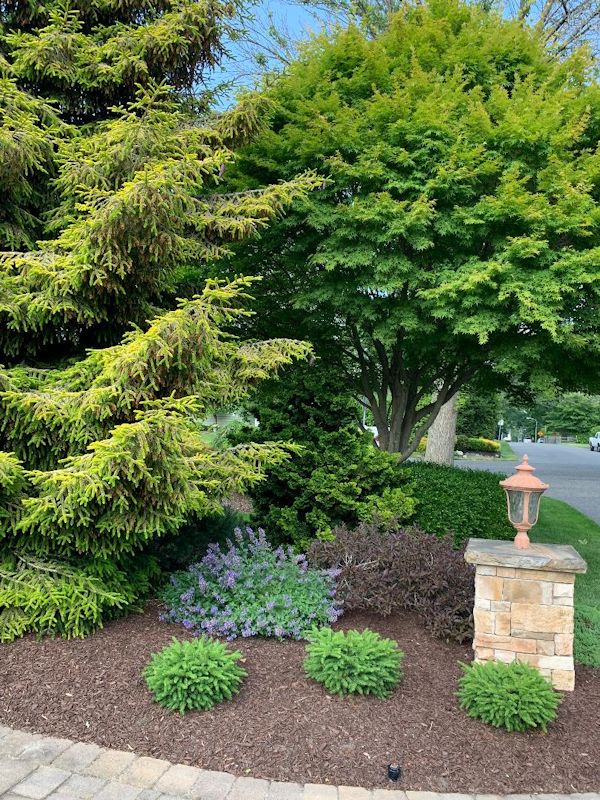
The new addition along the driveway border are these Dwarf Norway Spruce, with replaced the coreopsis. It was time for a neater look and less maintenance.
Entrance Walkway 
Along the front walkway, the heart-shaped foliage of Weeping Eastern Redbud is a delight...
Front Island Bed
and the Hosta's are in full swing on the front island bed. Accompanying them are Sedum 'Pure Joy', which will bloom later in the summer.
Thanks for Visiting!
The month of June has certainly been a busy one, with so many changes going on in my Long Island garden. As I put it...A garden is a work of art, a thing of beauty that constantly changes, and can be enjoyed for a lifetime.
June Garden
I hope you enjoyed the stroll. I appreciate you being here, look forward to your comments and enjoy seeing what you have blooming where you live! Special thanks go out to our hostess Carol at May Dreams Gardens, who makes it possible to see blooms on the 15th of every month with her meme Garden Bloggers' Bloom Day. Also, special thanks to Pam Penick at Digging who had hosted Foliage Follow-Up, a meme I will continue to honor. I am also linking with some other wonderful hosts and hostesses at Floral Friday Fotos, Friday Bliss at Floral Passions, Macro Monday 2, Mosaic Monday at Letting Go of the Bay Leaf, Nature Notes at Rambling Woods, Image-in-ing weekly photo share every Tuesday with NC Sue and Gardens Galore Link Up Party every other Monday with Everyday Living. I am also happy to join the Weekly Photo Link-Up at My Corner of the World on Wednesdays and Garden Affair at Jaipur Garden. Wishing all a wonderful spring with gardens that thrive!