Showing posts with label feature plant. Show all posts

Monday, June 1, 2026

Hens and Chicks: The Plant, the Story...the Legend!

Hens and Chicks with Sedum Angelina (Stonevrop)

The Plant: Today's feature plant, Hens and Chicks (scientific name Sempervivum) is an easy to grow outdoor succulent that is not only drought tolerant, but cold hardy to USDA zone 6, and the perfect selection for xeriscaping, planting along rock walls, along a pool border, or grown with other succulents for a decorative touch to the garden. While being drought tolerant, these evergreen perennials are also low maintenance, and supply interest throughout the year. Plant Hens and Chicks in a location will full sun and a well-drained soil, and they will thrive. In addition, these evergreen succulents attract bees, butterflies, and other beneficial insects. There is some mystery however; where did the name "Hens and Chicks" come from? Why aren’t they referred to as goose and goslings, or pig and piglets or duck and ducklings?

Hens and Chicks Poolside
The Story: Now it is time to solve the mystery! The attention catching name, Hens and chicks, came from the way they propagate. The larger mother plant is called the "hen," and as it multiplies it produces an abundance of tiny offspring through lateral stems, known as "chicks," that sprout up and cluster closely around it. Hens and chicks produce tall, thick stalks crowned with star-shaped or bell-shaped flowers in summer that signal the death of the mother plant. This is only part of the life cycle though, as the mother plant has already produced several offspring, and the “chicks” will continue to grow and divide after the “mother” rosette dies. 

Hens and Chicks with Rosettes
The Legend: Being cultivated as far back as ancient Roman times, these plants were grown in vases in at the entry of a home as a symbol for prosperity. There was also a belief that Hens and Chicks would protect against lightning, as their rosette-shaped leaves resembled the bearded, crowned face of the Roman god Jupiter. During the 8th century across Western Europe, Frankish King Charlemagne ordered his subjects to plant Hens and Chicks on their thatched-roof homes as a protection from lightening and possible fire, as their water retaining, fire-resistant leaves acted as an insulator and fire retardant. In European folklore, planting Hens and Chicks near the front door was believed to bring good luck, love, and fertility to the household. Scottish folklore claimed the plant could ward off black sorcery, and in rural areas of Wales and parts of England, the plant was believed to protect against storms, while also welcoming prosperity.

Hens and Chicks Poolside Rock Garden
Overall, these versatile and incredibly hardy succulents are low maintenance, drought tolerant, pollinator friendly, known for surviving freezing temperatures outdoors, and basically thrive on neglect! I hope you enjoyed your visit, and until we meet again...Happy Gardening!

Author: Lee Miller @A Guide to Northeastern Gardening, © Copyright 2010-2026. All rights reserved.

Monday, September 1, 2025

Feature Plant: Japanese Red Pine ‘Low Glow’-A Compact Evergreen for Year-Round Appeal

 Japanese Red Pine (Pinus densiflora ‘Low Glow’)
Welcome to This Month in the Garden! Today we feature a slow growing evergreen with an abundance of landscape appeal. If you’re looking for a compact, low-maintenance evergreen that adds year-round structure and rich green texture to the landscape, Japanese Red Pine Low Glow (Pinus densiflora ‘Low Glow’) is a standout choice! Pinus densiflora ‘Low Glow’ is native to North America and is cold hardy in USDA zones 3-7.

This dwarf cultivar of the North American native Red Pine offers all the beauty of its full-sized relative in a garden-friendly form that’s ideal for small spaces, rock gardens, and foundation plantings. The parent species, Red Pine (Pinus resinosa), is native to northern North America, stretching across the Great Lakes region into Canada and the northeastern United States. Known for its tall, straight growth and resilience in cold climates, Red Pine is often used in reforestation projects. ‘Low Glow’ is a dwarf selection, discovered and cultivated for its compact, mounded habit and adaptability to gardens and landscapes where full-sized Red Pines would be far too large.


Characteristics: Low Glow Red Pine is a small evergreen coniferous shrub displaying a compact, rounded habit and is slow growing. It typically reaches 2 to 3 feet tall by 3 to 4 feet wide after ten years, and in optimum conditions, a maximum of 6 feet wide at maturity. In springtime, clusters of vibrant yellow-green or chartreuse needles create a glowing effect against its dense, rounded form and prominent, white-pointed buds. Needles mature to a deeper green which remain vibrant throughout the year, while providing reliable winter color. Growth Rate is slow, adding only one to two inches of new growth per year, making it ideal for smaller spaces.


Care Requirements: Low Glow Red Pine is remarkably easy to grow with just a few key needs. Locate in full sun in a well-draining, sandy or loamy soil for best performance. Low Glow Red Pine tolerates partial shade but may lose its dense shape if it doesn’t receive enough light. Once established, it will tolerate poorer soils but does not thrive in heavy, wet, or clay conditions. Water regularly when young to establish strong roots. Once established, it is drought-tolerant and requires only occasional watering during extended dry spells. Generally, Low Glow Red Pine requires low to moderate feeding. If growth is slow or needles appear pale, apply a balanced, slow-release fertilizer for evergreens in early spring.


Pruning and Maintenance: Minimal pruning required. Low Glow Red Pine maintains its natural rounded shape without much intervention. If shaping is desired, light pruning can be done in late spring by “candling” (pinching back the new growth on candles before they harden). Remove any dead or damaged branches as needed.

Landscape Uses: Because of its compact habit and adaptability, Low Glow Red Pine is especially popular among collectors of dwarf and unusual conifers. Use in rock gardens and alpine plantings, foundation or border accents, mixed conifer gardens, low-maintenance landscapes and small urban gardens where space is limited.

I hope you enjoyed This Month in the Garden and have found the information to be useful. Low Glow Red Pine is a dependable, attractive, and easy-to-grow evergreen that offers year round interest with the charm of  being a compact, landscape-friendly form. Whether you’re looking to add structure to a rock garden, year-round interest to a foundation planting, or just a hardy, low-care shrub to your landscape, this dwarf pine is an excellent choice.

Looking for some Garden Inspiration? Check Out My Books:


As Always...Happy Gardening!

Author: Lee @A Guide to Northeastern Gardening, © Copyright 2010-2025. All rights reserved.  

Sunday, June 1, 2025

Feature Plant Nepeta (Catmint): A Fragrant Herb with Medicinal Value and Garden Charm

Nepeta x faassenii 'Cat's Pajamas' (Dwarf Variety)
Welcome to This Month in the Garden! Today's feature perennial is Nepeta, commonly known as catmint. Nepeta is a beloved herbaceous perennial in gardens around the world, admired for its soft, aromatic foliage and spikes of violet-blue flowers. Its name often confuses it with catnip (Nepeta cataria), which belongs to the same genus and shares some characteristics, especially its appeal to felines. Nepeta leaves are typically gray-green and emit a pleasant, minty fragrance when crushed. Blooming from late spring into fall, catmint produces spikes of small, tubular flowers in shades of blue, lavender, or purple depending on the variety, and grows between 12 inches to 3 feet in height, making it ideal for borders and edging. Another attribute is that Nepeta attracts pollinators such as bees, butterflies, and other beneficial insects. Due to its strong scent, it’s often left untouched by deer and rabbits.

Nepeta (Catmint)
Hardy in USDA zones 3-9, Nepeta tolerates poor or sandy soils but dislikes heavy, soggy ground and thrives in full sun, though it can tolerate partial shade. More sun typically leads to stronger flowering and a more compact form. Once established, catmint is drought-tolerant. Avoid overwatering, as soggy soil can lead to root rot. While little to no maintenance is required for this plant, regular deadheading will encourage reblooming. Cut back after the first flush of flowers to keep a more compact plant, promote new growth and extend bloom time. 
Nepeta (Catmint)
Historically, various species of Nepeta, particularly N. cataria (catnip), have been used in traditional herbal medicine. Though less well-known, catmint contains compounds that provide mild therapeutic effects. Nepetalactone, which is responsible for the intoxicating effect on cats has also been used as a mild sedative on humans. Tannins and flavonoids, known for their antioxidant properties can calm anxiety and promote restful sleep. Nepeta is often taken as a tea made from dried leaves and flowers to ease stomach cramps and nausea. It has also be used as a digestive aid to relieve gas, bloating, and indigestion. Its antispasmodic and soothing properties also make it helpful for easing symptoms of colds, coughs, and fevers and its infused oils can be used topically to treat minor skin irritations and insect bites.  Nepeta has also been used as a natural repellant to deter garden insects such as aphids and squash bugs.

Nepeta x psfike 'Little Trudy' (Dwarf Variety)
Overall, Nepeta or catmint is far more than just a pretty face in the landscape or a treat for cats. Its adaptability, easy-care, long-lasting blooms, and subtle healing properties make it a standout plant for both ornamental and herbal uses. Whether you’re lining a walkway, attracting pollinators, or brewing a calming evening tea, catmint is a quiet powerhouse that deserves a place in your garden! 

Looking for some Inspiration? Purchase My Books:


As Always...Happy Gardening!

Author: Lee @A Guide to Northeastern Gardening, © Copyright 2010-2025. All rights reserved. 

Sunday, December 1, 2024

Poinsettia-the History, the Folklore...the Plant

Feature Plant: Poinsettia
Welcome to This Month in the Garden! With the month of December upon us, I thought it would be a good time to talk about Poinsettia (Euphorbia pulcherrima), one of the most recognizable symbols of the holiday season. Known for its vibrant colors, this plant has a rich history, fascinating folklore and unique botanical features. 

The History: The poinsettia is native to Mexico and Central America where it thrives in the tropical rainforests. Back to the 14th century, the Aztecs valued the plant for its vibrant red color and used the bracts to create dye and the milky sap for medicinal purposes, such as treating fevers. In the 17th century, the poinsettia became attached to Mexican Christmas traditions, as the Franciscan monks began using the flower in their nativity processions. Coincidentally, this occurred around the same time as a legend of the "Flowers of the Holy Night" began. The poinsettia's introduction to the United States was credited to the first U.S ambassador to Mexico, Joel Roberts Poinsett in 1828 when he took clippings of the plant to propagate in his South Carolina greenhouse. December 12th is now National Poinsettia Day in remembrance of Poinsett's death and the plant's cultural significance. 

The Folklore: According to the legend "Flowers of the Holy Night", a poor child named Pepita wanted to bring a gift to baby Jesus at a Christmas service and had no money to buy one, but was reminded by her cousin "that even the most humble gift if given in love, will be acceptable in his eyes". An angel appeared and encouraged Pepita to gather weeds from a roadside. When she placed the weeds on the alter, they transformed into beautiful red poinsettias. Because of this story, the poinsettia is often referred to as the "Christmas Eve Flower".
Poinsettia (Red)
The Plant:  An interesting fact about poinsettia is that the colorful parts are not at all flowers, but rather bracts, or modified leaves. The colorful bracts draw pollinators to the true flowers, which are the small yellow-green clusters called cyathia, located in the center of the bracts. While red is the most popular color, this plant has been cultivated into a range of shades from pink to white, marbled and variegated varieties. In its native habitat it can grow up to 10-15 feet tall, but indoors it remains as as compact potted plant. Care is relatively easy with the correct conditions. Place your plant in a location with bright light and avoid direct sunlight, as it can scorch the leaves. Also avoid cold drafts, which can cause the leaves to drop. Water when the top inch of soil feels dry and ensure that there is proper drainage. After the holiday season, feed your poinsettia with a balanced houseplant fertilizer every two to three weeks.
Poinsettia (Pink/Variegated)
How to Get Your Poinsettia to Rebloom: To get your poinsettia to rebloom for the next holiday season, prune the plant back to six inches in height after it stops blooming. During spring and summer, place it in a sunny spot outdoors or indoors and continue regular watering and feeding. Beginning in late September, provide 14-16 hours of total darkness each night and bright light during the day. This mimics the shorter days of winter and triggers the development of the colorful bracts.

Safety: Poinsettias have a reputation for being poisonous, but it is largely a myth. The sap can cause mild skin irritation or stomach discomfort if ingested in large quantities, but it is not considered highly toxic. To be on the safe side, it is still good practice to keep these plants out of the reach of pets and children.

In conclusion, besides being aesthetically appealing, Poinsettia have been a symbol of good will, purity, rebirth, peace and hope throughout history. They will bring lasting color and a touch of the holiday season to your home. 

I hope you enjoyed This Month in the Garden. Be sure to stop by on the 1st. and 15th. of each month as I continue to share gardening tips, information and horticultural adventures! Catch up on posts and other news with my newsletter, Northeastern Gardening News. Subscribe for free to receive monthly updates.

Exciting News:
 There is a new book in the works which covers over 120 selections of houseplants with detailed information on characteristics, care requirements, maintenance, propagation, common houseplant insects and diseases, treatment and more. Follow My Author Page for the release date, sometime in early 2025!

"As Always...Happy Gardening!" 

Author: Lee @A Guide to Northeastern Gardening, © Copyright 2010-2024. All rights reserved. 

Tuesday, October 1, 2024

Feature Plant: Balloon Flower (Platycodon)

Welcome to This Month in the Garden!

This month's feature is Balloon flower. One of my favorite perennials in the garden, Balloon Flower is scientifically known as Platycodon grandiflorus, and is a member of  the Campanulaceae (bellflower family). It is ideally a unique perennial known for its balloon-like buds that burst into beautiful star-shaped blooms. Native to East Asia, Balloon Flower has gained popularity in gardens worldwide due to its low-maintenance nature and striking appearance. While the typical form has violet-blue blooms, there are several cultivars displaying colors ranging from blue to white and pink. These include Platycodon grandiflorus 'Komachi', the Platycodon grandiflorus 'Fuji Series', and the Platycodon grandiflorus 'Astra Series'. Platycodon grandiflorus 'Komachi' displays blue flowers that remain as balloon-shaped buds that never open, making them particularly unique and a conversation piece in the garden.  'Fuji Series' offers white, pink, and blue flowers and Platycodon grandiflorus 'Astra Series' consists of a collection of dwarf varieties at 8-10 inches high by 12 inches wide, which are perfect for smaller spaces producing compact, bushy plants. 

Platycodon grandiflorus 'Komachi' 

Balloon flowers are hardy in USDA zones 3 through 8, making them well-suited to a wide range of climates. Their resilience allows them to withstand cold winters, though they may die back completely to the ground during dormancy. In the spring, new growth emerges from the root system. Depending on the variety, balloon flowers can reach heights of 1 to 3 feet, with a spread of about 1 foot. Space plants accordingly to ensure adequate air circulation, which helps prevent fungal diseases. 


Growing Conditions: Platycodon grandiflorus prefers full sun to partial shade and moderate watering. The soil should be kept evenly moist but not soggy, especially in their first growing season when they are establishing roots. Once established, balloon flowers are fairly drought tolerant. Root rot is a condition that can happen in the case of poor drainage or overwatering. Make sure the plant is in well-drained soil, especially in areas with heavy rainfall. Balloon flowers are not heavy feeders. A light application of balanced fertilizer in the spring will help them grow vigorously. Over-fertilizing can lead to weak stems and reduced flowering.  Balloon flowers are relatively pest-free, though slugs and snails may nibble on young shoots. An organic slug deterrent can help protect them.  In some cases, balloon flowers may grow tall and develop weak stems that flop over. This issue can be resolved by staking taller varieties or planting them in groups where the plants can support one another.

Platycodon grandiflorus 'Komachi' 

Propagation: To propagate Balloon Flower, collect the seed pods once the flowers dry out and allow the pods to dry out completely. Once dry, break open the pods to expose hundreds of tiny, brown seeds and sow the seeds indoors 6-8 weeks before the last frost or directly outdoors in early spring. For indoors, scatter seeds on the surface of a seed-starting mix, press them lightly into the soil, but do not cover them so they can get light. Keep the soil moist and warm, at about 65°F-70°F (18°C-21°C), until seeds germinate within 2-3 weeks. Once the seedlings develop several true leaves and are large enough to manage, they can be transplanted outdoors once threat of frost is gone. Since balloon flowers have sensitive roots, seed propagation is recommended, as not to disturb the plant’s deep taproot system. If you decide to divide your plants, Spring is the best time to do so. Dig up the plant carefully to avoid damaging the taproot, and attempt division only if offsets are visible. Replant the divided sections in proper soil and water thoroughly. Note that it may take some time for the plants to recover. Propagation through seeds is known to be the easiest method, though division is possible with care. I am going to try propagating my own 'Komachi' Balloon Flowers from the seed pods I collected this September, hoping to grow more of this hard to find plant. 

Platycodon grandiflorus seed pods harvested in early fall

Balloon flowers are an excellent addition to any perennial garden. With their interesting balloon-like buds and star-like flowers, they bring charm and interest to garden beds, borders, and containers. By providing the right growing conditions, these plants will thrive with minimal maintenance and reward you with years of beautiful, long-lasting blooms!


I hope you enjoyed This Month in the Garden. If you have grown Balloon flower from seed, I would love to hear your experiences. Be sure to stop by on the 1st. and 15th. of each month as I continue to share gardening tips, information and horticultural adventures! 


"As Always...Happy Gardening!" 

Author: Lee @A Guide to Northeastern Gardening, © Copyright 2010-2024. All rights reserved. 

Tuesday, August 1, 2023

This Month in the Garden: St. John's Wort

Feature Flowering Shrub: St. John's Wort
Welcome to This Month in the Garden. This month we feature St. John's Wort. Hardy in USDA zones 5-8, St. John's Wort a semi-evergreen flowering shrub that comes in a variety of cultivars ranging in size from 2-3 feet tall by wide up to 6 feet tall with a spread of 3-6 feet in width. In its native form, Hypericum perforatum (St. John's Wort) is renowned for its medicinal properties and contains various active compounds, including hypericin, hyperforin and flavonoids, which are believed to possess unique antidepressant and anti-inflammatory qualities. As a topical, it is used to treat wounds, burns, muscle ache and bruising. St. John's Wort has been used throughout European medicine as far back as the ancient Greeks to treat a variety of conditions, including insomnia, depression, anxiety reduction, and nerve related pain. 
Hypericum x inodorum 'Magical Universe' (St. John's Wort) Summer
While the seeds and berries are considered toxic, the flowers, leaves and stems of the plant are typically harvested during the height of the bloom season. At that time they are dried thoroughly to remove moisture, extracted and infused in a solvent, such as alcohol or olive oil, then further filtered to obtain a clear liquid extract, which is then prepared as an herbal tea, tincture, capsule or tablet form. The final product is stored in dark glass bottles to protect the herb from light and preserve its medicinal properties.
Hypericum x inodorum 'Magical Universe' (St. John's Wort) Late-Summer
Today's feature variety, 'Magical Universe' is a hybrid, dwarf cultivar with deep green foliage and small, bright yellow blooms starting in June, followed by fruit that deepens to deep red in fall. Staying at a more compact size of 2-3 feet tall by wide, St. John's Wort 'Magical Universe' prefers a location with full sun to partial shade in well-drained soil with moderate watering. A location with bright morning sun and late afternoon shade is ideal. While this form of St. John's Wort is not considered medicinal, its lovely bright yellow blooms and red ornamental berries bring interest to the landscape throughout the seasons. As its foliage turns to a deeper burgundy in fall and the red berries dry, the plant adds a decorative touch even into winter. St. John's Wort is known to be drought tolerant once established, able to withstand a variety of soil types and is deer resistant. Other varieties of St. John's Wort include, but are not limited to, Hypericum 'Hidcote', 'Magical Midnight Glow' and 'Blue Velvet'.
Hypericum x inodorum 'Magical Universe' (St. John's Wort) Autumn

I hope you enjoyed This Month in the Garden for the month of August. Be sure to stop by on the 1st. and 15th. of each month as I continue to share gardening tips, information and horticultural adventures! Also, be sure to check out my author page and books, as I share a lifetime passion of gardening! 


Author: Lee @A Guide to Northeastern Gardening, © Copyright 2010-2023. All rights reserved. 

Thursday, June 1, 2023

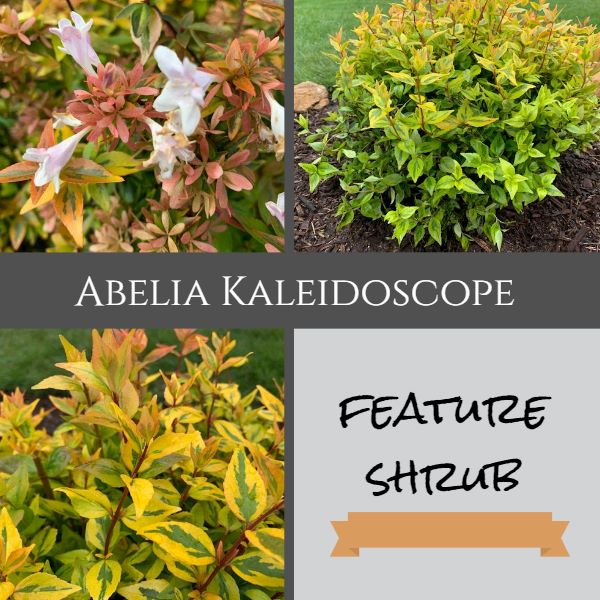
This Month in the Garden Feature Flowering Shrub: Abelia Kaleidoscope

This Month in the Garden: Feature Shrub Abelia Kaleidoscope
Welcome to This Month in the Garden! This month's feature plant selection is Abelia Kaleidoscope, an outstanding evergreen shrub known for its array of colorful bright golden and pink hues on a backdrop of medium green foliage, which changes color throughout the seasons. Starting in springtime as golden yellow to lime green, deeper orangey-red foliage develops as the season progresses. An additional attribute is the shrub's brilliant red stems, which along with colorful foliage, create a dramatic display of color throughout all four seasons. For even more interest, tubular fragrant pinkish-white blooms appear in summer and last into early fall. 

Abelia Kaleidoscope Springtime

Hardy in USDA zone 6-9, Abelia Kaleidoscope is a compact shrub, growing to just 2-3 feet high by 3-4 feet wide and is ideal for small spaces in the landscape, such as along a patio, foundation planting, or border planting. It prefers a location with full sun to partial shade and a moderately moist, well-drained soil.
Abelia Kaleidoscope Autumn
While little pruning is necessary, Abelia blooms on old wood; therefore, any pruning to shape the plant should take place after flowering. In late winter to early spring before new growth emerges, up to one third of the plant can be pruned to maintain a desired size. Abelia Kaleidoscope is pollinator friendly, attracts butterflies and hummingbirds, and is also known to be deer resistant. If you are looking for the perfect compact and colorful shrub for your landscape, that will provide interest in every season, Abelia Kaleidoscope may be the selection for you!
Abelia Kaleidoscope Blooms

I hope you enjoyed This Month in the Garden for the month of June. Be sure to stop by on the 1st. and 15th. of each month as I continue to share gardening tips, information and horticultural adventures! Also, be sure to check out my author page and books for gardening information and helpful advice, all based on my 27 years of experience as a landscape designer and ongoing involvement in the horticultural field. Until we meet again...Happy Gardening!


Author: Lee @A Guide to Northeastern Gardening, © Copyright 2010-2023. All rights reserved. 

Saturday, April 1, 2023

This Month in the Garden: Feature Spring Flowering Shrub-Dwarf Japanese Andromeda

Feature Plant: Pieris japonica 'Cavatine' (Dwarf Japanese Andromeda)
Welcome to This Month in the Garden for April. Spring has arrived at last and it's time to get out into the garden! This month's feature plant is Pieris japonica 'Cavatine', also known as Dwarf Japanese Andromeda. This lovely evergreen shrub produces dainty bell-shaped white blooms in early springtime which contrast beautifully against darker green foliage. The abundance of flowers are an attraction to early season pollinators and new buds start to form during the late summer months, giving further interest through fall and winter.
Pieris 'Cavatine' (Dwarf Japanese Andromeda)

This attractive spring flowering shrub is ideal for smaller spaces or in borders, staying compact, and reaching a height and width of 18-24 inches high by 24-30 inches wide. Hardy in USDA zones 4-8, Pieris japonica 'Cavatine' prefers a moderately moist, well-drained soil in partial to full shade. This slow growing shrub rarely needs pruning, but if shaping is desired, it should be performed immediately after flowering, since Dwarf Japanese Andromeda blooms on the previous years growth. For those of you who have deer frequenting your garden, this shrub is also deer resistant! 

I hope you enjoyed This Month in the Garden. Be sure to stop by on the 1st. and 15th. of each month as I continue to share gardening tips, information and horticultural adventures! If you are looking for some gardening inspiration, be sure to check out my books, based on 27 years of experience in the horticultural field, and including my newest publication, Shade Gardening for the Northeast and Mid-Atlantic, which includes over 150 plant selections suited for shade!