Showing posts with label evergreens for shade. Show all posts

Saturday, April 1, 2023

This Month in the Garden: Feature Spring Flowering Shrub-Dwarf Japanese Andromeda

Feature Plant: Pieris japonica 'Cavatine' (Dwarf Japanese Andromeda)
Welcome to This Month in the Garden for April. Spring has arrived at last and it's time to get out into the garden! This month's feature plant is Pieris japonica 'Cavatine', also known as Dwarf Japanese Andromeda. This lovely evergreen shrub produces dainty bell-shaped white blooms in early springtime which contrast beautifully against darker green foliage. The abundance of flowers are an attraction to early season pollinators and new buds start to form during the late summer months, giving further interest through fall and winter.
Pieris 'Cavatine' (Dwarf Japanese Andromeda)

This attractive spring flowering shrub is ideal for smaller spaces or in borders, staying compact, and reaching a height and width of 18-24 inches high by 24-30 inches wide. Hardy in USDA zones 4-8, Pieris japonica 'Cavatine' prefers a moderately moist, well-drained soil in partial to full shade. This slow growing shrub rarely needs pruning, but if shaping is desired, it should be performed immediately after flowering, since Dwarf Japanese Andromeda blooms on the previous years growth. For those of you who have deer frequenting your garden, this shrub is also deer resistant! 

I hope you enjoyed This Month in the Garden. Be sure to stop by on the 1st. and 15th. of each month as I continue to share gardening tips, information and horticultural adventures! If you are looking for some gardening inspiration, be sure to check out my books, based on 27 years of experience in the horticultural field, and including my newest publication, Shade Gardening for the Northeast and Mid-Atlantic, which includes over 150 plant selections suited for shade!

Wednesday, February 1, 2023

Book Launching: Introducing Shade Gardening for the Northeast and Mid-Atlantic

Exciting News! -Book Launching!

I wanted to share some exciting news with you about the launch of my newest book, Shade Gardening for the Northeast and Mid-Atlantic: A Guide to Planning the Ultimate Shade Garden! As a landscape designer, I have had an increasing number of requests for shade garden design, and with colleagues and clients encouraging me to write a book on the topic, I took the plunge and made it a reality! Most gardens change over time and just about every property experiences some element of shade at some point, which can be frustrating to some. The moral of the story is that a shade planting is easy to obtain if you have the right plants in the right place. I not only wanted to share my experiences but wanted to take the information a step further by offering specific species of plants which I have found to be successful. The majority of photographs in the book were personally taken by me over the years and the information presented is based on over 26 years of my involvement in the horticultural industry. My goal is to make it possible for others to plan a shade garden they can enjoy for years to come.

Here is a quick overview of the book:

Shade gardening can be challenging to some, but a beautiful shade garden that is both functional and aesthetically pleasing can be achieved providing you have the right tools. This handy reference delivers over 150 shade plant selections with full descriptions and tips for growing and maintenance all in one place, allowing you to plan your outdoor space easily and without the stress. Whether you are a novice or avid gardener, Shade Gardening for the Northeast and Mid-Atlantic: A Guide to Planning the Ultimate Shade Garden will provide the proper tools and knowledge you will need to create your outdoor retreat, even in the shadiest of conditions.

  • Explore over 150 plant selections ideal for shade.
  • View colorful photographs with detailed plant descriptions including zone hardiness, pollinator    friendliness, deer resistance, drought tolerance and more.
  • Learn about recommended plants for hard to plant areas and dry to moist shade.
  • Navigate easily: Plants are divided into categories of evergreens, deciduous trees & shrubs, perennials, grasses, sedges and ferns, groundcovers, and annuals.
  • Get some design inspiration with sample shade combinations. Recommendations for companion plantings are supplied along the way.   
  • Learn how to maintain a healthy garden with recommended maintenance tips. Learn how to identify and treat common insects and diseases.
  • This handy reference supplies all the tools you need to create a successful shade garden!

Create the Ultimate Shade Garden!

About The Author:

Lee Miller is a landscape/garden designer, consultant, garden coach, speaker, and award-winning garden blog author from the south shore of Long Island, who has been involved in the horticultural industry for over 26 years. She has donated her time as a contributing writer for various magazine publications and has participated as a presenter for local universities, gardening clubs and horticultural conferences. To keep current in the field, Lee Miller is an active member of various garden related organizations, constantly learning and sharing her knowledge with others. Lee Miller is the author of five publications, A Guide to Northeastern Gardening, Landscape Design Combinations, Dream, Garden, Grow!-Musings of a Lifetime Gardener, Gardening by Month: A Monthly Guide to Planning the Northeastern & Mid-Atlantic Garden and her most recent addition, Shade Gardening for the Northeast and Mid-Atlantic, each sharing her experiences and knowledge as a seasoned gardener. With trowel in hand since the age of five, her passion for gardening continues to grow.

I have been gardening all my life and am hoping that each one of my books can pass on a piece of my knowledge and experiences, and help you create a garden you can enjoy. To my clients, thank you for allowing me to design your gardens and thank you to all who welcomed me with camera in hand, which helped to make this book a reality! To my readers, thank you for being here and for your support.

Visit My Author Page and Books! 📚


"As Always...Happy Gardening!" 

 Lee @A Guide to Northeastern Gardening, © Copyright 2010-2023. All rights reserved.

Tuesday, September 1, 2020

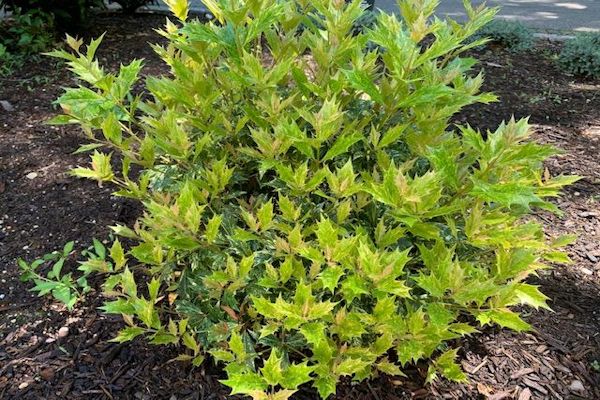
This Month in the Garden: Feature Evergreen Shrub Osmanthus (False Holly)

This Month in the Garden: Feature Plant

Welcome to This Month in the Garden! Often, clients are looking for a colorful, low maintenance addition to the garden that will also give year-round interest. This Month's feature is Osmanthus heterophyllus 'Goshiki' (Goshiki False Holly), a beautiful evergreen shrub known for its outstanding variegated “holly-like” foliage. Meaning 'five colored' in Japanese, the name ‘Goshiki’ refers to the various colors found on each leaf. Hues of cream, pink, orange, yellow, and white appear as attractive spots which combine beautifully together to create interest in all seasons. 

 Osmanthus (False Holly) Mature Growth

Hardy in USDA zones 6-9 and growing to just 3-5 feet tall and 3-4 feet wide, this lovely landscape shrub makes an excellent addition to the full sun to part shade garden. Osmanthus heterophyllus 'Goshiki' is slow growing, requires little maintenance, and can be pruned to keep a more compact size. This shrub can be grown in a variety of soil types and prefers moderate watering. Another attribute is that it is also "deer resistant".
Island Bed with Osmanthus heterophyllus 'Goshiki' (Goshiki False Holly)
As a landscape designer, I try to incorporate a variety of colors and textures, and have found multiple uses for this attractive evergreen shrub. Some ideas for placement include use as a foundation planting which receives partial shade, as a backdrop in a perennial border or as an addition to a raised island bed along with other partial-shade loving plants. For example, in the photo above I have used the highly variegated foliage of Osmanthus (in the foreground) to contrast with the dark green foliage of Weeping Norway Spruce (backdrop), with a variety of large-leaved hosta tucked in between. Depending on the season, the foliage of the Osmanthus will change to provide a constant display of changing color. This attractive and under-used shrub will be sure to make a statement in your landscape!
 Osmanthus (False Holly) New Growth in Spring
I hope you have enjoyed This Month in the Garden for September. Be sure to stop by on the 1st. and 15th. of each month as I share my lifetime love of horticulture with gardening and design tips, information and horticultural adventures. Today I am linking with: Macro Monday 2Friday Photo Journal and Image-in-ing Weekly Photo Link-Up. 

For more gardening information and tips...Visit

My Author Page/Purchase My Books


~As Always...Happy Gardening! ~

 Author: Lee@A Guide to Northeastern Gardening, © Copyright 2010-2020. All rights reserved.

Saturday, September 1, 2018

This Month in the Garden: Shade Loving Evergreen Leucothoe For Your Garden

Feature Plant Leucothoe axillaris
Welcome to This Month in the Garden! Today, the focus is on Leucothoe, an excellent and often over-looked low maintenance shrub for all season interest. Leucothoe axillaris, also known as Coast Leucothoe or Dog-hobble is a low-growing, blooming, evergreen shrub which is native to the southeastern United States from the state of Virginia southward. Leucothoe is hardy in USDA hardiness zones 5-8, prefers a moderately moist yet well-drained soil with a pH of approximately 4.5-6.0 (slightly acidic) and a partially to fully shaded location. Leucothoe can also be grown in an area with sun, providing there is sufficient irrigation.
Leucothoe axillaris Springtime Blooms
Leucothoe has many favorable attributes. It is characterized by its spreading vase-like shape and thick shiny, dark green foliage. Additionally, clusters of slightly fragrant, heather-like, white flowers appear on the plant in mid-spring. Seasonal interest is provided by foliage that changes in color from light green with pinkish tips in spring to a deeper green in summer, followed by a purplish-bronze hue in winter. Leucothoe axillaris grows to a mature height and width of 2-4 feet tall by 3-5 feet wide.
Leucothoe axillaris  Summertime Foliage
Leucothoe is relatively low maintenance and is not prone to any serious pests or disease problems. Leucothoe can be slightly borderline in some areas of zone 5 where winter winds are harsh and should be kept in a somewhat sheltered location. Since it is a broad-leaved evergreen, I would recommend spraying Leucothoe in late autumn in colder climates with anti-desiccant to prevent any possible winter drying. Leucothoe requires little to no pruning. If you desire to prune your Leucothoe to maintain a more compact shape, do so after flowering.  
Leucothoe axillaris Wintertime Foliage
There are several varieties of Leucothoe to choose from besides 'Axillaris', including Leucothoe ‘Rainbow’(zones 4-8 and 3-4 feet tall) Leucothoe fontanesiana or 'Nana' Dwarf Drooping Leucothoe (zones 5-8 and 2-3 feet tall) and Leucothoe fontanesiana or 'Zeblid' Scarletta (zones 5-8, 18-24 inches tall). Each of these shrubs serve nicely grouped in a rock garden, border or woodland garden, as an under-planting or for naturalizing. 
Leucothoe axillaris in Shade Garden
Excellent companion plants for Leucothoe include ‎other shade loving species such as Hakonechloa (Japanese Forest Grass), Variegated Hosta, Sweet Flag, Sedge, Variegted Boxwood, species of Ilex (Holly), Rhododendron and Taxas (Yew). In the photograph above, Leucothoe axillaris (center) is combined with Variegated Boxwood (Right), golden Japanese Forest Grass (Left) along with low spreading Repandens Yew and Variegated Hosta (Far Left Backdrop) for all season interest in the landscape.

For More Gardening and Design Tips~My Books :

~As Always...Happy Gardening!~


Author: Lee@A Guide to Northeastern Gardening, © Copyright 2018. All rights reserved.

Tuesday, February 22, 2011

Berry Producing Shrubs: Color in the Landscape

Berry Producing Shrubs
There are a variety of wonderful berry producing shrubs that can add color and interest to the landscape. Some of these shrubs include Nandina domestica (Heavenly Bamboo), Ilex 'Nellie R. Stevens' (Nellie Stevens Holly), Mahonia aquifolium (Oregon Grape Holly), Barberry 'Rosy Glow' (Rosy Glow Barberry), Ilex verticillata (Winterberry) and Callicarpa Americana (Beauty Bush). All of these shrubs add color and interest to the landscape throughout the different seasons and are an important food source for birds as well.
Callicarpa Americana (Beauty Bush)

Callicarpa Americana or Beauty Bush is known for its beautiful purple berries produced in fall on open cascading branches. It is a native to  North America and is enjoyed by many as an addition to the natural garden. This plant is deciduous, is hardy to USDA zones 7-10 and does best in full sun to partial shade.
Nandina domestica (Heavenly Bamboo)

Nandina domestica (Heavenly Bamboo) is not a bamboo at all but a hybrid evergreen plant that produces white flowers in spring followed by vibrant pinkish-red berries in late summer to fall that last throughout the winter months. Nandina prefers full sun to partial shade, is hardy in zones 4-10, and grows to approximately 5-8 feet tall.  There are also dwarf cultivars such as Nandina domestica 'Firepower' that stay on the smaller side to approximately 2-3 feet in height.

Mahonia aquifolium (Oregon Grape Holly) 

Another interesting plant is Mahonia aquifolium or Oregon Grape Holly.  Known for its purple-blue grape-like berries in summer preceded by yellow blooms in spring it makes a nice addition to the natural garden. Mahonia is a bold broadleaf evergreen shrub with deep green summer foliage and deep burgundy-bronze winter foliage.  It has a holly appearance but is related to the barberry.  Mahonia grows to 3-6 feet tall and wide and is hardy to USDA Zone 5.
Ilex 'Nellie R. Stevens' (Nellie Stevens Holly) 

If you are looking for more of a privacy screening then Ilex 'Nellie Stevens' or Nellie Stevens Holly may be the plant for you. This holly has a showy dark green glossy foliage and produces bright red berries throughout fall and winter. Ilex 'Nellie Stevens' grows to 15-25 in height by approximately 10 feet in width and is hardy to USDA Zone 6.  It prefers to be grown in full to partial sun with afternoon shade and keeps its beautiful deep green foliage throughout the winter.  
Barberris 'Rosy Glow' (Rosy Glow Barberry) in Winter

Barberris thunbergii 'Rosy Glow' (Rosy Glow Barberry) is a deciduous berry producing shrub growing 2-3 feet tall that exhibits bright burgundy foliage throughout the entire summer followed by bright red berries throughout winter that are a favorite food for your winter bird friends. The initial foliage of this plant is a purplish color mottled with pink to red splotches that matures into a deep burgundy followed by insignificant yellow flowers and red berries. There are many forms of barberry including Barberris 'Royal Burgundy', a smaller version growing 1-2 feet in height and a personal favorite!  Barberry  is hardy in USDA Zones 4-8 and prefers to be grown in full sun.
Ilex verticillata (Winterberry)

Ilex verticillata or Winterberry is native to the eastern portion of North America and southeastern portion of Canada and is hardy in zones USDA 3-9. It is one of the deciduous forms of holly growing 5-15 feet tall, preferring partial shade and moist conditions. The attractive red fruits of Winterberry are a food source to many small mammals and more than 48 species of birds. It is commonly used in landscaping in its native northeastern location and provides nice winter interest. Winterberry is not self pollinating so its does require one male plant per group of females in order for the females to produce their vibrant berries.

Color and interest can be achieved in the landscape throughout the entire year. Try incorporating any of these berry-producing plants into your garden and enjoy the benefits they have to offer. You will experience vibrant color in your landscape and all season interest while providing a natural food source for your feathered visitors!   


As Always...Happy gardening!


Author: Lee @A Guide To Northeastern Gardening Copyright 2011. All Rights Reserved.


Sunday, October 10, 2010

Shade Gardening-Designing For Shade

Shade Garden
Over the years, I have received questions on what to plant in a shaded spot. There are many different plants available to create a lovely shade garden that will provide interest throughout the seasons.  I will stick to the varieties of plants which I know from personal experience to be hardy and long lasting for years of enjoyment in your garden. 

Western Arborvitae
For starters, I would suggest the use of evergreens as  the first element in your shade garden. Use taller shade loving evergreens to provide an element of privacy or smaller evergreens for a foundation area. Some of the shade tolerant evergreens that I use for privacy screening are Blue Holly, Dragon Lady Holly, Fastigiate Holly, Oakleaf Holly, Nellie Stevens Holly, Skip Laurel, Western Arborvitae and Leyland Cypress. The Dragon Lady and Fastigiate forms of holly tend to stay more on the narrow side whereas the other varieties mentioned tend to become larger and fuller.  Western Arborvitae and Leyland Cypress are both shade tolerant and fast growing; however, Leyland Cypress are prone to wind damage and drying due to their shallow root system. 
Liriope Variegata
Western Arborvitae are deeper rooted and look similar to Leyland Cypress without the risk of damage. 

As a smaller evergreen backdrop, I often use Cherry Laurel 'Otto Luyken', Ilex 'Compacta', or Boxwood 'Wintergem'.  For added interest, some flowering shrubs I would recommend are 'Little Princess' Spirea, Hydrangea or Vibernum.  (The last three flowering shrubs are shade tolerant but do need some amount of filtered light in order to bloom correctly.) 

Heuchera (Coral Bells)
Once the foundation of your shade planting is established, perennials can be added for additional color. Some of the best shade perennials I have encountered are hosta, liriope, hakonechloa (japanese forest grass), astilbe, heuchera, japanese painted fern, golden sedge and ajuga.  These perennials combine beautifully with cherry laurel. rependans yew, boxwood, variegated boxwood, leucothoe, holly, skimmia and aucuba.   There are many forms of hosta to choose from as well as heuchera.  My personal favorite is Hosta'Patriot' combined with Heuchera 'Palace Purple' or 'Plum Puddng' . The variegation of the hosta along with the deep burgundy color of the heuchera combine beautifully with variegated liriope or golden sedge.  Astilbe can be another desired addition and is available in a variety of sizes and colors.

Additional interest can be achieved in your shade garden through the use of hardscape. There are various hardscape elements that can be used to complement your space, such as the addition of large boulders, stone pathways and raised walls. You may also like to add a bench for seating or other hardscape element such as a birdbath to attract wildlife to your garden. 


A shade garden can be very pleasing, providing you have the right plants.  So next time you ponder, "What can I do with this space?", there is so much that can be done to create the shade garden of your dreams! Visit the following link Shade Garden for my complete album of shade tolerant perennials.   

For more on Garden Design: My Books on Amazon:
Author:Lee@ A Guide To Northeastern Gardening Copyright 2010. All Rights Reserved