Showing posts with label butterfly garden. Show all posts

Sunday, August 1, 2021

Perennial Highlight: Echibeckia Summerina

This Month in the Garden
Welcome to This Month in the Garden! Come along for a visit on the 1st of each month to explore updates in the horticultural industry, garden design tips, gardening related locations, planting and maintenance tips, all along with new introductions into the gardening world. This months highlight is a relatively new plant in the horticultural industry, which I have personally tested, and found to be a successful addition to my zone 7 Long Island garden.

Echibeckia Summerina 'Blazing Fire'

Introduced by Pacific Plug & Liner, Echibeckia Summerina is a hybrid derived from an intergeneric cross between Echinacea (Coneflower) and Rudbeckia (Black Eyed Susan), possessing the appearance and rapid growth of Rudbeckia and the vigor and disease tolerance of Echinacea all in one plant! This herbaceous perennial displays yellow petals that start with a red ringed center in early summer, which becomes flecked throughout by fall. Depending on the variety, colors may appear lighter or darker and more towards either the yellow or orange side. Flowers that can last two to three months are three-inches in diameter on a 16-24 inch tall compact plant. 
Echibeckia 'Rainy Leaf'

Echibeckia is most hardy in zones 7-9, but may survive as far as zones 6 and 10, prefers full sun and a moderately moist soil. Echibeckia is perfect for sunny borders and cutting gardens, is drought tolerant once established, and attracts butterflies. Echibeckia is self-cleaning, which means there is no need to deadhead to extend bloom time, making this cultivar low maintenance and certainly worth a try! Newer varieties are being added to the collection, including Echibeckia 'Rainy Leaf' 'Butterscotch Biscuit' and 'Pumpernickel'. I found this beauty at a local farm stand, and it is a winner!

I hope you enjoyed This Month in the Garden. Be sure to stop by on the 1st. and 15th. of each month as I continue to share gardening tips, information and horticultural adventures! (Linking with: Floral Fridays, Macro Monday 2, Ruby Tuesday and Image-in-ing Weekly Photo Link-Up.

~Sharing my knowledge and passion of gardening~

My Author Page and Books

Thursday, July 1, 2021

Pollinator Friendly Perennials & Shrubs

This Month in the Garden: Pollinator Friendly Perennials & Shrubs
Welcome to This Month in the Garden! For the month of July and start of summer, pollinator-friendly plants are the topic of discussion. With the declining population of bees, it is important now more than ever to include plants in your garden that are helpful to these important members of our ecosystem. Besides the infamous Milkweed, there are numerous long-blooming selections that will not only add color and fragrance to your garden, but will help to attract the well-needed pollinators and give you enjoyment throughout the spring-fall season!
Double Knock Out Rose
For beautiful blooms starting in spring that are pollinator friendly, Knock Out Rose is an excellent choice. These prolific blooming shrubs are hardy to USDA zone 5 and have a bloom cycle that starts in spring and lasts well into frost. Knock Out Roses grow to 3-4 feet high by wide and should be grown in full sun in a well-drained soil. They do not require any special care but can be pruned in early spring after the threat of frost is gone to keep them full. They do not require deadheading but if desired you can remove spent blooms to encourage more blooms. They are the most disease resistant roses on the market and are not susceptible to black-spot fungal disease.  Note: Roses prefer to be watered from the bottom to avoid fungal issues on the leaves.
Salvia 'May Night' (Meadow Sage)
Salvia nemerosa 'May Night' displays deep purple blooms from late May through July on 12-18 inch spikes and is hardy in USDA Zone 3-9. Salvia prefer to be grown in full sun in a moist, yet well-drained soil and are drought tolerant once established in the garden. With regular pinching back of spent blooms, this beautiful perennial can have a repeat performance all the way through fall. Other varieties of Salvia include, but are not limited to, 'April Night' (earlier blooming) 'East Friesland' (later blooming), and 'Caradonna' (taller). 
Veronica (Spiked Speedwell) Magic Show 'Royal Candles'
Veronica Magic Show 'Royal Candles' (Spiked Speedwell) is known for its prolific blooms from late spring through fall. Hardy in USDA zones 3-8, this hummingbird and bee-friendly perennial displays spikes of deep purple-blue flowers above attractive deep green foliage on a 15-18 inch tall plant. Plant Veronica in full sun to part shade in a moderately moist soil and enjoy its beauty all summer long.
Veronica (Spiked Speedwell) 'Purplegum Candles' 
Hardy in USDA zones 4-8, Veronica spicata 'Purplegum Candles' is another compact upright Veronica producing pinkish-purple blooms starting in early to mid-summer and lasting through autumn on a 14-16 inch high plant. Plant 'Purplegum Candles' in a location with full sun to part shade and a moderately moist soil. This plant is a major attraction for hummingbirds and bees.
Nepeta (Catmint) 'Walkers Low'
Nepeta 'Walkers Low', a dwarf form of nepeta with gray-green aromatic foliage, produces large violet-blue  flowers that bloom all summer long. Nepeta 'Walkers Low' is drought tolerant and deer resistant.  It can be grown in full sun to partial shade and forms round compact mounds.  This perennial goes well with coreopsis and daylily and is hardy in zones 3-8. Other forms of dwarf, more compact Nepeta include 'Walkers Low Junior', 'Blue Wonder' and 'Little Titch'. Nepeta can be easily pruned to maintain its shape.
Coreopsis (Tickseed) 'Zagreb'
Hardy in USDA zones 3-9, Coreopsis 'Zagreb' is a popular favorite for areas of full sun and produces a clump of delicate, ferny foliage, with an abundance of bright, golden yellow daisies throughout summer on 12-18 inch fern-like stalks. Coreopsis prefers a well-drained soil and can withstand drought-like conditions once established. Coreopsis will spread so plant it in a place where you have plenty of room and enjoy its beauty. Coreopsis is complemented nicely by either salvia or nepeta. Also, look out for all the newer cultivars of Coreopsis, including 'Daybreak' and 'Sunkiss', each displaying yellow blooms with orange centers.
Hemerocallis (Daylily) 'Stella D Oro'
June blooming 'Stella D' Oro' Daylily brings in summer with continuous bright yellow blooms from late spring until frost. This is by far the most popular Daylily selection of all time, performing well in zones 4-11, and flowering for months on end. 'Stella D Oro' forms a dense clump of grassy green foliage, with upright stems of mildly fragrant, golden yellow trumpet flowers on 24-30 inch stems. Plant Daylily in an area receiving full sun to partial shade in a well-drained soil with moderate watering. Removing spent bloom stalks and foliage will increase bloom time well into autumn.
Echibeckia 'Summerina 'Blazing Fire'
A new cultivar is here, combining the features of Echinacea and Rudbeckia all into one! Hardy in USDA zones 7-9, Echibeckia Summerina 'Blazing Fire' grows to a height and width of 16-24 inches high by 18-24 inches wide and prefers full sun. It's blooms that are much larger than those of its parent cultivars are on display from early summer to autumn and are a wonderful attraction for pollinators! 
Echinacea (Coneflower) 'Cheyenne Spirit'
One of the newer hybrids of Coneflower, Echinacea Cheyenne Spirit features daisy-like blooms in vivid shades of orange, red, rosy-red, yellow, purple and cream surrounding a large brown cone all on the same plant! 'Cheyenne Spirit' is hardy in USDA zones 4-10, blooms early summer to fall and prefers full sun and moderate watering in a well-drained soil. Drought tolerant once established, this perennial is also cold hardy, disease resistant, heat tolerant, humidity tolerant and pest resistant. This herbaceous perennial has a mature size of 24-30" tall by 18-24" wide and displays a full upright habit. Echinacea 'Cheyenne Spirit' is ideal for sunny borders, mass plantings, massing in cottage gardens and cut flowers. 
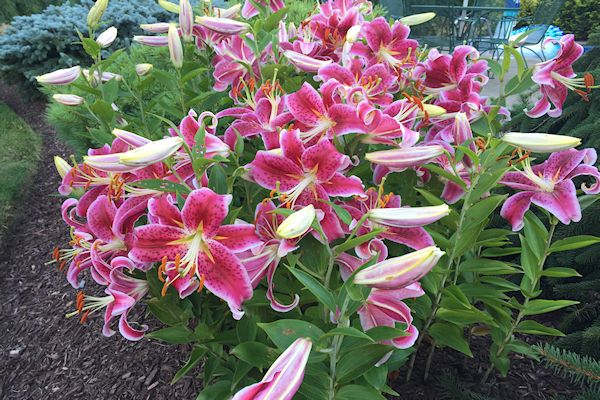
Lillium 'Stargazer' (Asiatic Lily)
Bringing in mid-late summer, Lillium 'Stargazer' is known for its beautiful coloration and very fragrant blooms. 'Stargazer' grows in clumps that are 12-16 inches in width and reaches a height of 36 inches and blooms from July-August. It is hardy in USDA zones 4 to 10 and prefers to be grown in full sun in a slightly acidic and rich, well-drained soil. 'Stargazer' can be easily divided by digging up bulbs and re-planting (best done in fall). 'Stargazer' is a prolific bloomer that thrives in the garden and is an attraction to pollinators. 
Buddleia (Dwarf Butterfly Bush) 'Blue Chip'
Hardy in zones 4-9 and blooming later in summer, Buddleia Lo & Behold 'Blue Chip' is a dwarf cultivar of Butterfly Bush, displaying delicate arching branches and colorful nectar filled flowers that are a major attraction for Hummingbirds and butterflies. Lo and Behold 'Blue Chip' displays a low mounding compact habit, growing to approximately 24-26 inches high by 30-36 inches wide. Its neater well branched habit makes it an ideal addition in tighter spaces or small gardens. Another dwarf variety of Buddleia is 'Pugster Blue'. This cultivar displays elongated  deep purple blooms on a compact plant, and the pollinators love it!

I hope you enjoyed This Month in the Garden. Be sure to stop by on the 1st. and 15th. of each month as I continue to share gardening tips, information and horticultural adventures! (Linking with: Floral Fridays, Macro Monday 2, Ruby Tuesday and Image-in-ing Weekly Photo Link-Up.


For gardening info and tips: Visit my Author Page/Purchase My Books  Be sure to check out my newest book: Gardening by Month for 12-months of interest in the landscape!😊
Author: Lee @A Guide to Northeastern Gardening,© Copyright 2010-2021. All rights reserved. 

Saturday, August 15, 2020

Garden Bloggers' Bloom Day & Foliage Follow-Up August: Blooms, Visitors & Adventures

Welcome to my August Garden!

Welcome to my August Garden! It has been an eventful month (to say the least) here in the Long Island northeastern garden. Tropical Storm Isaias arrived on a Tuesday afternoon on the 4th of August with high winds gusting to 60 miles per hour, followed by the power going out at 3 pm, and not returning until three days later. There were trees and branches down everywhere, and I cringed as I watched the garden with each gust of wind. Thankfully, the garden was spared. We are still in the process of cleaning up, but all is good.
Lillium 'Stargazer'
Before we visit what is currently blooming, here is a flashback from before the storm. A heat wave at the end of July sparked the Lillium 'Stargazer' to bloom a little earlier than usual. They were exceptionally beautiful this year, so I thought I would share.
Littlium 'Stargazer'
The plants were just loaded with fragrant blooms!
Ruby-Throated Hummingbird
After several years of putting out a variety of hummingbird feeders, we finally have a regular visitor! This Ruby-Throated Hummingbird has returned for a second season and has made our home his feeding station. He flies back and forth all day between the Magnolia tree in the back garden, taking a momentary stop at the Hosta blooms, and then to the feeder right by our patio. I can hear the humming of his wings and little tweeting noises he produces as he enjoys the nectar. Seeing his presence is so much fun and we get excited every time our visitor comes by!
Rudbeckia (Black Eyed Susan) 'Little Goldstar'
Here is Rudbeckia 'Little Goldstar', a dwarf form of Black Eyed Susan. It stays nice and compact (14-24 inches tall x 18 inches wide), blooms mid-late summer and stays where you plant it. In the foreground are  Hosta blooms, which are an attraction to hummingbirds and other pollinators.
Patio Garden-Buddleia 'Pugster Blue'
August is Butterfly Bush time and this Buddleia 'Pugster Blue' is showing off its fragrant deep purple-blue blooms. It is literally a butterfly magnet! Butterflies of various types are attracted to and visit the plant constantly. We even got a visit (for the second year in a row) from the hummingbird moth.
Swallowtail Butterfly on Buddleia
Here is a Swallowtail Butterfly visitor. He frequents the blooms several times a day and cannot get enough!
Pollinator!
Bumblebees are hard at work too!
Agastache 'Rosie Posie' Hyssop
New to the garden this year is Agastache (Hyssop) 'Rosie Posie'. Hardy in USDA zones 6-9, this is one of the longest blooming varieties of Hyssop and grows to a height of about 22 inches. I am hoping it does well and will become as a longtime member of the garden.
Platycodon (Balloon Flower)
Here is Platycodon (Balloon Flower) blooming in the August garden. This perennial never ceases to amaze me with its interesting "balloon-shaped" blue blooms. It is always a conversation piece for visitors too.
Waterfall Extension
What does one do during a pandemic and heat wave? An obsessive gardener like myself would go to the nursery with the pick-up truck and load it with hundreds of pounds of moss rock boulders. After too many complaints from hubby about soil getting into the pool, I did a renovation of the two sides of the pool waterfall using the moss rock to extend it on both sides. After ripping out a very stubborn and overgrown ground-cover shrub that had served its time, I placed the rock to prevent erosion from the slope. Mission accomplished and hubby is happy!
Astilbe 'Sprite'
Back to the tour! If you are looking for a variety of Astilbe that blooms much later after all the others, here is Astilbe 'Sprite'.  It displays delicate foliage and light pink blooms, that last for several weeks.
Crape Myrtle 'Sioux'
It's Crape Myrtle season! Here is Lagersstroemia indica 'Sioux' with its deep pink blooms. 'Sioux' is one of the larger forms of Crape Mytle and reaches about twenty to twenty-five in height. I have had this tree for many years and was so worried about it during the storm. It had lost some major branches two years ago during a severe winter and has been recovering nicely, so I was concerned.
Crape Myrtle 'Sioux'
Here is a view of the full tree. I have allowed the trunks to multiply, as I love the massiveness of the tree.
Crape Myrtle 'Sioux' Peeling Bark
Crape Myrtles are also known for their exfoliating bark, exposing various colors as it peels away to uncover a new layer.
Sedum 'Brilliant' Almost Blooming!
As we stroll around to the southern garden, here is Sedum 'Brilliant' getting ready to bloom. It's a lovely plant for its foliage, even when it's not blooming. Watch for it in next month's garden tour!
Echibeckia Summerina 'Blazing Fire'
Here is another new addition to the perennial border for this year. Echibeckia is a new cultivar combining the features of Echinacea and Rudbeckia all into one! Echibeckia Summerina 'Blazing Fire' grows to a height and width of 16-24 inches high by 18-24 inches wide and prefers full sun. It blooms early summer to autumn. I hope this one does well in the garden!
Daylily 'Stella D Oro'
Last but not least is Stella D' Oro Daylily, still blooming with just a little deadheading! I love how this variety just keeps on giving!
Long Island August Sunset
With summer storms also come summer sunsets, and this one was one of the most beautiful views I have seen in a long time. 
August Sunset in the Garden
Nature certainly has its moments!
Thank you for visiting!

I hope you enjoyed your visit to my August garden. As always, I thank you for being here and enjoy hearing from you. Special thanks go out to our hostess Carol at May Dreams Gardens, who makes it possible to see blooms on the 15th of every month with her meme Garden Bloggers' Bloom Day. Also, special thanks to Pam Penick at Digging who has hosted Foliage Follow-Up for all these years, a meme I will still continue to honor. I am also linking with some other wonderful hosts and hostesses at Floral Friday Fotos, Macro Monday 2, Mosaic Monday at Letting Go of the Bay Leaf, Nature Notes at Rambling Woods, Image-in-ing weekly photo share every Tuesday with NC Sue and Gardens Galore Link Up Party every other Monday with Everyday Living. I am also happy to join the Homestead Blog Hop and Weekly Photo Link-Up at My Corner of the World on Wednesdays. 

~Sharing my knowledge and passion of gardening~

My Author Page and Books


Author: Lee@A Guide to Northeastern Gardening,© Copyright 2010-2020. All rights reserved.

Friday, June 1, 2018

This Month in the Garden: Ten Perennials For Your Garden That Deer Will Avoid

Deer Resistant Perennials
Over the years as a garden designer, I frequently meet with clients who have an ongoing issue with deer foraging their gardens. The deer population has been escalating and I have heard stories of new homeowners landscaping their entire property with beautiful blooms only to find that all their hard work was destroyed, and sadly within the first week of planting. While no plant is completely deer resistant, there are species that are avoided by our four-legged friends due to their taste, texture or aroma. If you are looking for interest to add to your landscape that will supply years of enjoyment, and not be foraged by deer, here are a few suggestions.
Coreopsis ‘Zagreb’(Tickseed)
The first is Coreopsis or 'Tickseed', which is known for its delicate yellow or pink daisy-like flowers on lacy foliage, that bloom from early summer into fall. Coreopsis is hardy in USDA zones 4-8, prefers to be grown in full sun in a well-drained soil, and is drought tolerant once established. Coreopsis is available in several varieties ranging in flower size and colors ranging from yellow to pink, and reddish-orange to the newly hybridized yellow-orange bloom. I have found the ‘Zagreb’ variety (photo above) to be an excellent “deer resistant” bloom that produces a full array of repeat blooms for many years in the garden.
Nepeta ‘Walkers Low’ (Catmint)
Nepeta is a member of the mint family and is known for its distinctive gray-green aromatic foliage that is an attraction to cats when crushed. Nepeta displays soft lavender-blue blooms which are produced in early summer and continue through fall, giving a long-lasting display of color. The perennial is available in a variety of heights ranging from the smaller 18-24-inch tall 'Little Titch' to the taller 2-3-foot tall 'Mussinii'. Nepeta is hardy in USDA zones 4-9 and prefers to be grown in full sun to partial shade in a well-drained soil. Little care is required once this plant is established.
Salvia ‘May Night’ (Perennial Sage)
Salvia or sage thrives best in USDA zones 4-8, is "deer resistant" and blooms throughout the summer with regular dead-heading. There are many varieties of sage to choose from, ranging in height from the 10-12- inch tall Salvia ‘Marcus’ to the 20-30-inch tall ‘Caradonna’ variety. Species vary in color from the white (Salvia nemerosa ‘Snow Hill”) to rose-pink (Salvia nemerosa ‘Sensation Rose’) to the more popular purple varieties (such as Salvia nermerosa ‘April Night’, ‘May Night’ or ‘Caradonna’). A very popular plant in the garden, Salvia is also an attraction to butterflies.
Peony ‘Karl Rosenfeld’
Peony displays large mildly fragrant blooms in late spring to mid-summer. Peony are hardy in USDA zones 2-8, prefer full sun to partial shade and like their roots protected. Peony are available in a wide range of colors including light pink, rose pink, white and yellow. Plants vary in stature depending on the variety, but generally range in height between 2-3 feet. These beautiful late spring/early summer-blooming beauties are an asset to any garden and blooms are followed by handsome foliage that lasts for the remainder of the gardening season.
Dwarf Fountain Grass ‘Hameln’

If you enjoy having ornamental grasses in your garden, they are also "deer resistant". There are many varieties of grasses in varying heights to choose from including the well-known Fountain Grasses Pennisetum Alopecuroides 'Hameln' (2-3 feet) or 'Little Bunny'(1-2 feet) as well as the Maiden Grasses Miscanthus Sinensis 'Gracillimus' (5-8‘) or 'Morning Light' (4-5’) among others. Ornamental grasses are generally hardy to USDA zones 5-9 and prefer full sun and a well-drained soil. They will add grace and movement to your landscape and are well suited to a variety of garden styles.
Ajuga reptans 'Burgundy Glow' (Bugleweed)
Ajuga (Bugleweed) is a groundcover perennial hardy in USDA zones 3-10 that displays bluish-purple blooms in early spring on 4-6-inch tall plants. Ajuga thrives in partial to full shade and serves well as a massed planting under trees or in perennial borders. Foliage remains evergreen in winter and takes on a rich bronze-burgundy tone to provide constant interest.
Hakonechloa macra ‘Aureola’ (Japanese Forest Grass)

Hakonechloa, or Japanese Forest Grass, is a grass-like perennial hardy in USDA hardiness zones 4-9 that prefers partial sun to shade and a moderately most soil. Wispy golden-green low arching stems cascade gracefully on an 18-inch tall and wide plant to add a dramatic look to the garden. This plant adds beautiful interest to the landscape when cascaded over a wall, as seen above.
Allium ‘Globemaster’

Allium (Ornamental onion) is an easy to grow bulb which has become increasingly popular in gardens over the past few years. Allium produces globe-shaped purple, white or pink blooms in late spring/early summer on tall stately stalks. Allium is hardy in USDA zones 4-9 and is best grown in full sun in a well-drained soil. Bulbs are best planted in fall (September-November) the season before you want them to flower. If you have an issue with deer or rodents, Alliums are an excellent addition, since they are looked upon as distasteful to the palate.
French Lavender

Lavender is a well-known aromatic herb used over the centuries as a perfume and herbal remedy. It is hardy in USDA zones 5-9 and requires full sun and a well-drained, moderately dry soil. Lavender displays bluish-purple blooms on 24-30-inch grey-green foliage in mid-summer to early fall and is deer resistant as well as drought tolerant once established. Lavender also is known to attract butterflies. Different species of lavender vary in cold hardiness,  so choose accordingly for your zone.
Stachys (Lamb’s Ear)

Stachys (Lamb’s Ear) is hardy in USDA zones 4-9 and displays silvery-white “wooly” leaves with a velvety feel. Tall stalks appear in summer with pinkish-pink blooms that last into fall. Lamb’s Ear prefers to be grown in full sun to partial shade in a moderately moist soil. The interesting foliage of Stachys remains throughout the winter and serves nicely as a border plant in a perennial garden.

This selection of perennials that can be utilized to create a colorful cottage garden or perennial border that is undesirable to deer. More structural elements to complement these plants could include, but are not limited to, Spirea, Butterfly Bush, Boxwood, Crape Myrtle and certain species of holly and cedar. Generally, the more aromatic and coarse the foliage, the more undesirable the plant will be to foragers. Remember, deer can be unpredictable creatures and your situation may vary, but these selections should get you started in the right direction for a successful and beautiful garden.

For more information on "deer resistant" plantings and use of these ornamental plants in landscape design, see my books,  A Guide to Northeastern Gardening and Landscape Design Combinations, or visit my Author Page.

~As Always...Happy Gardening!~

Author: Lee@A Guide to Northeastern Gardening, © Copyright 2018. All rights reserved

Sunday, October 1, 2017

This Month's Color in the Garden October 2017: Chrysanthemum for the Autumn Garden

This Month's Color in the Garden October 2017
Autumn is upon us in the northern hemisphere and it's time for another This Month's Color in the Garden. For the month of October the feature color is orange and Chrysanthemum comes to mind, as it is a favorite fall addition for many a gardener, supplying a burst of color for the landscape as the temperatures cool.
Chrysanthemum (Dendranthema grandiflora)

Chrysanthemum, commonly referred to as mums, are characterized as perennials in many areas, but are also treated as annuals by many gardeners. Their bright colors and variety of blooms are an attraction in the autumn garden. Depending on the specific variety, most mums are cold hardy in USDA zones 5 through 9, which means they can overwinter in the ground. In northern areas, it is preferable to plant Chrysanthemums in spring so they have the entire season to become established. In southern areas, they may be planted in either spring or autumn, but autumn is best to avoid excessive heat. Most Chrysanthemums do well in an organic well-drained soil in full sun. To care for your plants and keep them full, pinch back new growth when it reaches 4-6 inches and continue pinching through June. This will keep plants compact and prevent them from blooming too early.
Chrysanthemums
There is much history and folklore behind Chrysanthemums. Named from the Greek prefix "chrys-" meaning golden (the original color) and "-anthemion," meaning flower, years of hybridization have produced a full array of colors including shades of yellow to white, orange, purple, pink and red. Chrysanthemums are the November birth flower, the 13th wedding anniversary flower and in Japanese culture, the opening of a chrysanthemum's petals represents perfection. Confucius at one time considered these plants to be associated with mediation and since the 15th century, Chrysanthemums were grown as flowering herbs and considered an honored plant with exceptional powers. Folklore says that a single petal at the bottom of a wine glass will encourage a long and healthy life. Since this month's color is orange, orange is known to symbolize joy, warmth, optimism, happiness, freedom, expression, enjoyment and creativity. Throughout history, the American Indians have associated the color orange with kinship, and in China and Japan, the color orange symbolizes happiness and love.
Chrysanthemums come in a variety of colors.

Whether you are in the northern or southern hemisphere, Chrysanthemums can be an excellent addition to your garden. Other orange blooming flowers include Gaillardia (Blanket Flower), Lillium, Lantana, Marigold, Zinnia, Dahlia, Butterflyweed, Helenium, Red Hot Poker, California Poppy or perhaps Bird of Paradise or Aloe for those warmer climates.

I hope you enjoyed This Month's Color in the Garden for October. Please do share your experiences with the color orange in your garden, whether it be with plants, hardscape or garden decor. Next, join me for Garden Bloggers' Bloom Day and Foliage Follow-Up on the 15th! See you around the garden!

As Always...Happy Gardening!

Author: Lee@A Guide to Northeastern Gardening, © Copyright 2017. All rights reserved