Showing posts with label combining perennials. Show all posts

Sunday, September 1, 2019

This Month in the Garden: Long Island Places, Sunflowers, and Childhood Dreams Come True!

This Month in the Garden
Welcome to This Month in the Garden! I have been a gardener all my life and ever since I was a small child, I have had a fascination with sunflowers. Every summer my parents and I would go for a Sunday drive out east here on beautiful Long Island, a tradition which I continue to honor along with my husband of 37 years. While growing up back in the 60's, sunflower fields were not readily available to the public and I would gaze in awe each time we traveled past the fields of yellow discs pointing towards the sky. Times have changed and just recently in 2018, farmers have opened up their fields to the public. I am thankful to have for the first time last year experienced standing among acres of sunflowers, I couldn't wait to revisit the fields this year. Come along! 

Late Summer Perennials at Verderber's Garden Center & Nursery
On the way out east, there are some amazing nurseries on the way, some which are more like botanical gardens. Here is a late summer display of Black Eyed Susan, Joe Pye Weed and Russian Sage, each perennial being an attraction for pollinators. They can be seen at Verderber Nursery out in Aquebogue. The family owned business comprising of 300 acres of conifers, shade trees, perennials and shrubs is run by husband-and-wife team John and Maria Verderber and their three children, aged 26 to 28, all who possess a love of horticulture.
Verderber's Nursery
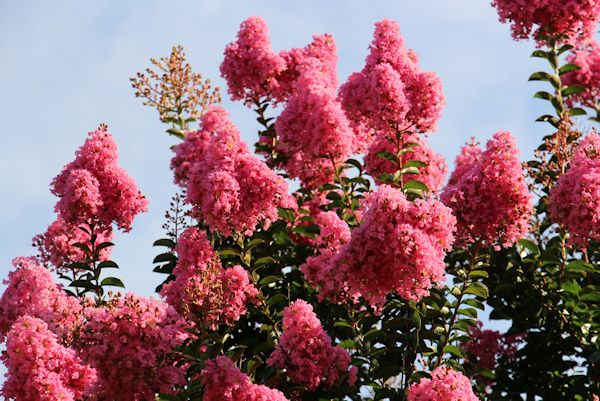
This beautiful Natchez Crape Myrtle is in full bloom for the late summertime into fall. It's one of my personal favorites for late summer interest and enjoyment in the garden.

Perennials at Verderber's Nursery
Here is Joe Pye Weed close up with a  butterfly visitor! Now that I've gotten my nursery fix, onto the sunflowers!

Bayview Farms & Market
One of the local farm stands we regularly visit on our rides out east is Bayview Market & Farms, a 200-acre farm in Aquebogue, Long Island. The farm, owned by the Reeve family started when Orry Reeve floated wagons across the Peconic Bay to peddle produce to Southampton hotels. As the family expanded and after many years of selling fruits and vegetables off the back of a truck, George C. Reeve, Sr. and his sons George Jr. and Bradford Reeve built the first roadside stand, which they named Little Chief, after George's favorite variety of sweet corn. In 2002, Bradford Reeve, Sr. and his wife Lorraine, built a larger farm market, returning it to the original name Bayview Farms and Market. In 2014, the Reeve family further expanded, building a second market in Jamesport.

Sunflower Field
Here is the family owned sunflower field that lies on the property of Bayview Farms. This was our second year visiting it and it was just as beautiful as the first time!

Sunflower Maze North Fork Long Island
Continuing on the journey, my husband and I visited the North Fork sunflower maze for the second year. The Sidor sisters, Cheryl and Maureen, decided to open the fields to visitors in 2018 after growing sunflowers at the site for several years. They tried doing a sunflower maze back in 2012, and after a six-year break, they decided to bring it back for the 2018 season by popular demand. The fields are grown in succession with a variety of different types of sunflowers, each producing a differently flavored oil for the production of their well-known potato chips.
One with the Sunflowers!
Life is the accumulation of memories and experiences. The meaningful trip out east in 2018 and being able to stand in a field among the glorious sunflowers sparked childhood memories, and ended up opening an idea for a chapter in my latest book, Dream, Garden, Grow!-Musings of a Lifetime Gardener, recently published in December of 2018. It is amazing how experiences, memories of childhood and a love of horticulture can make dreams come true. After much research and accumulating past and present memories, the words for Chapter 4 materialized. The meaning and uses behind the mysterious sunflower throughout centuries of garden history and folklore made the memories I have even more dear to my heart.
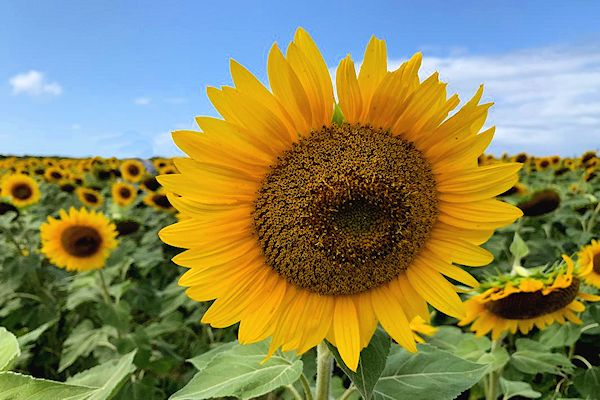
Long Island Sunflowers-Sunflower Maze 
I will look forward to the next encounter with my field of dreams. Now...onto the rest of our journey!
Wisteria Arbor Jamesport, Long Island
I am a Long Island native and continue to be amazed by all the beauty and history that exists here. On our way back, we stopped to view this Wisteria lined pergola at the Jedediah Hawkins Inn, a historic property nestled in the town of Jamesport. Jedediah Hawkins, born in Stony Brook in 1837, ventured to sea at the young age of 12 and became the master of a trading vessel by the age of 18. He and each of his four siblings later moved eastward and settled in the town of Jamesport.
Jedediah Hawkins Inn, Jamesport, NY
Jedediah Hawkins built this Italanite style home in 1863 on a 22 acre plot in Jamesport, Long Island, New York. The home was occupied into the first half of the 20th century, but became abandoned in the 1980's. The home was acquired in 2004, just days from planned demolition, and restored to its original form. Jedediah Hawkins Inn opened in September of 2005 and was added to the National Registry of Historic Places in 2008. 


There are numerous features on the grounds such as this beautiful fountain...


and scenes like this garden bench surrounded by Weeping Japanese Maple, Hydrangea, Black Eyed Susan, Nepeta and Hosta...


and this welcoming gazebo surrounded by beautiful gardens.

Monarch Butterfly
The gardens at the Inn are full of pollinator friendly flowers and August and September are Monarch season, so there are plenty to be seen. This Monarch Butterfly stayed and posed for me!
Long Island Sunflower Maze, North Fork
I hope you enjoyed This Month in the Garden for September. Be sure to stop by on the 1st. of each month for This Month in the Garden, as I share gardening tips, information and horticultural adventures! As you can see, there is always more to explore within your own backyard and childhood dreams can come true. 

Visit my Amazon Author Page and Books

To read more about sunflowers and other musings, check out my newest book...


~As Always...Happy Gardening!~

Author: Lee@A Guide to Northeastern Gardening,© Copyright 2010-2019. All rights reserved.

Monday, October 1, 2018

This Month in the Garden: Alluring Alliums!: Fall Planting, Care & Maintenance

Allium Planting, Care & Maintenance
Allium is a genus consisting of over 850 species of plants which includes ornamental forms used for gardening and those cultivated for food, such as onion, garlic, chives, scallion, leek and shallot. Allium can be found growing in the Northern Hemisphere, with a few species occurring in Chile, Brazil and tropical Africa. Originally classified by Carolus Linnaeus in 1753, allium were considered a plant with valuable attributes. By the late 1800’s Russian botanists began collecting species of Allium from Central Asia and introduced them to horticulturists through the Imperial Botanical Garden. Soon after, Britain had heard of this new family of garden-worthy plants and continued to expand the number of available selections through hybridization. Allium has gained increased recognition over the years for its ornamental qualities and was named bulb of the year in 2016 by the The National Garden Bureau and the Perennial Plant Association has voted Allium 'Millenium' as the Perennial Plant of the Year for 2018! 
Globemaster Allium
Allium (Ornamental Onion) are hardy in USDA hardiness zone 3-9, depending on the species, and prefer to be grown in full sun. Allium are drought tolerant and should be planted in a well-drained, slightly acidic soil (pH 5.5-6.5) which is kept on the drier side. Bulbs should be planted in early autumn (September-November) at a depth of approximately four times the diameter of the bulb. Smaller growing Alliums should be planted at 3-4 inches (8-10 cm) apart, while taller species need at least 8 inches (20 cm) between the bulbs. A sprinkle of bone meal around the bulbs at time of planting (but not near the root) will give them a good start. As mentioned, Allium bulbs are best planted in autumn (by late November) but can be planted in late winter/early spring for late May/June blooms. Flowers may not be as large in the first season, so the application of a balanced fertilizer once foliage emerges will encourage plant strength and blooms.
Allium Mont Blanc
Allium bloom time starts in late spring into early summer and plants are available in a wide variety of sizes and colors, ranging from the white Allium (example 'Mont Blanc'), to blue (Allium caeruleum), yellow (Allium flavum) and purple (Allium giganteum). Plant heights vary between 10 inches (25.4 cm.) and 50 inches (127 cm.) and produce rounded blooms that form at the top of a leafless stalk. Many Allium have basal leaves that commonly wither away before or while the plants are in flower, but some species have persistent foliage throughout the season. Generally, species that hold onto their foliage typically bloom later into fall and form dense clumps rather than individual blooming plants. Varieties that lose their foliage tend to form individual stalks with larger blooms. Allium can be planted as seed, but is best planted as bulbs, which vary in size between species from the smaller 2–3 mm bulb to the larger 8–10 cm bulb of larger blooms. 
Allium Globemaster (Allium giganteum)
Allium require little to no maintenance and are mostly pest and disease free. They are members of the onion family, so the foliage and blooms and are not preferred by deer, rabbits or squirrels. They are also an attraction to butterflies, bees and other pollinators. Removing spent blooms after blooming can encourage plants to store more energy for the following year, but it is not necessary, and some gardeners prefer to leave dried blooms for the remainder of the summer for interest and to encourage re-seeding. There is no need to dig Allium up in the fall, since they do not require any dividing, but can be moved to other locations at that time.
Allium caeruleum Blue
Allium have a wide variety of uses in the landscape and can be planted among evergreen or flowering shrubs and along with other perennials. This versatile plant is easy to plant and maintain and will bring years of enjoyment to your landscape. The possibilities are endless!
Photo Credit: Longwood Gardens (Flowering time Left to Right: Late Spring-Early Summer)

As Always...Happy Gardening!

Author: Lee@A Guide to Northeastern Gardening, © Copyright 2018. All rights reserved

Sunday, September 3, 2017

This Month's Color in the Garden September 2017: Feature Plant-Black Mondo Grass

This Month's Color in the Garden
Welcome to This Month's Color in the Garden! It's September and the feature color is black. Black is a rare and unusual color in the garden, but is exquisite when mixed with the right combination of plants. Although there are no truly black flowers or foliage, some varieties appear black due to the deepness of the purple or burgundy hues within them. Black blooms or foliage can bring interest and drama to the landscape when used properly. One plant in particular, which is known for its striking black foliage, is Black Mondo Grass. Mondo Grass is actually not a grass, but rather a member of the genus Ophiopogon, a genus of evergreen perennial plants native to India, China, Japan and Vietnam. Black Mondo Grass, Ophiopogon planiscapus 'Nigrescens' is considered a ground cover that grows to approximately ten inches tall and slowly spreads to about two feet in width. Foliage emerges as dark green in spring and matures to a deep purplish-black by summer. Black Mondo Grass is hardy in zones 6-10.
Black Mondo Grass (Ophiopogon planiscapus 'Nigrescens' )
Ophiopogon planiscapus 'Nigrescens' produces spikes of small light pink-white bell shaped flowers in mid-summer, followed by small black berries. Mondo Grass prefers to be grown in full to partial shade in a well-drained, slightly acidic soil. In cooler climates, Mondo Grass can withstand some sun. These plants can be propagated by division, best to be performed in early spring before new growth emerges. 
Black Mondo Grass and Golden Japanese Sedge (Photo Credit: Houzz Idea Books) 
To add that wanted interest and drama to the garden, combine Mondo Grass with other grass-like plantings such as Variegated Liriope, Golden Japanese Sedge and Golden Variegated Sweet Flag (as pictured above). Black Mondo Grass fits into a variety of garden styles, including container gardening, mass plantings and rock gardens. Mondo Grass is mostly maintenance free, except for an occasional feeding with a light fertilizer, or as mentioned, a division in spring. If desired, prune back old foliage in spring to tidy up the plant and promote new growth. 
Black Mondo Grass with Variegated Liriope in Backdrop
When discussing the color wheel and design, 
black, white and gray are not true colors (or hues) but are considered as neutral, achromatic colors. According to the language of flowers, the color black has been associated with power, elegance, formality, death, evil, and mystery throughout history. It denotes a feeling of strength and authority, and is considered to be formal, elegant, and prestigious. In the horticultural industry, plant developers have been working on hybridizing even darker varieties of plants due to the increased interest of using black in the garden. 

I hope you enjoyed This Month's Color in the Garden for September. Please do share your experiences with the color black in your garden, whether it be with plants, hardscape or garden decor. Next, join me for Garden Bloggers' Bloom Day and Foliage Follow-Up on the 15th! See you around the garden!


As Always...Happy Gardening!

Author: Lee@A Guide to Northeastern Gardening, © Copyright 2017. All rights reserved

Saturday, August 15, 2015

Garden Bloggers' Bloom Day & Foliage Follow Up August 2015: Late Summer Blooms

August 2015 Garden
Welcome to my Long Island garden. As the summer moves along, record high temperatures in the 90’s, with virtually no rain scorched the landscape during the second half of July through first week in August. The temperatures finally broke as severe storms moved into the area, lowering temperatures into the 80's which is more normal for this time of year.  Now there are many familiar sights in the late summer garden such as the vibrant pink blooms of Crape Myrtle and fragrant purple blooms of Butterfly Bush, each welcoming butterflies to the landscape. There are also signs of summer coming to an end with plumes of fountain grasses dancing in the wind and Sedum 'Brilliant' getting ready to bloom.  Come take a walk with me in my August garden.
Swallowtail Butterfly on Dwarf Butterfly Bush Lo & Behold Blue Chip
  Butterfly visitors frequent Lo & Behold Butterfly bush as it goes into full bloom.  The butterfly population has been slight, but after the decline last year they are a very welcomed sight in the garden.
Crape Myrtle 'Sioux'
Here, Crape Myrtle starts blooming at the end of July, and will continue throughout August and even into September.  The display is so worth the wait, and just as the summer winds down, the blooms bring new life to the landscape.
Crape Myrtle Sioux August 2015
I cannot get enough of their color and enjoy looking at them several times a day.
Platycodon (Balloon Flower)
These Platycodon (Balloon Flower) are such a conversation piece and have been for years.  They are located in the garden bed leading to the back entry and visitors always want to know their identity. This particular variety is unusual in that the "balloons" never open. They stay closed and filled with air so you can pop them like bubble wrap once they turn brown...such fun!
Hydrangea 'Endless Summer'
The hydrangea are in flower and doing well after not blooming last season due to the harsh winter.  Here are Hydrangea  'Endless Summer' with its voluminous bluish-purple blooms...
Hydrangea 'Tardivia'
and 'Tardivia' with its large white fragrant panicles that last for several weeks.
Daylily 'Stella D Oro'
 Daylily 'Stella D Oro' is still blooming for a second round after rejuvenating them in July... 
Echinacea 'Pow Wow' Wild Berry
and Echinacea 'Pow Pow' Wild Berry is still putting on a show...
Echinacea 'Pow Wow' Wild Berry
And now for the close up!
Saliva 'May Night'
Salvia 'May Night' is a favorite perennial of mine for its vibrant color.  It will get several blooms throughout the summer with regular deadheading.  This is bloom cycle number three, which will bring color into the end of August.
Mockingbird in Golden Oriental Spruce
Above is one of the Mockingbirds on the property. They appear to be very territorial and every year the population seems to increase. They sing a melody of tunes consisting of several calls in sequence throughout the day and seem to have a need to serenade whoever is outside at the time...which is alright by me!
Weeping Blue Atlas Cedar
In the front yard is Weeping Blue Atlas Cedar, Japanese Garden Juniper, Liriope and Heuchera (Coral Bells) 'Caramel'...
Coreopsis 'Zagreb' and Dwarf Fountain Grass 'Hameln'
along with dwarf fountain grass plumes behind Coreopsis, which is still in bloom from June.
Backyard Color Combinations
As we move along to the back here are a few long shots of the raised garden with dwarf butterfly bush in bloom...
Back Side Garden
the side gardens with Nepeta and Coral Bells...
Perennial Border August

and back perennial border along the patio with Lamb's Ear, Astilbe and Echinacea.
Sedum and Mugo Pine
For some foliage combinations, Mugo Pine serves as a backdrop to Sedum 'Brilliant', which will start blooming within the next week and continue into fall.
Sedum with Palace Purple Heuchera (Coral Bells)
Here is another combination consisting of Sedum 'Brilliant' with Heuchera 'Palace Purple' for some color contrast.
Double Pink Knock Out Rose
Still blooming are Double Knock Out Rose.  They bloom from June until frost and require little maintenance.  I just clip them once in a while to keep them full and compact.  The blooms just keep repeating for months!
Fountain Grasses August
Summer is winding down and a sure sign are the plumes on fountain grasses at the driveway's end.  One of the elements of gardening I enjoy most is the way the garden changes from month to month.  There is always something new to look forward to.

Lillium 'Stargazer' July - August
This tour would not be complete without seeing the 'Stargazer' Lilies in bloom.  Their sweet fragrance and spectacular blooms grace the property from the end of July into August. I look forward to their beautiful display every year.
August 2015 Garden
I hope you enjoyed your walk through my August garden. Thank you to our hostesses Carol at May Dreams Gardens, who makes it is possible to see blooms on the 15th of every month with her meme Garden Bloggers' Bloom Day and Pam at Digging for hosting Foliage Follow-Up.  I am also linking with some other wonderful hosts and hostesses at Tuesday Garden Party, Today's Flowers, Floral Fridays, Mosaic Monday at Lavender Cottage, I Heart Macro, Macro Monday 2, and Nature Notes at Rambling Woods.  Also check out What's Blooming This Week Garden Update.

That's it for this month's tour!


As Always...Happy Gardening!

Author: Lee@A Guide to Northeastern Gardening, © Copyright 2015. All rights reserved