Showing posts with label bulbs. Show all posts

Monday, October 1, 2018

This Month in the Garden: Alluring Alliums!: Fall Planting, Care & Maintenance

Allium Planting, Care & Maintenance
Allium is a genus consisting of over 850 species of plants which includes ornamental forms used for gardening and those cultivated for food, such as onion, garlic, chives, scallion, leek and shallot. Allium can be found growing in the Northern Hemisphere, with a few species occurring in Chile, Brazil and tropical Africa. Originally classified by Carolus Linnaeus in 1753, allium were considered a plant with valuable attributes. By the late 1800’s Russian botanists began collecting species of Allium from Central Asia and introduced them to horticulturists through the Imperial Botanical Garden. Soon after, Britain had heard of this new family of garden-worthy plants and continued to expand the number of available selections through hybridization. Allium has gained increased recognition over the years for its ornamental qualities and was named bulb of the year in 2016 by the The National Garden Bureau and the Perennial Plant Association has voted Allium 'Millenium' as the Perennial Plant of the Year for 2018! 
Globemaster Allium
Allium (Ornamental Onion) are hardy in USDA hardiness zone 3-9, depending on the species, and prefer to be grown in full sun. Allium are drought tolerant and should be planted in a well-drained, slightly acidic soil (pH 5.5-6.5) which is kept on the drier side. Bulbs should be planted in early autumn (September-November) at a depth of approximately four times the diameter of the bulb. Smaller growing Alliums should be planted at 3-4 inches (8-10 cm) apart, while taller species need at least 8 inches (20 cm) between the bulbs. A sprinkle of bone meal around the bulbs at time of planting (but not near the root) will give them a good start. As mentioned, Allium bulbs are best planted in autumn (by late November) but can be planted in late winter/early spring for late May/June blooms. Flowers may not be as large in the first season, so the application of a balanced fertilizer once foliage emerges will encourage plant strength and blooms.
Allium Mont Blanc
Allium bloom time starts in late spring into early summer and plants are available in a wide variety of sizes and colors, ranging from the white Allium (example 'Mont Blanc'), to blue (Allium caeruleum), yellow (Allium flavum) and purple (Allium giganteum). Plant heights vary between 10 inches (25.4 cm.) and 50 inches (127 cm.) and produce rounded blooms that form at the top of a leafless stalk. Many Allium have basal leaves that commonly wither away before or while the plants are in flower, but some species have persistent foliage throughout the season. Generally, species that hold onto their foliage typically bloom later into fall and form dense clumps rather than individual blooming plants. Varieties that lose their foliage tend to form individual stalks with larger blooms. Allium can be planted as seed, but is best planted as bulbs, which vary in size between species from the smaller 2–3 mm bulb to the larger 8–10 cm bulb of larger blooms. 
Allium Globemaster (Allium giganteum)
Allium require little to no maintenance and are mostly pest and disease free. They are members of the onion family, so the foliage and blooms and are not preferred by deer, rabbits or squirrels. They are also an attraction to butterflies, bees and other pollinators. Removing spent blooms after blooming can encourage plants to store more energy for the following year, but it is not necessary, and some gardeners prefer to leave dried blooms for the remainder of the summer for interest and to encourage re-seeding. There is no need to dig Allium up in the fall, since they do not require any dividing, but can be moved to other locations at that time.
Allium caeruleum Blue
Allium have a wide variety of uses in the landscape and can be planted among evergreen or flowering shrubs and along with other perennials. This versatile plant is easy to plant and maintain and will bring years of enjoyment to your landscape. The possibilities are endless!
Photo Credit: Longwood Gardens (Flowering time Left to Right: Late Spring-Early Summer)

As Always...Happy Gardening!

Author: Lee@A Guide to Northeastern Gardening, © Copyright 2018. All rights reserved

Friday, October 30, 2015

Fall Gardening: Time to Plant Those Spring Blooming Bulbs! -Planting Guide

Spring Blooming Bulbs
Fall has arrived and it is time to plant your spring-blooming bulbs! Bulbs require a chilling period so plant your bulbs anytime in fall before the soil freezes but early enough so the root systems can grow before extremely cold weather sets in. Generally, in the coldest areas (Zones 1-4) bulbs should be planted in late August into September and in moderate climates (Zones 4 -7) planting can occur anytime after the temperatures start to dip in September through late November. Various bulbs prefer to be planted a little higher or lower (as shown below) for best development. Generally, bulbs should be planted so the bottom rests at a depth that is two-and-a-half times the bulb's diameter. In a well-drained or sandy soil, plant an inch or two deeper to discourage damage from rodents and increase the longevity of your plants.

Credit: Fall Planting Guide

Purple Crocus

Yellow Crocus

For maximum visual impact, plant bulbs in mass using a garden spade instead of a bulb planter (which encourages single planting) and combine many bulbs together in holes approximately the size of a dinner plate. It is recommended to loosen the top eight inches of soil and mix in a two-inch layer of compost with the loosened soil or use a prepared bulb food while planting to supply nutrients to the bulbs. If using a bulb food be sure to mix the granules into the surrounding soil around the bulb. Avoid placing food directly under the roots to prevent burning. For spring-blooming bulbs prepare the soil in fall, six weeks before the first frost or for summer varieties prepare in spring after the last frost. Apply a layer of mulch to protect your bulbs and water thoroughly after planting to encourage root development.
Purple Dutch Hyacinth (Purple Hyacinthus Peter Stuyvesant)

White Dutch Hyacinth (White hyacinth 'Aiolos')

Muscari armeniacum (Grape Hyacinth)


Different types of bulbs can be layered from bottom to top in the same planting hole to  form a succession of blooms in a given location. For example, you can combine the larger Dutch Hyacinths and smaller Grape Hyacinths in the same hole. Place the larger bulbs first with the smaller bulbs scattered an inch or so above.  The two will bloom at the same time but the smaller plants will fill in between the larger ones. The same can be done with daffodils and other plantings.
Daffodils
Miniature Daffodils

Yellow Tulips

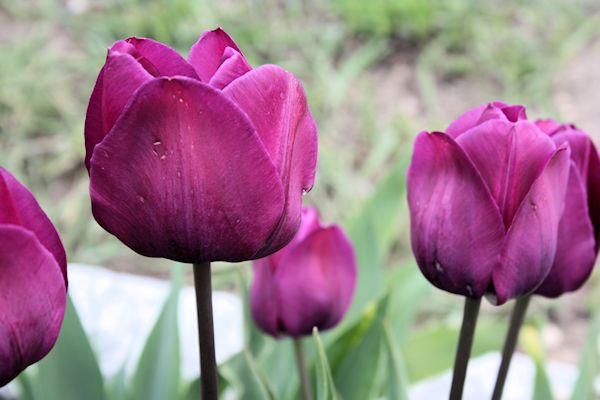
Magenta Tulips
Bulbs can also be planted as companion plants that will complement one another in spring. Try a combination of tulips with an under story of Grape Hyacinths or Allium with a bulb or perennial of choice at the base.  Companion planting will provide a layering effect and provide your garden with additional interest. Consider the growing height of each bulb while planning. Generally, taller growing bulbs should be placed in the rear of the planting bed while shorter growing bulbs (or perennials) are in the front. A favorite combination of mine is a grouping of Allium with an under story of perennial Stella D Oro Daylily. The green foliage from the daylilies masks the dying foliage of the Allium in late spring/early summer while the voluminous blooms of the Allium look from overhead, followed by blooms underneath...an array of interest!
Tulip Collection Brooklyn Botanical Garden
Allium Globemaster and Stella D Oro Daylily Combination

Allium Globemaster
Allium Mont Blanc

Different varieties of Allium can be combined for interest as well...
Mixed Bulbs (Tulips, Hyacinths and Daffodils)
or perhaps a mix of several varieties of bulbs may be the look you are seeking. Here is a combination of tulips, hyacinths and daffodils all planted together in mass for maximum impact.
Spring Flowering Bulbs
  Bulbs can add so much interest to the early spring and summer garden and the possibilities are endless. For some early color in your spring landscape try adding some bulbs to your garden this fall. It's not too late...the time to plant is now!

As Always...Happy Gardening!

Linking to Today's Flowers

  Author: Lee@A Guide To Northeastern Gardening, © Copyright 2015. All rights reserved.