 |
| This Month in the Garden |
Welcome to This Month in the Garden! I have been a gardener all my life and ever since I was a small child, I have had a fascination with sunflowers. Every summer my parents and I would go for a Sunday drive out east here on beautiful Long Island, a tradition which I continue to honor along with my husband of 37 years. While growing up back in the 60's, sunflower fields were not readily available to the public and I would gaze in awe each time we traveled past the fields of yellow discs pointing towards the sky. Times have changed and just recently in 2018, farmers have opened up their fields to the public. I am thankful to have for the first time last year experienced standing among acres of sunflowers, I couldn't wait to revisit the fields this year. Come along!
 |
| Late Summer Perennials at Verderber's Garden Center & Nursery |
On the way out east, there are some amazing nurseries on the way, some which are more like botanical gardens. Here is a late summer display of Black Eyed Susan, Joe Pye Weed and Russian Sage, each perennial being an attraction for pollinators. They can be seen at Verderber Nursery out in Aquebogue. The family owned business comprising of 300 acres of conifers, shade trees, perennials and shrubs is run by husband-and-wife team John and Maria Verderber and their three children, aged 26 to 28, all who possess a love of horticulture.
 |
| Verderber's Nursery |
This beautiful Natchez Crape Myrtle is in full bloom for the late summertime into fall. It's one of my personal favorites for late summer interest and enjoyment in the garden.
 |
| Perennials at Verderber's Nursery |
 |
| Bayview Farms & Market |
One of the local farm stands we regularly visit on our rides out east is Bayview Market & Farms, a 200-acre farm in Aquebogue, Long Island. The farm, owned by the Reeve family started when Orry Reeve floated wagons across the Peconic Bay to peddle produce to Southampton hotels. As the family expanded and after many years of selling fruits and vegetables off the back of a truck, George C. Reeve, Sr. and his sons George Jr. and Bradford Reeve built the first roadside stand, which they named Little Chief, after George's favorite variety of sweet corn. In 2002, Bradford Reeve, Sr. and his wife Lorraine, built a larger farm market, returning it to the original name Bayview Farms and Market. In 2014, the Reeve family further expanded, building a second market in Jamesport.
 |
| Sunflower Field |
Here is the family owned sunflower field that lies on the property of Bayview Farms. This was our second year visiting it and it was just as beautiful as the first time!
 |
| Sunflower Maze North Fork Long Island |
Continuing on the journey, my husband and I visited the North Fork sunflower maze for the second year. The Sidor sisters, Cheryl and Maureen, decided to open the fields to visitors in 2018 after growing sunflowers at the site for several years. They tried doing a sunflower maze back in 2012, and after a six-year break, they decided to bring it back for the 2018 season by popular demand. The fields are grown in succession with a variety of different types of sunflowers, each producing a differently flavored oil for the production of their well-known potato chips.
 |
| One with the Sunflowers! |
Life is the accumulation of memories and experiences. The meaningful trip out east in 2018 and being able to stand in a field among the glorious sunflowers sparked childhood memories, and ended up opening an idea for a chapter in my latest book, Dream, Garden, Grow!-Musings of a Lifetime Gardener, recently published in December of 2018. It is amazing how experiences, memories of childhood and a love of horticulture can make dreams come true. After much research and accumulating past and present memories, the words for Chapter 4 materialized. The meaning and uses behind the mysterious sunflower throughout centuries of garden history and folklore made the memories I have even more dear to my heart.
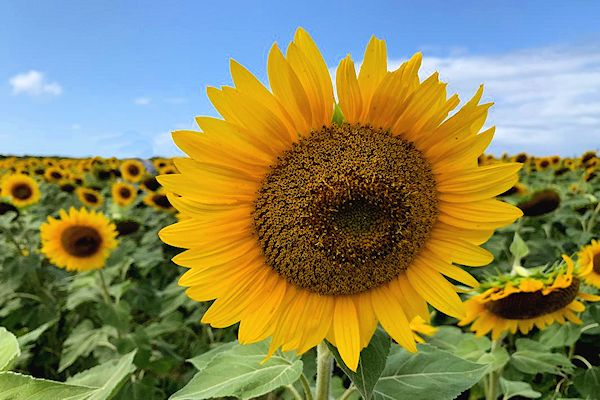 |
| Long Island Sunflowers-Sunflower Maze |
I will look forward to the next encounter with my field of dreams. Now...onto the rest of our journey!
 |
| Wisteria Arbor Jamesport, Long Island |
I am a Long Island native and continue to be amazed by all the beauty and history that exists here. On our way back, we stopped to view this Wisteria lined pergola at the Jedediah Hawkins Inn, a historic property nestled in the town of Jamesport. Jedediah Hawkins, born in Stony Brook in 1837, ventured to sea at the young age of 12 and became the master of a trading vessel by the age of 18. He and each of his four siblings later moved eastward and settled in the town of Jamesport.
 |
| Jedediah Hawkins Inn, Jamesport, NY |
Jedediah Hawkins built this Italanite style home in 1863 on a 22 acre plot in Jamesport, Long Island, New York. The home was occupied into the first half of the 20th century, but became abandoned in the 1980's. The home was acquired in 2004, just days from planned demolition, and restored to its original form. Jedediah Hawkins Inn opened in September of 2005 and was added to the National Registry of Historic Places in 2008.

There are numerous features on the grounds such as this beautiful fountain...

and scenes like this garden bench surrounded by Weeping Japanese Maple, Hydrangea, Black Eyed Susan, Nepeta and Hosta...

and this welcoming gazebo surrounded by beautiful gardens.
 |
| Monarch Butterfly |
The gardens at the Inn are full of pollinator friendly flowers and August and September are Monarch season, so there are plenty to be seen. This Monarch Butterfly stayed and posed for me!
 |
| Long Island Sunflower Maze, North Fork |
I hope you enjoyed This Month in the Garden for September. Be sure to stop by on the 1st. of each month for This Month in the Garden, as I share gardening tips, information and horticultural adventures! As you can see, there is always more to explore within your own backyard and childhood dreams can come true.
Visit my Amazon Author Page and Books
To read more about sunflowers and other musings, check out my newest book...
Dream, Garden, Grow!-Musings of a Lifetime Gardener
For gardening information and design tips, check out my other two books:
For gardening information and design tips, check out my other two books:
~As Always...Happy Gardening!~
Linking with: Floral Fridays, Macro Monday 2, Friday Photo Journal, Image-in-ing Weekly Photo Link-Up and Dishing It & Digging It.
~As Always...Happy Gardening!~
Author: Lee@A Guide to Northeastern Gardening,© Copyright 2010-2019. All rights reserved.


