Wednesday, August 4, 2010

Crape Myrtle-A Personal Favorite For Long Blooming Time and Lasting Color


Crape Myrtle Varieties
Known more as a familiar planting of the Southeast the new hybridized form of Crape Myrtle (Lagerstroemia indica) can be successfully grown here in the Northeast as well as in the Northwest where the winters are harsher.  These showy trees are a personal favorite of mine due to their beautiful long lasting blooms that start at the end of the summer and last well into Fall, a bloom period of approximately 120 days!   Just as other flowering trees and shrubs are reaching the end of their bloom cycle the stately Crape Myrtle 'Lagerstroemia indica' starts its spectacular show. I often use these beautiful trees as an eye catching element in my designs as they serve nicely as an anchor plant in a foundation planting or as a focal point in an island bed or backyard garden.

Lagerstromeia indica 'Sioux'
There are many varieties of this beautiful tree ranging in size from ‘Pocomoke’ and ’Chickasaw’, which are dwarf varieties topping off at approximately 5 feet to ‘Natchez’ (White),‘Tuscarora’ (Coral Pink),‘Muskogee' (Lavender) and 'Catawba' (Purple) ranging at a height between 12-20 feet. A personal favorite of mine is Crape Myrtle ’Sioux’, a medium variety that ranges in height to approximately 12-15 feet. The medium-pink flowers of the ‘Sioux’ Crepe Myrtle begin late in July and last well into October and are an elegant display not to be missed. Three other varieties of Lagerstroemia worth mentioning are ‘Tonto’ and ‘Dynamite’, both known for their vibrant red flowers and medium height of 12-15 feet and 'Zuni' (Purple) at a smaller 8-9 feet in stature.


Lagerstroemia indica 'Muskogee'


HARDINESS & PRUNING: Lagerstroemia are a hardy to zones 7-9 and are “deer resistant”, meaning that deer will most likely avoid them in their diet. They grow best in full sunlight in a well-drained soil with a pH of 5.0-6.5. These trees require little to no pruning but can be pruned to maintain a more compact shape or to remove any dead branches that may result from a harsh winter.  If you are going to prune wait until late winter or early spring after the last frost. The plants are dormant in winter and any flowering occurs on new growth so pruning will encourage new flower producing branches. Remove any dead branches, suckers growing from the base or weak twiggy branches and allow strong leader branches to keep the framework of the tree.

Lagerstroemia indica 'Natchez'
TRANSPLANTING:  If you are planning on transplanting your Crape Myrtle tree the best time to transplant in the northeast is in mid April or mid September through mid October.  Roots need time to become established before the summer heat or winter cold set in. Dig a hole slightly wider than the root ball and make sure the tree sits at the height of the surface or slightly above.  Apply a layer of mulch around the tree to protect the roots and keep well watered until established.  Crape Myrtle are somewhat sensitive to cold so there may be some branch die back in the first season until the plant becomes well established. 
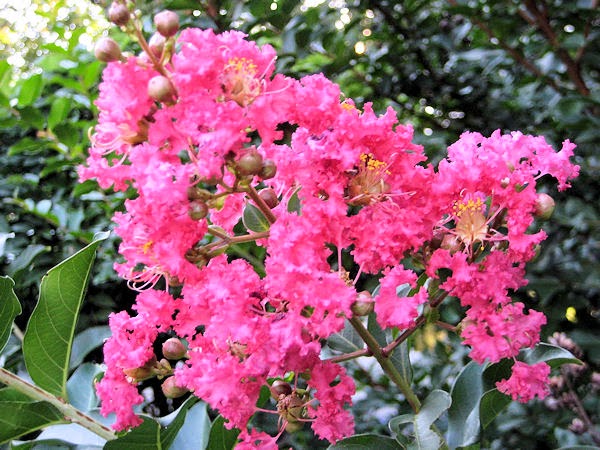
Lagerstroemia indica 'Tuscarora'
Depending on the preference of the grower Crape Myrtle can be planted as either a multi -trunk or singular-trunk form and can be displayed as either a shrub or tree in the landscape.  An important note worth mentioning is that Crape Myrtle (Lagerstroemia) are among the last plants to push out their new growth so if they appear to be dead at the end of winter going into spring just give them some time to come into their glory. Since they are later to push out their leaves they do benefit from an early spring feeding of a high phosphorus-lower nitrogen 5-10-5 formula to promote good foliar growth and an abundance of blooms in July-August. Crape Myrtles are not susceptible to insects or disease but as in any landscape planting they should be monitored and properly maintained to keep them in good health. 

If you are looking for a long blooming, deer resistant, low maintenance tree to add color to your garden then Crape Myrtle may be the tree for you. I for one would highly recommend this beautiful plant as a welcome addition to any formal or informal landscape.
Author: Lee@A Guide To Northeastern Gardening © Copyright 2010. All Rights Reserved.


Saturday, July 3, 2010

Pruning Salvia - A Simple How to

Pruning Salvia-A Simple How To
I was contemplating what my next discussion was going to be while in the garden pruning the salvia. One of the most often asked questions I receive from my customers is,“What should I do with my salvia now that it is done blooming?” 
Salvia 'May Night'
Very often as the salvia stalks start to turn brown it appears that the plants are dead, but they are only finished with their first show. Now for some of you the timing of this post may be a bit early, but here in the Northeast, the perennials seem to be a bit ahead of schedule, are bigger and better than ever and the salvia are magnificent! By the way if you are wondering what type of salvia this is, it is one of my favorites, Salvia 'May Night'. Its deep purple coloring and long blooming habit make it a welcome addition to any full sun garden. Now let’s talk about how to prune your salvia for maximum bloom.
Perennial Border with Salvia May Night
When your plants are starting to look a little less desirable than you prefer it is time to dead head. It is sometimes difficult to explain how to prune salvia so follow me on this. Take a look at any three fingers on your hand that are next to each other. When you prune your salvia you will be cutting out the center stalk that is done blooming. On each side of the center stalk you will see two other stalks with new buds and blooms forming. If there are blooms done on the two side stalks you can cut those out as well. Only cut the spent stalks and the new flowers will form. I usually get about three blooms out of my salvia throughout the summer and into the early fall. 
Pruning Center Stalk from Salvia
By the second or third bloom you may want to give your plants a little plant food to give them a boost and add energy for the rest of the season. If your plants are brand new they may have been force bloomed so for the first season you may only get one or two blooms but come next year you will be able to push out three blooms if you time your pruning right.
Salvia Before Pruning Late June/Early July in Zone 7
Now that you are ready to prune your salvia the best time of day is either early morning or late afternoon or just when you need a little garden therapy. Pruning salvia can be both rewarding and therapeutic so pick the right time to perform this task! When the fall season arrives and winter is on its way be sure to prune your salvia down to just two to three inches above the ground and add a little mulch around the plant for protection. With regular maintenance of your plants you will receive blooms to enjoy for the entire season. Now-back to my garden! 
Salvia After Pruning Early July Zone 7

Saturday, June 19, 2010

"A Little Garden Music" Garden Tour 2010 Presented by the Bay Area Friends of Fine Arts and Sayville Garden Club

Garden Tour June 2010
We were so honored in being chosen as one of the garden participants for the June 19th, 2010 BAFFA (Bay Area Friends of the Fine Arts) and Sayville Garden Club Tour," A Little Garden Music".  The garden tour turned out to be a great success. The sun was bright in a clear blue sky just as we had hoped for.  As delightful music lingered throughout the gardens and the garden artist painted away, our guests enjoyed the sights and sounds around them.  We were very excited to have so many wonderful people join us to see our garden that we were so happy to share! We took many photos so here is a peek.
Garden Musicians (BAFFA)
Garden Artist (BAFFA)
Garden Art Painting
Garden Artist
Backyard Garden
Gardening Club
Musicians (BAFFA)
Frontyard Garden
Garden Musicians (BAFFA)
Garden Artist
Backyard Garden
Backyard Garden
Patio Garden
Backyard Garden
Backyard Poolscape Patio & Garden
Garden Sitters
Front Driveway Garden Entrance
Garden Sitters
 The garden tour was certainly a memory which I will never forget.  
 
Thank you for visitng and As Always...Happy Gardening!
 
 
Author: Lee@A Guide To Northeastern Gardening, Copyright 2010. All rights reserved


Thursday, May 27, 2010

Garden Tour 2010

We're on the Garden tour in June 2010!  We have been given the honor of being chosen for the June 19th, 2010 BAFFA (Bay Area Friends of the Fine Arts) and Sayville Garden Club Tour," A Little Garden Music".  The two organizations have joined together to present a tour of seven local homes in order to combine the arts with an appreciation for horticulture. The Sayville Garden Club was established in 1927 and members work together to beautify the community, raise environmental awareness and develop an appreciation for horticulture.  BAFFA was formed in 1968 by a small group of local residents and has grown to be well known for its appreciation for the arts and contributions to the community through art and music.  We are so happy to have been selected for this tour and are looking forward to sharing our property and knowledge of horticulture with others. 


This is where our story begins.  Built in 1953, our home stands on what was once a gladiola farm. Our gardens originated from a vast lawn shadowed by maple and wild cherry trees along with an original iris garden that still exists today. My husband and I have resided here since 1982 and it all started when we decided to install an in ground pool in 1996.  At that time I had been studying landscape design and now had the perfect palette to work with-our own backyard!  That is where it all blossomed (no pun intended).  As time went on I had an increasing desire to expand on the design of the property. As time allowed, our once vacant lot has transformed over the years into a private sanctuary for us to enjoy, and the gardens have become a part of what brings joy into our lives.

Our grounds consist of colorful evergreens, flowering shrubs, grasses and perennials that highlight every season of the year. The centerpiece of the back garden is a mountain lake pool and patio surrounded by a waterfall and gardens. There are Star Magnolia, Weeping Norway Spruce, Weeping Blue Atlas Cedar, Weeping White Pine, Crepe Myrtle, Spirea, Daylily, Salvia, Coral Bells and Astilbe among other plantings.  Golden Oriental Spruce, Blue Atlas Cedar, Hinoki Cypress, Barberry, Gold Lace Juniper, Nepeta and Coreopsis highlight the front gardens and accent pieces of moss rock boulders are used throughout the property.

When not designing I can be found in my gardens planning the next addition, a never-ending process. "A garden is an extension of its owner; a thing of beauty that constantly changes and can be enjoyed forever.


Author:Lee@ A Guide To Northeastern Gardening Copyright 2010. All Rights Reserved


Wednesday, March 31, 2010

Thinking Spring-Color in the Garden Part III: Perennials

The rains are coming down in the northeast and the daylilies are poking their heads up through the soil so it is time to talk about perennials.

When it comes to combining perennials, colors from opposite sides of the color wheel combine the best. My favorite combination is that of purple and yellow. The cool color of purple ‘Maynight ‘ Salvia or blue Nepeta ‘Walkers Low’ combine beautifully with the warm yellows of Coreopsis ‘Zagreb’ and Daylilly ‘Stella D’Oro’and also go along with the yellow-orange color of Gaillardia 'Goblin'.  Combine purples and yellows along with the deep maroon color of Barberry ‘Royal Burgundy” and you have an array of color which one cannot resist.
Salvia 'Maynight'
Another favorite is heuchera or ‘Coral Bells’ which is known for its deep burgundy foliage throughout the season and dainty white flowers in Spring which closely resemble baby’s breath. There are many varieties of heuchera but the one which I find to be most hardy in the Northeast is Heuchera ‘Palace Purple’ which tends to hold up better here with our severe winters. Heuchera goes beautifully along with coreopsis, salvia and nepeta as well as with grasses.
Coreopsis 'Zagreb'

Another suggestion for combining perennials with grasses would be the combination of Sedum ‘Brilliant’ with dwarf fountain grass, coreopsis and perhaps a weeping evergreen as a focal point. As far as sedum is concerned, there are also many varieties but I prefer the ‘Brilliant’ for its more vibrant pinkish color and shorter stature as compared to ‘Autumn Joy’-but it’s a matter of opinion. The ‘Autumn Joy’ or even the Spurium ‘Rose Glow’ would also complement grasses nicely in the garden.
Hosta 'Patriot'

If you prefer the woodland look or have shady conditions then the ole reliable hosta comes to mind. There are so many varieties of Hosta to choose from and it is virtually indestructible. Also if you separate them with a sharp spade in early spring they will re-grow quickly to form a perfectly circular shape as if they were never touched. One of my favorite varieties of hosta is ‘Patriot’. It’s deep green foliage edged with a creamy white border makes it a welcome guest to brighten up even the darkest of shade gardens. It does very well here in the Northeast and goes beautifully with variegated liriope, heuchera (coral bells) and astilbe. Other favorites are ‘Francee Williams’, ‘Blue Cadet’ and ‘Golden Tiarra’.
Gaillardia 'Goblin'

There are so many perennials to choose from for the garden.  I have tried to focus on varieties which are hardy in the Northeast and which are my all time favorites for long bloom time, abundant color and dependability. 
Heuchera 'Coral Bells'
After years of experience as a designer I find these to be the most reliable and have enjoyed them in my own gardens for years and will continue to enjoy them for years to come.  


In future articles I will focus more on the uses of combinations of perennials in the cottage garden as well as the incorporation of perennials along with evergreens and deciduous plants for everlasting beauty and enjoyment.  For a complete gallery of perennials mentioned in this post visit:  Perennials .

Happy gardening!


Author:Lee@ A Guide To Northeastern Gardening Copyright 2010. All Rights Reserved

Monday, March 8, 2010

Thinking Spring-Color in the Garden Part II: Deciduous & Flowering Shrubs

PeeGee Hydrangea Tree
In the last segment I discussed evergreen color in the garden. In this section I will be adding the use of deciduous shrubs with color as well as flowering shrubs for long term color. These shrubs along with perennials are to be used along with the evergreens discussed previously. When choosing colorful shrubs remember to use only a few color choices and repeat them throughout the garden in groupings of odd numbers for a more naturalistic look.

Rosy Glow Barberry
An old time favorite in the garden is the ‘Royal Burgundy’ barberry. Its deep burgundy color stands out against any of the green, golden or blue varieties of evergreen discussed in the previous section and grows only to two feet in height. Another variety of barberry, ‘Rosy Glow’ grows much taller to about three to four feet or more over time but is beautiful in the right setting and can be maintained with regular Fall or late winter-early spring (March) pruning. It gets its name ‘Rosy Glow’ from the light pink glow of new growth which it gets in the spring through early summer. Each of these barberries contrast nicely with blue spruce, gold mop cypress and blue atlas cedar. Alternates to barberry for burgundy foliage are Weigela 'Spilled Wine' and Ninebark 'Diablo'.

Spirea 'Limemound'
Spirea in the family Rosaceae is a wonderful addition in the garden and is available in a multitude of sizes and colors. Some of my personal favorites are Spirea ‘Little Princess’, a small compact pink flowering form that tolerates shade and the sun loving Spirea ‘Limemound’ which has an unusual lime color to its foliage as the name indicates. Some other nice selections are ‘Gold Mound’, ‘Gold Flame’ and Spirea ‘Anthony Waterer’. The later ‘Spirea ‘Anthony Waterer’ grows taller than the other varieties to about three to four feet and serves well as a backdrop to lower plantings, adding a touch of deep pink throughout the summer. Spireas can get as wide as they are tall so give them plenty of space and enjoy. They can be easily maintained by regular Fall or early Spring (March) pruning to keep their shape and fullness.

Hydrangea 'Endless Summer'
Now onto the hydrangeas and vibernum. The ‘Endless Summer’ collection of hydrangea are the best new additions ever cultivated, a worry free long blooming form of hydrangea which blooms on both old and new wood so you no longer need to worry about when to prune ...fear no more! Hydrangea ‘All Summer Beauty’ also blooms on the new wood of the season and is a nice addition to the landscape. Hydrangea ‘Pee Gee’ and Hydrangea ‘Tardivia’ are two varieties which are available in tree form, each exhibiting bountiful fragrant white blooms and either can be used as a stand alone piece adding a wonderful focal point to the garden.

Viburnum 'Carlcephalum'
If it is a more natural look in the garden you are looking for then the genus viburnum may be what you prefer. Viburnum are known for their graceful arching branches and white blooms, some which resemble the flower of a dogwood. Viburnum plicatum 'Summer Snowflake' as the name indicates has very delicate white flowers which resemble snowflakes which cover the entire plant when in bloom. It is one of the more compact lower spreading forms of viburnum which serves beautifully in the woodland garden and grows to about three to five feet in height. Fragrant varieties of viburnum include Viburnum ‘Burkwoodi’, Viburnum ‘Juddii’ and Viburnum’ Carlesii’ all of which have the fragrance of the sweetest perfume and are all an excellent addition to a natural planting.

Also check out these other interesting shrubs which can add color and interest to your garden: Nandina domestica (False Bamboo), Japanese Skimmia, Weigela, Leucothoe, Knock Out Rose, Rhododendron and Azalea.  Each flowering shrub can add its own personal elegance and beauty to the outdoor landscape. 

In the next part of this series I will discuss the incorporation of long lasting colorful perennials into the garden and make suggestions as to which perennials are best for the continuous enjoyment of your landscape.


                                                       Landscape Design Combinations


Author:Lee@ A Guide To Northeastern Gardening Copyright 2010. All Rights Reserved