Thursday, March 31, 2011

New Flowering Shrubs for 2011

Bella Anna Hydrangea
There are some new flowering shrubs to be on the look out for in 2011.  Hydrangea 'Bella Anna' is the first variety of Hydrangea arborescens to be introduced into the Endless Summer Collection.  Bella Anna prefers to be grown in a moist, well-drained soil  in full sun to partial shade.  It is hardy in zones 4-9, grows 3-5 feet in height and is a repeat bloomer. Its strong stalks support huge magenta-pink flower heads and it blooms on new and old wood.   Bella Anna can be used as a foundation planting, shrub border or perennial garden border and could be a nice addition to your garden!

Buddleia Lo and Behold 'Blue Chips'
Another newcomer is the first miniature Buddleia and first of the Lo and Behold variety, Buddleia 'Blue Chips'.  Lo and Behold 'Blue Chips' displays a low mounding compact habit, growing to approximately 24-26 inches high by 30-36 inches wide.  It is a summer bloomer, prefers full sun and a well-drained soil and is hardy in USDA zones 4-9.  Buddleia 'Blue Chips' is also deer resistant and can be grown in a planter due to its compact size.  If you always wanted a Butterfly Bush but just didn't have a place to put it this miniature variety could be just the one for you!  


'Incrediball' Hydrangea
Also out are two more new hydrangeas.  Hydrangea 'Incrediball' is an improved version of 'Annabelle' with stronger stems to support its large white blooms.  Like 'Annabelle' this hydrangea blooms on the new wood of the season.  It is hardy to zone 3 and is more heat tolerant than its predecessor.  

Invincibelle Spirit Hydrangea
Developed by Dr. Tom Ranney at North Carolina State University's Mountain Horticultural Crops Research Station, Hydrangea 'Invincibelle Spirit' is the very first pink arborescens. It displays large 10 inch wide pink blooms that bloom on the new wood of the season. 


I for one am very excited to see new varieties of two favorite plants in the garden.  Stay posted for other
newcomers as they arrive! 
 
Happy Gardening!
 
Author: Lee@A Guide to Northeastern Gardening, Copyright 2011. All rights reserved


Sunday, March 20, 2011

Pruning Buddleia (Butterfly Bush)

Pruning Buddleia (Butterfly Bush)

 
Buddleia 'davidii'
Buddleia 'davidii' or Butterfly Bush is a wonderful shrub in the landscape for the naturalized garden. Hardy in zones 5-10 and growing between six and twelve feet in height,  its delicate arching branches and colorful nectar filled flowers are a major attraction for Hummingbirds and butterflies. Butterfly Bush are evergreen in areas where minimum winter temperatures are above twenty degrees and are deciduous where temperatures go below freezing.  In areas colder than zone 5, Buddleia may die back all the way to the ground and will grow vigorously once spring arrives.  In areas zone 5 and colder it is advisable to leave branches on until spring and to cover the root crown with mulch for winter protection.  Buddleia grow best in a well-drained fertile soil in full sun.

When To Prune Buddleia:  Buddleia 'davidii' blooms on the new wood of the season and should be pruned in late winter /early spring to encourage new growth.  Prune before new growth starts to appear to approximately 12 inches (30 centimeters) above the ground.  Buddleia are a type of plant that highly benefit from a severe pruning.  "Hard" pruning Butterfly Bush promotes many new arching branches with larger flowers than if the plant had not been pruned. 

Later in the Season Pruning:  It is also beneficial to prune off dead and faded flowers once the flowering season has completed. With regular "deadheading" or removal of spent flowers your Buddleia will put its energy back into producing even more flowers well into fall.  In colder climates, never prune completely to the ground in Fall for it can be detrimental to the plant.  It is best to wait until late winter/early spring to perform this task.

Retaining Height of Buddleia:  If you chose to use your  Buddleia as a backdrop shrub simply allow it to grow larger then prune new growth so that the plant is approximately 24 inches (60 centimeters) in height.  Also by keeping the height in the center of the plant a little above the sides, the plant will grow in a nice shape appearing taller.  In either case, whether you choose to keep your plant higher as a backdrop or lower in front, a hard pruning will always benefit your plant and encourage new growth for the season. 

Buddleia Lo & Behold 'Blue Chip'


If you would like to try a dwarf form of buddleia that does not grow above three feet in height try the new Buddleia 'Blue Chip' from the Lo & Behold collection! 


Visit my Author Page and Books on Amazon:


As Always...Happy Gardening!

Author: Lee @A Guide To Northeastern Gardening Copyright 2011. All Rights Reserved.


Tuesday, March 15, 2011

Garden Blogger's Bloom Day March 2011

Purple Hyacinth Bud
Well it's that time again.  Inspired by the quote, “We can have flowers nearly every month of the year.” by Elizabeth Lawrence, Carol at May Dreams Gardens hosts Garden Blogger's Bloom Day.  On the 15th of every month gardeners from all over the world walk out into their gardens to note what is currently blooming. 
 
It has been a long snowy winter here in the northeast and it took some seeking, but there are sure signs of spring starting to emerge here in the zone 7 garden.  Come along with me and join the tour!

Pink Hyacinth Bud
The purple hyacinth (photo above) is popping up out of the ground showing that is ready for spring. Some warm weather in the next couple of weeks should encourage this spring bloomer to start its show. The pink hyacinth next to it is getting ready too!

Weeping Pussy Willow Catkins
The Weeping Pussy Willow (Salix caprea 'Pendula') is proudly displaying its first catkins and the Rosy Glow Barberry is showing signs of buds swelling to display its deep burgundy and pink foliage. It won't be long until its branches are completely filled out.

Barberry 'Rosy Glow' budding
I just love walking the garden at this time of year to see the emergence of life everywhere after the winter. The plants are looking well for the blanket of snow has supplied moisture and insulated them from the cold. The perennials should flourish this year.
Stella D Oro Daylily Emerging
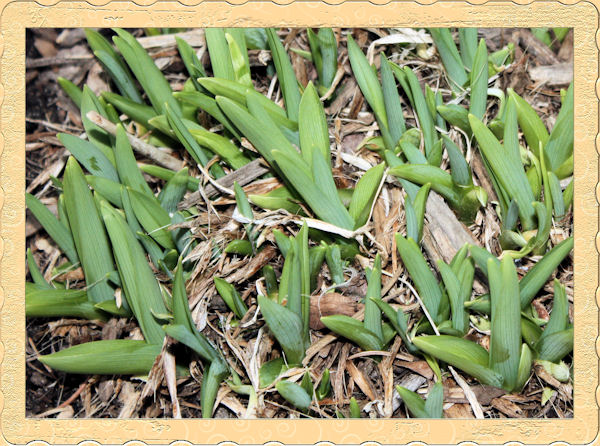
Walking around further and look...the lilies are emerging from their winter's sleep. They will not start to sprout flowers for some time now but the foliage is a welcome treat.
Sedum 'Brilliant' peeking out
As we move along, the sedum 'Brilliant' is showing some color as it emerges in all its glory.  I love the purple edges in the new growth. This perennial will keep its perfectly round shape as it grows and displays interesting foliage throughout the summer. 
Lamb's Ears new growth
And last but not least, the Lamb's Ears (Stachys lanata) are perking up and new soft white foliage is starting to grow as the soil warms.

Bloom Day is a wonderful day of the month to be more aware of the changes going on in the garden.  There are surely signs of spring on the way and dreams of more blooms to come!  Be sure to visit our hostess Carol at May Dreams Gardens and check out all the other wonderful blooms that are emerging.


It is always exciting to open the door and go out into the garden for the first time on any day. - Marion Cran

Happy Gardening.  Happy GBBD!


Thursday, March 10, 2011

Best Houseplants for Indoor Gardening

I have been wanting to do a segment on indoor houseplants, so it seemed to be a good time to do so. While waiting for my outdoor plants to come to life here in the northeast I have been paying a little extra attention to my indoor plants in anticipation of the grander scheme outside.  Let's discuss some of the indoor plants that I have found to supply great pleasure at a low a maintenance cost. 


A colorful versatile plant in the philodendron family is Golden Philodendron or Philodendron 'Brasil'. It displays variegated heart-shaped leaves and is a climber that is happy as either a stand-alone piece or mixed with other plants. Philodendron 'Brasil' prefers bright-diffused indirect light and moderately moist soil with good drainage. It is for the most part carefree and is a nice addition to the indoor garden.


The next candidate is Clivia minata.  This beauty originates from South Africa and is known as "bush lily". Its elongated dark green foliage alone makes it an attractive houseplant and in spring and fall the plant produces beautiful yellow-orange flowers that last for several weeks. Clivia prefers low to medium light and well-drained soil.  Allow drying out in between watering and water weekly during the growing months and less in winter. Fertilize when blooms are produced.  This plant prefers to be root bound.


Chinese Evergreen (Aglaonemas) is a tropical evergreen known for its variegated green and white foliage and easy maintenance.  It prefers to be grown in low light in a moist, well-drained soil.  Aglaonemas produce white flowers occasionally in spring and summer that are better to be cut off because they do drain energy from the plant. Chinese’s Evergreen is carefree and makes a nice house-warming gift for a low light area.

The next beauty is Croton, a multi-colored foliage plant for higher light areas. Croton is native to Southeast Asia and was once only grown outdoors. They have increased in popularity indoors because of their beautiful orange-green-yellow foliage. Croton grows best in a southwestern window in a moderately moist soil with high humidity. When kept in higher light these beauties will put on a show of color!


Another favorite indoor plant is Spathiphyllum or Peace Lily.  Spathiphyllum prefers to be grown in a moderately moist-well drained soil in diffused sunlight preferably in a northern or eastern window. Peace Lily are easy to grow, have elongated glossy dark green foliage and frequently display their lovely white flowers that are formed from the leaf stalk of the plant. Spathiphyllum can be grown as a stand-alone piece or can be combined with other low light plants to make a lovely display.

Another plant in the Philodendron family is Philodendron 'Xanadu'. 'Xanadu' is a compact grower displaying medium-large finger-like leaves in the form of a full clumping plant. Philodendron 'Xanadu' prefers to be root bound and grown in bright indirect light in a moist well-drained soil. When leaves yellow, simply pull them out by the stalk and new shoots and leaves will unfold to keep the plant full and attractive. Thumbs up for this one for it is low maintenance!


Another very low maintenance plant is Snake Plant or Mother-in-Law's Tongue. This easy to grow plant is very versatile, can be grown in low light to full light conditions in a slightly moist, well-drained soil. This plant is about as low maintenance as you can get and has been a popular houseplant favorite for years. Under the right conditions it will last for many years.
Jade Plant (Crassula argentea) is a popular succulent plant that displays small pink-white flowers if grown in a southern window. Jade prefers to be grown in bright direct light as in a southern or western window. Crassula argentea does not require much water and should only be watered when dry to the touch. When cared for properly this showpiece will last for many years and become a valued family member! 


Here is the newest addition to my houseplant family.  It is Zamioculcas Zamiifolia (nicknamed ZZ plant).  It thrives in nearly any lighting condition except darkness.  I have mine in indirect sun and it is doing just great.  As far as watering is concerned, Zamioculcas Zamiifolia is a tuber plant that stores its water intake.  It is best to let its soil completely dry out and then water thoroughly.  Zamioculcas Zamiifolia does not require much feeding. Feed four times a year with a balanced liquid fertilizer at half strength.


There are a huge variety of houseplants to light up your home every day of the year. These are just a few that can bring some enjoyment to your indoor garden!  


As Always..Happy Gardening!

Author: Lee @A Guide To Northeastern Gardening Copyright 2011. All Rights Reserved.


Thursday, March 3, 2011

Best Long-Blooming Perennials: What are your favorites?

Top (Left to Right) Gaillardia, Liriope, Heuchera
Bottom (Left to Right) Coreopsis, Salvia May Night, Astilbe 'Sprite'
Perennials play such an important role in adding lasting beauty to the landscape and there are so many wonderful long-blooming perennials for the zone 7 northeastern garden. In this article I will discuss some of my all time favorite perennials for overall performance, hardiness, excellent foliage and long lasting blooms. 

Gaillardia 'Goblin'
     First there is Gaillardia 'Goblin', or Blanket Flower, which produces red to yellow bi-color blooms throughout June to August on 12" stems. It is hardy in zones 4-8 and repeats its performance year after year if grown in full sunlight. Gaillardia prefers well-drained soil, is considered drought tolerant and does not require abundant watering once established.

Liriope muscari 'Variegata'
Liriope muscari 'Variegata' is popular for its grass-like, cream or yellow-margined leaves. Liriope can be grown in sun or shade and produces small purple blooms in August to September followed by round, dark purple berries. Liriope is very versatile as it can be planted just about anywhere in the garden as a complement to other plantings and is hardy in USDA zones 4-10.  

Heuchera 'Palace Purple' 
One of my favorite perennials for shade is Heuchera.  From experience I find Heuchera 'Palace Purple' to be the most hardy with beautiful burgundy foliage. The delicate white flowers produced on 12 inch stems in August to September that resemble baby's breath are just an added bonus. Heuchera can be grown in partial sun to shade and prefers a moderately moist organic soil. It is hardy in zones 4-8.     

Coreopsis 'Zagreb'
Coreopsis 'Zagreb' is a popular favorite for areas of full sun and produces yellow daisy-like blooms from June to July that last throughout August on 12-18 inch fern-like stalks.  Coreopsis is deer resistant, prefers a well-drained soil and can withstand drought-like conditions once established.  I find this perennial to be highly reliable and very hardy in zone 7. Coreopsis will spread so plant it in a place where you have plenty of room and enjoy its beauty.  Coreopsis is complemented nicely by either salvia or nepeta.

Salvia 'May Night'
     Salvia 'May Night' displays beautiful deep purple flowers on 12-18 inch stalks from the end of May through July.  To extend the bloom time of your salvia all the way into fall simply prune off spent flower stalks as new ones arise and the plant will continue to produce more blooms! Salvia prefers to be grown in full sun in zones 4-8 and can tolerate some drought. It is also deer resistant.
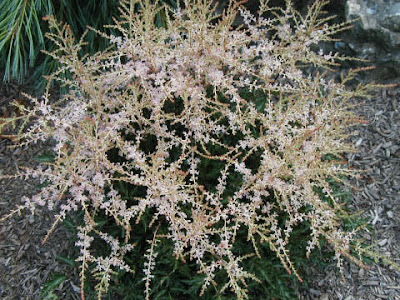
Astilbe 'Sprite'
The next selection for shady areas is Astilbe 'Sprite'. This perennial displays bronze foliage with pale pink flowers in late July to August on dwarf 12 -14 inch plants.  There are several other wonderful varieties of astilbe but in my opinion this variety has the nicest foliage and the most delicate blooms. Astilbe 'Sprite' prefers to be grown in partial sun to shade in an organic, moderately moist soil and is hardy in USDA zones 4-9.

Daylily 'Stella D'Oro'
There are two more of my of my all time personal favorites that cannot go by without being mentioned. The first is Daylily 'Stella D'Oro'. There are many varieties of daylily but this semi-fragrant, golden yellow repeat bloomer will continue to produce blooms on 12-18 inch stalks from June until fall with some pruning. This perennial prefers to be grown in full sun and complements many other perennials such as heuchera, liriope, salvia and nepeta and is hardy in USDA zones 3-9.

Nepeta 'Walkers Low'
The second is Nepeta 'Walkers Low', a dwarf form of nepeta with gray-green aromatic foliage and large violet-blue flowers that bloom all summer long. Nepeta 'Walkers Low' is drought tolerant and deer resistant.  It can be grown in full sun to partial shade  and forms round compact mounds.  This perennial goes well with coreopsis, daylily and heuchera and is hardy in zones 3-8.

It is almost impossible to narrow down the best of the best perennials for your garden and there are thousands to choose from but I am hoping that this article will give you a brief idea of the possibilities that are available. The perennials mentioned in this article are my favorites based on experience. They have proven to be winners over the years with excellent foliage, repeat colorful blooms and all around summer interest in the landscape.


Author: Lee@A Guide To Northeastern Gardening Copyright 2011. All Rights Reserved

Saturday, February 26, 2011

Winter Burn on Blue Atlas Cedar and Other Evergreens

Weeping Blue Atlas Cedar
Some winters have been known to be unusually harsh on the landscape.  I for one have been getting a lot of questions regarding winter burn on weeping and upright Blue Atlas Cedar as well as on Cryptomeria and Golden Oriental Spruce.  The narrow needles on these evergreens can be prone to dehydration due to the drying effect of winter winds that can cause the needles to appear brown.  The intense snow and reflection of rays from the sun can also magnify this effect. 

Winter Burn on Blue Atlas Cedar

This browning of the needles or "winter burn" should correct itself once the weather starts to warm and water is able to get to the cells of the plant and once again activate the chlorophyll within.  If the tree is well established it should most likely fully recover and start to push out new growth as the temperatures rise.  If the tree looks severely damaged then getting water to the roots and deep root feeding in early spring are recommended to help the plant to recover.  Deep root feeding is a controlled fertilization process that supplies immediate beneficial nutrients directly to the root system to give it a boost. There is also a product on the market called PHC BioPak Plus which contains micro nutrients and beneficial bacteria to help the roots to absorb nutrients and help plants in stress.

Cryptomeria
Just an added note that the needles of Cryptomeria japonica do turn a bronze color in winter which is perfectly normal.  I have found that with the severe weather there has also been an increased number of fallen branches and browning of needles and branches; however, the winter winds seem to be nature's way of giving the trees a good cleaning out.   In the spring sunlight will be able to reach the inner portion of these evergreens and cause the trees to push out new growth.  

Skylands Oriental Spruce
There may be some winter burn and dead branches on your Oriental Spruce as well from the winter's winds and snow.  Spring is the best time to cut out any dead branches and the browned needles should recover once water moves back into the cells and chlorophyll causes the plant to re-gain its color. 

It is not recommended to spray the above-mentioned trees with anti-desiccant because it has been known to change the beautiful color of these trees. When in doubt always ask a tree professional.

Many evergreens do go through a natural shed of their inner needles approximately every three years in order to make room for new growth.  Once the harshness of the winter winds diminish and spring arrives new growth will eventually push out and restore the natural beauty of your evergreens.


Author: Lee@A Guide To Northeastern Gardening, Copyright 2011. All rights reserved


Tuesday, February 22, 2011

Berry Producing Shrubs: Color in the Landscape

Berry Producing Shrubs
There are a variety of wonderful berry producing shrubs that can add color and interest to the landscape. Some of these shrubs include Nandina domestica (Heavenly Bamboo), Ilex 'Nellie R. Stevens' (Nellie Stevens Holly), Mahonia aquifolium (Oregon Grape Holly), Barberry 'Rosy Glow' (Rosy Glow Barberry), Ilex verticillata (Winterberry) and Callicarpa Americana (Beauty Bush). All of these shrubs add color and interest to the landscape throughout the different seasons and are an important food source for birds as well.
Callicarpa Americana (Beauty Bush)

Callicarpa Americana or Beauty Bush is known for its beautiful purple berries produced in fall on open cascading branches. It is a native to  North America and is enjoyed by many as an addition to the natural garden. This plant is deciduous, is hardy to USDA zones 7-10 and does best in full sun to partial shade.
Nandina domestica (Heavenly Bamboo)

Nandina domestica (Heavenly Bamboo) is not a bamboo at all but a hybrid evergreen plant that produces white flowers in spring followed by vibrant pinkish-red berries in late summer to fall that last throughout the winter months. Nandina prefers full sun to partial shade, is hardy in zones 4-10, and grows to approximately 5-8 feet tall.  There are also dwarf cultivars such as Nandina domestica 'Firepower' that stay on the smaller side to approximately 2-3 feet in height.

Mahonia aquifolium (Oregon Grape Holly) 

Another interesting plant is Mahonia aquifolium or Oregon Grape Holly.  Known for its purple-blue grape-like berries in summer preceded by yellow blooms in spring it makes a nice addition to the natural garden. Mahonia is a bold broadleaf evergreen shrub with deep green summer foliage and deep burgundy-bronze winter foliage.  It has a holly appearance but is related to the barberry.  Mahonia grows to 3-6 feet tall and wide and is hardy to USDA Zone 5.
Ilex 'Nellie R. Stevens' (Nellie Stevens Holly) 

If you are looking for more of a privacy screening then Ilex 'Nellie Stevens' or Nellie Stevens Holly may be the plant for you. This holly has a showy dark green glossy foliage and produces bright red berries throughout fall and winter. Ilex 'Nellie Stevens' grows to 15-25 in height by approximately 10 feet in width and is hardy to USDA Zone 6.  It prefers to be grown in full to partial sun with afternoon shade and keeps its beautiful deep green foliage throughout the winter.  
Barberris 'Rosy Glow' (Rosy Glow Barberry) in Winter

Barberris thunbergii 'Rosy Glow' (Rosy Glow Barberry) is a deciduous berry producing shrub growing 2-3 feet tall that exhibits bright burgundy foliage throughout the entire summer followed by bright red berries throughout winter that are a favorite food for your winter bird friends. The initial foliage of this plant is a purplish color mottled with pink to red splotches that matures into a deep burgundy followed by insignificant yellow flowers and red berries. There are many forms of barberry including Barberris 'Royal Burgundy', a smaller version growing 1-2 feet in height and a personal favorite!  Barberry  is hardy in USDA Zones 4-8 and prefers to be grown in full sun.
Ilex verticillata (Winterberry)

Ilex verticillata or Winterberry is native to the eastern portion of North America and southeastern portion of Canada and is hardy in zones USDA 3-9. It is one of the deciduous forms of holly growing 5-15 feet tall, preferring partial shade and moist conditions. The attractive red fruits of Winterberry are a food source to many small mammals and more than 48 species of birds. It is commonly used in landscaping in its native northeastern location and provides nice winter interest. Winterberry is not self pollinating so its does require one male plant per group of females in order for the females to produce their vibrant berries.

Color and interest can be achieved in the landscape throughout the entire year. Try incorporating any of these berry-producing plants into your garden and enjoy the benefits they have to offer. You will experience vibrant color in your landscape and all season interest while providing a natural food source for your feathered visitors!   


As Always...Happy gardening!


Author: Lee @A Guide To Northeastern Gardening Copyright 2011. All Rights Reserved.