Showing posts with label gardeningtips. Show all posts

Saturday, February 1, 2025

Landscape Plant Care in Freezing Temperatures

This Month in the Garden
Winter can be a challenging season for outdoor plants. Freezing temperatures, frost, and harsh winds can harm or even kill your garden’s greenery if not properly protected. However, with some planning and care, you can ensure your plants survive through the cold months. Here’s how to give your outdoor plants the preventive care they need during freezing weather.

1. Plant Hardiness: Understanding the hardiness of your plants is the first step. Some plants, like pansies and evergreens, are naturally cold-tolerant, while others are more vulnerable. Use the USDA Plant Hardiness Zone Map to determine which plants are best suited for your region and which need extra protection during winter. By the way, here on Long Island we are in hardiness zone 7b. Also, when choosing plants, try to choose those that are cold hardy one to two zones colder than where you live.

2. Monitor Weather Forecasts: Stay informed about upcoming freezes, frost warnings, and temperature drops. Quick action such as covering plants or moving containers can make all the difference in preventing damage. It is the extreme temperature fluctuations that are most detrimental to your outdoor plants.

3. Mulch for Insulation: Adding a layer of organic mulch such as wood chips, straw, or shredded leaves can help insulate the soil and roots from extreme temperature fluctuations. Mulch acts like a blanket, retaining warmth in the ground and preventing frost heaving, where repeated freezing and thawing push roots out of the soil. Apply a 2–4 inch layer around the base of your plants but keep it away from the stem to avoid rot.

4. Anti-Desiccants: Some broadleaved evergreens such as Rhododendron, Azalea, Aucuba, Skip and Cherry Laurel, Holly and Leucothoe (to name a few) lose excessive moisture through their leaves in winter. Applying an anti-desiccant spray can help prevent water loss and protect foliage from drying winds. Anti-desiccant should be sprayed in the late fall/early winter as a preventive before freezing temperatures occur. Follow the instructions on the product label and do not apply when temperatures are going below freezing, as this can do more harm than good and put the plant at risk. With the temperature extremes we have been having, and popularity of certain tropical-like plants such as palms and banana trees increasing in outdoor spaces, anti-desiccant can be a helpful preventive.


Thermonasty: During frigid days when temperatures reach below 20 degrees, certain broad-leaved evergreens such as Rhododendron, display a unique trait known as thermonasty. This adaptation causes the leaves of the plant to act as a natural thermometer. When temperatures dip below freezing, leaf margins curl inward causing the leaf to roll up and droop. This process reduces the surface area of the leaves, thereby reducing water loss. Also, the narrow, drooping, needle-like leaves help to shed snow, which would otherwise accumulate and break branches.

5. Keep your Plants Hydrated: Hydration is crucial for plants in winter, but overwatering can be just as harmful as dehydration. Before a freeze, give your sensitive plants a deep watering to ensure the roots are well-hydrated. This helps the soil retain warmth and protects the roots from freezing. Avoid watering during freezing temperatures, as it can lead to ice damage. Watering before a deep freeze works well with outdoor container gardens and should be done before covering the plant.

6. Frost Heaving: Certain perennials such as Heuchera (Coral Bells) are subject to frost heaving during extreme temperatures. This occurs as the ground freezes, then thaws, then freezes again, causing the roots of the plant to uplift. When this occurs, gently push the crown of the root back into the soil with your foot. If possible, push some extra mulching around the plant for further protection. The mulch will help keep the plants roots and crown in contact with the insulating soil.

7. Relocate/Cover and Protect Plants: Plants in containers are more susceptible to cold weather because their roots are less insulated. Move pots to a sheltered location, such as a garage, porch, or greenhouse. If relocating isn’t an option, frost cloths, burlap, or even old bed sheets can shield your plants from freezing temperatures. Cover delicate plants, such as citrus trees or young or tender shrubs, when frost is predicted. Make sure the cover extends to the ground to trap heat from the soil, and secure it with stakes or rocks to prevent it from blowing away. Avoid using plastic directly on plants, as it can trap moisture and cause more harm.

8. Avoid Pruning in Winter: While it’s tempting to prune during winter, avoid heavy cutting as it can stimulate new growth that’s vulnerable to frost. Instead, wait until late winter or early spring when the risk of freezing has passed. For now, remove only dead or damaged limbs to prevent disease. An additional note is to not try to remove frozen ice from the plant. It is best to allow the plant to thaw naturally, as not to damage/break any branches.

9. Build Wind Barriers: Strong winter winds can dry out plants and cause damage, especially in areas located near water. Create windbreaks using fences, screens, or even stacks of straw bales to shield your garden. Place these barriers on the side of your plants that faces the prevailing wind to minimize exposure. 

10. Build Cold Frames & Cloches: Cold frames and cloches are great for protecting tender plants or seedlings from frost. A cold frame is essentially a mini greenhouse, while cloches are dome-shaped covers placed over individual plants. These structures help to extend the gardening season by  trapping heat and creating a microclimate that helps plants survive harsh conditions. Each method captures the daytime solar energy; thus, heating the surrounding air and the soil floor, while helping to insulate plants. Try to place your cold frame in a sheltered location (as near a structure) and away from strong winds.


Winter doesn’t have to mean the end of your garden’s beauty. By preparing your outdoor plants for freezing weather, you can protect their health and enjoy a thriving landscape come spring. With proper insulation, hydration, and care, your plants will emerge stronger and ready for the growing season.

I hope you enjoyed This Month in the Garden. Be sure to stop by on the 1st. and 15th. of each month as I continue to share gardening tips, information and horticultural adventures! Catch up on posts and other news with my newsletter, Northeastern Gardening NewsSubscribe for free to receive monthly updates. 

Wednesday, February 15, 2023

Garden Bloggers' Bloom Day & Foliage Follow-Up February: Interest in the Midst of Winter

Welcome to my February Garden!

Welcome! It certainly has been an interesting month to say the least! After a relatively uneventful January with milder than usual temperatures, February 4th brought in temperatures in the single digits, with 45 mph winds, and a wind chill of 30 below zero! Needless to say, I did not venture out into the garden that day! A few days later, temperatures returned to 50 degrees and it has been a rollercoaster ever since, going from fifty degrees one day to into the thirties the next. In the midst of a crazy winter, there are blooms (and foliage) to be seen. Come along with me for a tour of my Long Island garden!
Helleborus 'Shooting Star'
Even in the deepest of cold, Helleborous comes through with its colorful bracts that last for months. The first to always start blooming is 'Shooting Star', which usually starts displaying flowers in January. 
Helleborus 'Merlin'
Next to bloom starting in February is Helleborus 'Merlin' with deeper pink bracts...
Helleborus 'Champion'
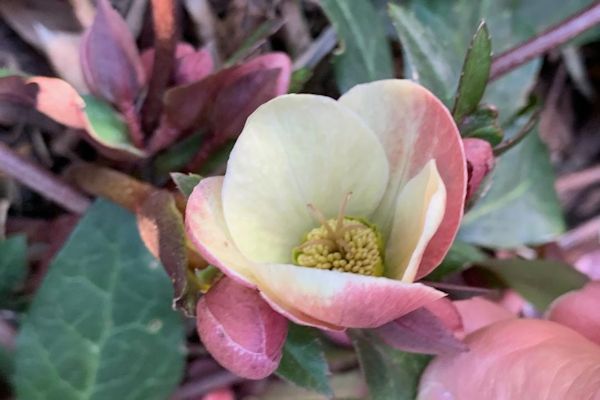
followed by 'Champion' with greenish-yellow bracts, which last through March.
'Skylands' Oriental Spruce and Coral Bark Maple
On the front lawn/driveway border is stately 'Skyland's Golden Oriental Spruce. Planted in 2008 as a memorial for my mom, it now towers at a mature twenty-five feet tall. The brilliant red branches to the left behind it are of Coral Bark Maple 'Sangu Kaku'.
'Skylands' Oriental Spruce Seed Cones
Seed cones dangling from up high on the branches of the spruce is always a fun sight!
Azalea Wintertime
In the back pool surround garden, the foliage of Azalea turns a deep burgundy this time of year...
'Anna's Magic Ball Arborvitae and 'Pieris 'Cavatine'
and the foliage of  'Anna's Magic Ball' Arborvitae turns from a golden summer color to a wonderful orangey hue in wintertime.
Blue Globe Spruce and Variegated Boxwood
Some other evergreens known for their colorful foliage are Blue Globe 'Montgomery' Spruce and Variegated Boxwood.
Weeping Japanese Maple 'Viridis'
Moving along to the front lawn, this mature Weeping Japanese Maple has the most amazing structure in the wintertime when all the leaves are gone. I remember planting this tree some thirty plus years ago.
Blue Atlas Cedar
Planted in 1995, this Blue Atlas Cedar now towers over the island bed in the front yard. For some size perspective, the Gold Lace Juniper beneath it on the right are approximately four feet tall!
Blue Atlas Cedar Seed Cones
Here are the seed cones of the cedar close up!
Kousa Dogwood and Evergreens in Backyard Garden Winter
Venturing around again to the backyard, here is a view of the framework of Kousa Dogwood along with Gold Lace Juniper and Arborvitae...
Backyard Shade Garden
while we see Leucothoe, Spreading Yew and Weeping Norway Spruce in the shadier part of the garden.
St. John's Wort 'Magical Universe'
Here is a more dwarf version of  St. John's Wort with its dried fruit for winter interest.
Leucothoe and Golden Sweet Flag
Golden Sweet flag adds some color to the shade garden along with the Leucothoe behind it. Spoiler alert...I talk about several of these plants in my new shade gardening book!
Nellie Stevens Holly Berries
Here is 'Nellie Sevens' Holly with its colorful berries!
Hyacinths Already?!!!
As we approach the end of our stroll, there is a very unusual sight for February. With mild temperatures for the most part, the Hyacinth are already appearing...
Sedum Rosettes in February!
and so are the Sedum! I have never experienced this happening this early in the year!!!
Tea Time!!!
So, there have been many surprises in the winter garden thus far and we are less than five weeks away from the official start of spring!
Indoor Garden 
I'll just keep enjoying the indoor garden for now on the colder days...
Still Blooming!
and continue to dream of gardening days ahead!
Thanks for Visiting!

I hope you enjoyed your visit to my February garden and as always, I look forward to your comments and seeing what you have growing in your garden! Special thanks go out to our hostess Carol at May Dreams Gardens, who makes it possible to see blooms on the 15th of every month with her meme Garden Bloggers' Bloom Day. Also, special thanks to Pam Penick at Digging who had hosted Foliage Follow-Up, a meme I will continue to honor. I am also linking with some other wonderful hosts and hostesses at Floral Friday FotosFriday Bliss at Floral Passions, Macro Monday 2, Mosaic Monday at Letting Go of the Bay Leaf, Nature Notes at Rambling WoodsImage-in-ing weekly photo share every Tuesday with NC Sue and Gardens Galore Link Up Party every other Monday with Everyday Living. I am also happy to join the Weekly Photo Link-Up at My Corner of the World on Wednesdays and Garden Affair at Jaipur Garden. Here is to a wonderful 2023 planting season and gardens that thrive!

IN THE NEWS!!! 

I am excited to announce that my fifth book, Shade Gardening for the Northeast and Mid-Atlantic:  A Guide to Planning the Ultimate Shade Garden is now a reality! Come check it out and if you have it, please post a review on Amazon and/Goodreads. Reviews are so very important in getting the word out about a new book on these sites and I would so appreciate your support!

I recently had the honor of being a guest on two podcasts as we chatted about shade gardening and my new book, first on Washington Gardener Magazine with Kathy Jentz , then on Better Lawns and Gardens with Teresa Watkins! It is always fun chatting gardening with colleagues and I am sending out a big thank you to both for having me on! Be sure to check out both of their amazing podcasts!

Sunday, August 15, 2021

Garden Bloggers' Bloom Day & Foliage Follow-Up August: Late Summer Blooms!

Welcome to my August Garden!
Welcome! It's August and the Crape Myrtle are blooming along with many other sights to see! The "dog days" of summer are here with the past three days of  89 to 91 degree temperatures with lots of humidity. The gardens are loving it though and the blooms keep coming. Come along and join me for a tour of my Long Island garden!
Patio Garden
One of my favorite all-summer bloomers is this potted red Mandevilla vine which lives on the patio right by the back door entry. It is an addition I make a point of having every year and it provides so much joy! In the raised garden bed and along the patio are late summer blooming favorites, Crape Myrtle 'Sioux' and Platycodon (Balloon Flower) with more to follow.
Patio Garden Looking out to Island Bed
Lets take a closer look. Now in view is blue-hued Balloon Flower (Playtcodon 'Komachi') with the back island bed straight ahead. I've had the Platycodon for many years and purchased this Crape Myrtle at about four feet tall, grew it in a planter until it was 6 feet tall, then transplanted it into an island bed on the back lawn, created to become its permanent home. That was sometime in the late 1990's. It is now at a stately 25-30 feet tall and bears magnificent deep pink blooms which I look forward to late July into fall.
Crape Myrtle 'Sioux'
Here are the blooms of Crape Myrtle 'Sioux' up close...
Platycodon grandiflorus 'Komachi'
and an up close and personal with the Platycodon (Balloon flower)! 'Komachi' unlike other Platycodon varieties, never opens its blooms, making it very unique.
Crape Myrtle Exfoliating Bark
The bark of Crape Myrtle is especially interesting late summer into winter as it exfoliates to expose colorful layers. This is one of those additions that provides more than just the blooms for all season interest!
Perennial Border
In the perennial border, other blooms can be seen alongside Platycodon. They include Echinacea (Coneflower) Pow Wow 'Wild Berry', Stachys (Lamb's Ear ) and Echibeckia Summerina.
Rudbeckia 'Little Gold Star'
This dwarf form of Rudbeckia, Little Gold Star' has really done well since I purchased it about four years ago. It stays nice and compact and does not spread like its parent form.
Echibeckia Summerina 'Blazing Star'
This summer I returned to the local farm stand where I had purchased  Echibeckia last year and got another one for the opposite side of the garden. Now the two of them frame the path leading from the patio to the back lawn. I am really enjoying the new cultivar, which is a cross between Echinacea and Rudbeckia.
Southeastern Garden Border
The Sedum 'Brilliant' are about to show their pink blooms any day now as Double Knock Out Rose continues to bloom along the back fenceline...
Daylily Stella D' Oro Still Blooming!
and Daylily 'Stella D Oro' continues with its third round of blooms after rejuvenation.
Mandevilla
Here is Mandevilla up close!
Hydrangea 'Nikko Blue' Late Summer
Hydrangea blooms are always welcomed, as the blooms of this 'Nikko Blue' variety turn to a purplish hue as the summer moves on. The Hydrangea have had an outstanding season after suffering from two previous cold winters with no snow cover.
Driveway Border
Along the driveway border, Coreopsis 'Zagreb' continues its blooms throughout summer into fall with purple-leaved Weigela 'Spilled Wine' in the backdrop, Skylands Oriental Spruce to the left and Coral Bark Maple to the right. There is also Hinoki Cypress 'Verdoni' and Coneflower to the right.
Echinacea 'Cheyenne Spirit'
The Coneflower (Echinacea Cheyenne Spirit) is sporting several blooms this time of year. It's always a surprise what color flowers will form on this plant, with blooms ranging from pink to orange, to the cream colored blooms you see here.
Hydrangea 'Tardiva'
I always look forward to the blooms of Hydrangea 'Tardiva', a later-blooming panicle hydrangea along the northeastern side of the property. I will often cut the slightly fragrant flowers to give as gifts or to display in a vase.
Front Lawn & Tree Hydrangea
As you can see, it is a prolific bloomer.
Front Lawn-Blue Atlas Cedar
This very mature Blue Atlas Cedar lives on the front lawn, towering at about forty feet tall. Yes...it is the tree that I brought home in the back of a Ford Probe when I had just started designing. It was entertainment for everyone at the nursery as I loaded it into the back of the car through a hatch-back before finally moving to a pick up truck. Ahh...those were the days!
Front Lawn Long View
The Weeping Japanese Maples on the front lawn can be seen at this angle. To the south of the Japanese Maples is the front corner island bed with a dwarf form of Sedum, Sedum 'Pure Joy,' which is displaying its light pink blooms.
Sedum 'Pure Joy'
Here is a close up!
Driveway Border Southwest Side
Moving back along the driveway once again, Spirea 'Magic Carpet' is still pushing out some of its rosy pink blooms alongside Weeping Norway Spruce and the foliage of Variegated Iris.
Patio Container Garden
As we come to the end of the tour, this newly planted container garden with Dwarf Alberta Spruce 'Jeans's Dilly' (maximum height of three feet), Dwarf Hinoki Cypress and 'Franklin Boy' Ornamental Arborvitae' with its unusual threadlike golden foliage are thriving. I hope it continues to do well throughout the winter months.
Greeting Committee (just for fun!)
I hope you enjoyed your stroll and thanks for stopping by.  Hope to see you around! 
August Garden-Thanks for Visiting!
Thank you for visiting my August garden. As always, I enjoy hearing from you and seeing what's growing in your neck of the woods! Special thanks go out to our hostess Carol at May Dreams Gardens, who makes it possible to see blooms on the 15th of every month with her meme Garden Bloggers' Bloom Day. Also, special thanks to Pam Penick at Digging who has hosted Foliage Follow-Up for all these years, a meme I will still continue to honor. I am also linking with some other wonderful hosts and hostesses at Floral Friday FotosMacro Monday 2, Mosaic Monday at Letting Go of the Bay Leaf, Nature Notes at Rambling WoodsImage-in-ing weekly photo share every Tuesday with NC Sue and Gardens Galore Link Up Party every other Monday with Everyday Living. I am also happy to join the Weekly Photo Link-Up at My Corner of the World on Wednesdays and Garden Affair at Jaipur Garden

A GUIDE TO NORTHEASTERN GARDENING NEWS:

The GardenComm 2021 Virtual Conference was a great success with so much fun, great information and the best group of gardeners you'd ever want to meet! Four fun filled days were packed with everything to do with gardening, from TV personalities to advice from professionals to garden tours around the world, and I was honored to be a presenter on the Meet the Authors Panel! Go to the GardenComm website to learn more and become a member!

If you haven't already done so, and would like to stay informed of new posts, there is a new follow.it subscription service at the top right side of this page to replace the feedburner app which will no longer send e-mail notifications in the future. You may have already received an e-mail to confirm your subscription to continue receiving posts. 

If you are a gardener or wanting to learn more about garden design and maintenance, you may enjoy my books. To learn more, visit 
My Author Page. I have written four books to pass along my knowledge and experiences as a landscape designer and gardener, which I have been all my life! They are A Guide to Northeastern Gardening: Journeys of a Garden Designer Zones 3-9Landscape Design CombinationsDream, Garden, Grow!-Musings of a Lifetime Gardener and my latest Gardening by Month: A Monthly Guide to Planning the Northeastern & Mid-Atlantic Garden

Be well and As Always...Happy Gardening! 😊

Author: Lee @A Guide to Northeastern Gardening,© Copyright 2010-2021. All rights reserved.