Showing posts with label native plants of Hawaii. Show all posts

Thursday, March 23, 2017

The Beautiful and Romantic Fern Grotto Kauai, HI

Fern Grotto, Kauai, HI
This past year my husband and I had the pleasure of re-visiting one of the most beautiful and romantic places we have ever experienced, the Fern Grotto, on the island of Kauai in Hawaii. There was a time when the Grotto was a sacred place only to be seen by Hawaiian royalty, but for the past 50 years, visitors have been allowed to travel to the site by river boat. Unusual tropical ferns grow upside down from the roof of a lava rock grotto, which was formed millions of years ago, a true geological wonder. Native Hawaiian plants and colorful exotic tropical plants provide a rain-forest atmosphere, which is cooled by the remains of an ancient waterfall. The concave rock formation forms a natural amphitheater, which is the location of many wedding ceremonies. 
Fern Grotto Kauai, HI
The Fern Grotto is part of the Wailua River State Park and access is by boat on the Wailua River. More than 60 years ago, Walter Smith, Sr. started taking visitors up the river on a small rowboat, powered by an outboard motor. Seeing the need for something better, he came up with the idea of a rear-engine system river boat, which is used by the Smith’s family Wailua River tours today. The spacious, open-air boats provide excellent views from either side during the trip upstream. The Wailua River is known as “the only navigable river” in all of Hawaii.
Smith's Family Tours, Fern Grotto Kauai, HI
The river’s fresh water pours down from Mt. Wai‘ale‘ale, one of the wettest spots on the planet. The land along the river makes up the sacred capital of ancient Kauai and the was the birthplace of the island’s royalty. The two mile ride up the Wailua River is a peaceful one in which tropical foliage and wildlife can be explored.
Rear-engine System River boat, Fern Grotto Kauai, HI
Along the way, kayaking tours can be seen, as well as an ancient Hawaiian Village.
Kayakers along Wailua River Kauai, HI
The Kamokila Hawaiian Village is a 4 acre reconstructed ancient Hawaiian village along the banks of the river. The village consists of thatched huts and houses, including an ancient canoe house, chief's assembly and doctor's house. Story boards and artifacts are located around the grounds to explain ancient Hawaiian life. Our destination is just a few minutes away.
Kamokila Hawaiian Village Along Wailua River Kauai, HI
Once docked, a short walk through the tropical rain forest leads visitors to the beautiful Fern Grotto. Already, the memories started to come back.
Fern Grotto Kauai, HI
There is an abundance of both indigenous and introduced tropical plants along the walk, including Hawaiian Ti Plant, Torch Ginger, Shampoo Ginger, Bird of Paradise, philodendron, bamboo and a variety of palms. Magnificent aerial roots came down from the trees above.
Fern Grotto, Kauai, HI
A non-invasive form of clumping bamboo can be seen along the path. This type of bamboo exists in many of the gardens on the island.
Clumping Bamboo, Fern Grotto Kauai, HI
Tropical plants surrounded the walkway from all directions. Red Torch Ginger is a popular plant on the island. This beautiful flower is grown for its ornamental value.
Red Torch Ginger, Fern Grotto, Kauai, HI
While following the path, even more beauty can be admired. Grown for its ornamental value, Beehive Ginger can grow to over 6 feet in height with one foot long leaves. 
Beehive Ginger, Fern Grotto, Kauai, HI

Its bracts arise from the ground and can range in color from chocolate to golden and pink, resembling the shape of a beehive. The true flowers are insignificant white blooms that appear in between the bracts.
Shampoo Ginger, Fern Grotto, Kauai, HI
Near the end of the path is Zingiber zerumbet (Awapuhi).  It is named Shampoo ginger, or 'awapuhi kuahiwi' and may be recognized as the name of a familiar brand of shampoo made by Paul Mitchell. Awapuhi was introduced to Hawaii by early Polynesians and includes earlier uses with the leaves being used as flavoring for foods and rhizomes and leaves being used for medicinal purposes. 
Path through rain forest to Fern Grotto Kauai, HI
As we approached the grotto, a joyous feeling came upon me, as we had finally made it back to this wonderful place after so many years.
Fern Grotto Kauai, HI

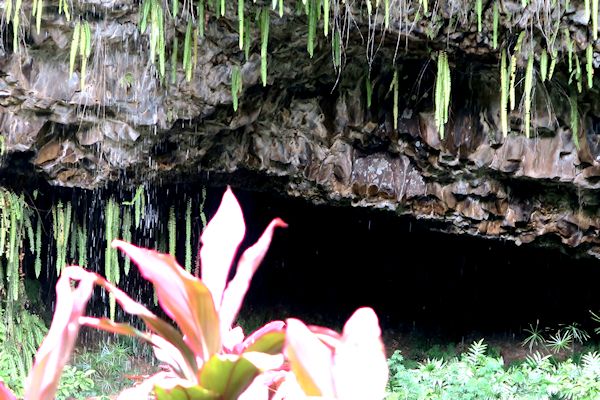
We have arrived! To give a little background, the Fern Grotto is one of nature's wonders. Native tropical Sword ferns grow upside down from the top of the 80 foot opening, with water streaming down from the top of the cave where a waterfall used to exist. The plant life in the grotto is nurtured by rainwater, which feeds from the river, beginning on the slopes of Mount Waialeale, 20 miles inland. The 5,000-foot mountain averages 450 inches of rain per year, which comes down into the grotto.
Sword Fern and Ti Plant Fern Grotto Kauai, HI

The falling water from the river can be seen from the visitor platform facing the grotto.
Fern Grotto Kauai, HI

In 1992, the Fern Grotto was nearly destroyed when the island of Kauai was hit by Hurricane Iniki. Most of the ferns hanging from the grotto were torn from the rocks and the grotto is still rebounding. We were pleased to see that much of the vegetation had returned over the years and the grotto still remains one of the most popular and beautiful spots on the island. Even though visitors can no longer stand inside the grotto, today it can be viewed from the designated observation deck. 

Hawaiian Wedding Song, Fern Grotto Kauai, HI
In April of 2006, the grotto was hit again by severe rains that caused rocks to fall from the ceiling onto the viewing area below, causing the area to have to close. The Grotto was reopened in 2007 following artificial reinforcement of the rock walls and installation of ramps to access to the area.
Hawaiian Wedding Song, Fern Grotto Kauai, HI
Up until 2006, weddings were performed within the grotto, but due to the damage, they now they take place on the observation deck facing the amazing feature. We got a feel for how a wedding ceremony would be there, as we listened to water falling from the top of the fern-lined cave, while being serenaded by the beautiful and well known Hawaiian Wedding song.
Aerial Roots Fern Grotto Kauai, HI

While standing in silent awe, we could not get over the beauty of this magical place. It was as we had remembered, with cascading aerial roots and three to five foot long tropical ferns descending from the roof of the grotto. Close to the platform were Hawaiian Ti Plants, believed to bring good luck. 
Fern Grotto Kauai, HI 2016

It started to gently rain, which seemed to make the grotto even more magical. We were signaled by the tour guide that is was time to go. I could have stood there all day.
Ravenala madagascariensis (Traveler's palm or Peacock Palm) Fern Grotto Kauai, HI


One the way back, we viewed Peacock Palm, a favorite of mine. Peacock Palm is not really a palm at all, but rather belongs to the genus Strelitzia, which is a relative of the Bird of Paradise. If you have ever seen a Bird of Paradise flower, the resemblance is remarkable.
Philodendron along path at Fern Grotto Kauai, HI

Philodendron, introduced to the islands many years ago, have grown freely and become invasive due to the perfect conditions of temperature and rainfall. Philodendron can be seen along this pathway to the left, climbing up the trees.
Fern Grotto Kauai, HI

I believe this is another variety of ginger. The color is striking and adds to the beauty of this place!
Departing Fern Grotto Kauai, HI

We have now arrived back to the river boat and the captain is ready for the trip back. 
Boat Ride Back from Fern Grotto Kauai, HI


On the boat ride back, Hawaiian singers play a variety of island songs, including Blue Hawaii, as Hula dancers sway to the music. Even a fun hula lesson was taught to the passengers as we approached the shore. After a fun day, we say "A hui hou", or good-bye and until we meet again.
Fern Grotto, Kauai, HI

It was a very special day as memories flooded our minds...memories of our honeymoon vacation to this very spot back in 1982, when the grotto was lush and undamaged from the dangerous winds of hurricane Iniki. We were part of a privileged group who had the experience of standing inside the actual grotto and feeling the mist from the water that came from above. We had heard stories that the grotto just wasn't the same after the storm, but it has recovered quite well, and the whole experience was just as wonderful as we had remembered.

For more information on the Fern Grotto visit Smith's Family Tours, Hawaii.

Linking with Our World Tuesday, Floral Friday Photos and Image-in-ing Photo Link-Up.

As Always...Happy Gardening!

Author: Lee@A Guide to Northeastern Gardening, © Copyright 2017. All rights reserved


Wednesday, November 23, 2016

Allerton Tropical Botanical Garden, Kauai

Allerton Botanical Garden Kauai
Hawaii is the home to many botanical gardens, and Allerton Tropical Botanical Garden on the island of Kauai is one of my favorites. Located in the beautiful Lawa'i Valley, Allerton Gardens encompass approximately 85 acres of land. The mission of this private, non-profit organization is to preserve and protect the one third of all plants that are threatened by extinction. The Allerton Garden Guided Tour lasts approximately two and a half hours and is presented by knowledgeable tour guides, each sharing their vast knowledge of Allerton's botanical and cultural history. Sit back, listen to some Hawaiian music and enjoy the tour!
Allerton Tropical Botanical Gardens Kauai
Kauai's Lawa'i Valley was known in ancient Hawaiian culture as the land divide of Lawa'i. In 1848, the land was granted to King Kamehameha I, who willed a third of the land to Queen Emma. In 1885, Kamehameha's widow gave the remaining land to Queen Emma, and she took permanent residence there after her husband and son passed away. Since she possessed such a deep passion for gardens, Queen Emma planted numerous plumeria, bougainvillea, mango, pandanus, rose apple and fern throughout the valley. Queen Emma leased the Lawa'i Valley to the McBryde family, who eventually bought the estate from her in 1886. The McBrydes continued to plant sugarcane, taro and rice, then sold the land to Robert Allerton in 1938. Allerton was the only son of a Mayflower descendant who had made his fortune in Chicago in livestock, banking, and real estate, who had became fascinated by landscape architecture. Allerton met John Gregg, a young architectural student at the University of Illinois, whom he eventually adopted. The two men traveled the world purchasing works of art and getting new inspiration for the gardens. On their way home from a trip in the Pacific in 1937, the Allertons visited Kaua’i and were amazed with the lower portion of the Lawa’i Valley. They purchased the property and in 1938 moved into their new home, which was designed by John Gregg. They called the property “Lawa’i-kai” (kai is the Hawaiian word for “near the sea”). In 1964, Allerton was declared as a tropical botanical garden, chartered by the U.S. Congress, which completely took over the estate in the early 1990's.
Water Lily
The ride into the gardens starts with Pump Six, the original pump house that delivered water to the sugarcane fields in the upper valley during the early 1900's. These beautiful water lilies now thrive in the water source behind the pump house.
 Pachypodium rutenbergiantium 
Next is Pachypodium rutenbergianum, an unusual looking tree with spiny leaves that only grow at the very tips of the branches. The tree reaches a height of 3 to 12 meters and displays fragrant white and yellow flowers in the warmer months, the blooms resembling those of plumeria.
Hawaiian Native Hibiscus
 Hawaiian Hibiscus is endemic to the island of Kauai and grows as a shrub or small tree, reaching a height of 10-23 feet. The state flower of Hawaii is the yellow hibiscus, while other forms such as red, orange and white can be seen throughout the islands. Native Hawaiian hibiscus is on the endangered species list and is under protection by the National Tropical Botanical Gardens.
Monkey Brain Tree 

If you look closely at the fruit of this tree, it exhibits a bumpy appearance, almost  resembling a brain. This tree is known as Osage-orange, hedge apple or monkey-brain tree. It was late in the season when these photos were taken, so the fruit which is normally a yellow-green has started to fade. The fruit of the tree is related to the Mulberry, but for the most part is not edible.  The seeds are edible and the hard wood has been widely used in the making of bows.

Our Tour Guide explains the nutritional value of Artocarpus altilis – Breadfruit Ulu

Native to Hawaii, Breadfruit grows in tropical lowland areas, especially in those areas near ancient Hawaiian settlements. The ancient Polynesians had brought Breadfruit to Hawaii in their canoes and used it as a life-sustaining staple, the fruit and seeds are edible and very nutritious. The milky sap was used for medicinal purposes and the fruits were cooked and eaten, sometimes used to make poi. Ulu is known as the "tree of bread" in Hawaii.
Breadnut Tree
This bread nut is a smaller version of breadfruit, containing seeds which are very high in minerals, vitamins and antioxidants. The fresh seeds can be cooked and eaten or allowed to dry out.
Allerton Garden Room

Robert Allerton had an affection for formal gardens, so he created this enclosed walled garden. The room serves as a peaceful retreat and leads to a more open area.
Shell Ginger
The lattice structure above leads to these beautiful Shell Ginger which grow in the gardens beyond.
Allerton Garden Kauai
The tour continues through a rain forest of tropical plants including native palms, bromeliads, orchids and ferns, leading to the Allerton family orchid.
Palmello Tree (Hawaiian Grapefruit)
The fruit orchid is full of culinary delights, including this Hawaiian grapefruit, which is quite a tasty treat. It has a similar appearance to grapefruit as we know it and the taste is much sweeter...no sugar needed!
Pomegranate Tree
The tropical climate on the island of Kauai allows these Pomegranate trees to grow upwards to 100 feet, producing pomegranates larger than I have even seen.
Diana Goddess of the Hunt Allerton Garden Rooms
Following the trail, we encounter this peaceful reflecting pool being overlooked by a beautiful Romanesque statue...and
Spilt Leaf Philodendron
over-sized philodendron and aerial roots lead us to another garden room.
Mermaid Room Sculpture and Fountain
One hundred year old Monkey Pod trees and naturally scalloped palms line the Mermaid Room, where a scalloped-shaped fountain creates a soothing water flow at a pace of about 52-54 pulses per minute. Allerton had this fountain designed in order to create a calming "Neptune Effect", which is achieved by sitting on the bench and allowing your mind to relax and heart rate to slow to the beat of the pulsating water.
Chinese Ceramic Urn
More unique sights are seen as we move along. This ancient Chinese urn is placed in just the right location in the gardens.
Three Reflection Pools Room Art
Next is this elongated, three-tiered reflection pool which is overlooked by a Sleeping Horse. This original Hawaiian artwork was purchased by Robert Allerton. It is important to note that all the reflection pools in the gardens are fed by underground springs.
Allerton Garden Opening Scene of Gilligan's Island
Do you remember the television series "Gilligan's Island"? This lagoon is where the filming of the opening scene took place.
Pink Quill Bromeliad and Orchid
Along the walk to the Bamboo Room is an abundance of tropical Bromeliads and Orchids. 
Clumping Bamboo (Non-Invasive)
This Bamboo Room was one of the first garden rooms that Robert Allerton came up with. Many do not know that Robert Allerton was partially deaf; therefore, he enjoyed the loud clicking and clacking of the bamboo reeds as they moved in the wind. This bamboo grove was also used in the filming of 'Pirates of the Caribbean IV:" when Captain Jack crossed over the bamboo bridge!
Crytostachys renda Lipstick Palm 
As we leave the Bamboo Room, we encounter a tropical Lipstick Palm. Its bright red bark was used to make dyes by the ancient Polynesians.
Moreton Bay Figs Kauai
Here are the famous Moreton Bay Figs. In 1992, Steven Spielberg filmed the movie "Jurassic Park" right here at this sight. If you remember the scene of the raptor eggs, they were placed in the root of the second tree, and the jeep scene took place in the third tree over. The Moreton Bay Fig, originally native to Australia was introduced to Allerton Gardens just 70 years ago. 
Moreton Bay Figs Kauai
The figs that were collected as saplings by Allerton and shipped in empty beer cans now have roots reaching 6-8 feet in height.
Palm Seeds
As we continue the tour, bright red palm tree seeds tower above our heads...
Vanilla Bean Orchid
and Vanilla Bean Orchid vines can be seen climbing up a palm tree.  If you are wondering if this is where vanilla comes from...you are correct!
Heliconia (Lobster Claw)
Other sites are the beautiful and unusual blooms of Heliconia, also known as Lobster Claw Plant...
Staghorn Fern Allerton Garden
and Staghorn Fern hanging from the trees above.

Allerton Botanical Garden Kauai
I hope you enjoyed the tour of the beautiful Allerton Botanical Gardens in Kauai. For now it's Aloha or A hui hou...until we meet again.
Allerton Botanical Garden Kauai

For more information visit Allerton Botanical Gardens 

Visitors Center - 4425 Lawai Road, Poipu 96756


As Always...Happy Gardening!
Author: Lee@A Guide To Northeastern Gardening, Copyright 2016. All rights reserved