Saturday, March 15, 2014

Garden Bloggers' Bloom Day & Foliage Follow-Up March 2014: Spring at Last!

Welcome!  It is mid-March and spring arrives in just under a week.  The month of March came in like a lion with snow flurries and winds but the winter that seemed would never end is slowly disappearing with each passing day. After seven snow storms and frigid temperatures the daily temperatures have been rising up into the 40's and 50's and the ground is defrosting.  Surprisingly temperatures plummeted once again into the 20's right before Bloom Day but there are evident signs of the changing seasons.  The birds have come out of hiding and the first robins have arrived.   Life is gradually coming back into the landscape and it will be spring at last!  Come along and take a walk with me in my Long Island garden.  
The first robins arrived just the other day so I had to photograph them to mark the occasion.  This male robin is really flaunting his bright red color!
Hyacinths are emerging from the earth and showing their pink tipped buds that will form into blooms within the next several weeks.
The Lamb's Ear is sporting its new growth of soft fuzzy white foliage.
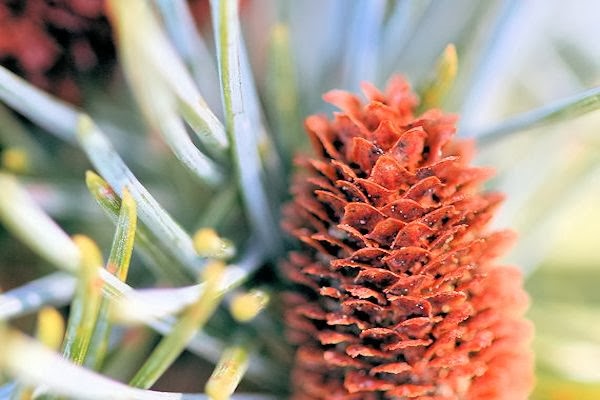
Here are some close ups with the new macro lens of a cone overwintered on the Blue Atlas Cedar...
and the new spring growth emerging on the Blue Montgomery Spruce.
In the backyard the white cottony Weeping Pussy Willow catkins are opening with the rising temperatures...
and the rosette-looking Sedum 'Brilliant' growth is emerging from the ground...both sure signs of spring!
The golden foliage of the 'Skylands' Oriental Spruce' is a show stopper every season of the year but seems more vibrant now when getting ready for new spring shoots. 
In the backyard under the Magnolia tree is my new favorite birdbath purchased at the end of last summer.  It has been a water source for the birds throughout the winter and now every morning it is a regular meeting place for robins, blue-jays and chickadees.  I love to watch them flutter their wings and splatter water everywhere.  I will try to get some photos of this morning ritual with my telephoto lens as spring and summer arrive!
Here are some macros of the Weeping Pussy Willow catkins...
and a pine cone on my Weeping White Pine.
In the front yard by the driveway the bark of the Coral Bark Maple glows a reddish-pink before new growth emerges.  The unusually cold winter has really made the colors of this tree vibrant.
Here is a closer view of the golden hue of the Skylands Spruce.  The Coral Bark Maple and Skylands are very near one another so I get a show of color all year long.
 
Here is another one of the arriving robins.  I am assuming this one is the female.  Did I mention how happy I am to see them here at last?
As spring gets closer the  buds on the Star Magnolia are growing larger and will soon form into beautiful white fragrant blooms and the garden boy and girl are finally visible again after being covered in a blanket of snow for most of the winter.
Spring is such a wonderful time of the year when the garden is full of hope and slowly changes as new growth emerges day by day.  Once the temperatures become seasonal spring will be in all its glory here in the northeast. Please visit our hostesses Carol at May Dreams Gardens for  Garden Bloggers' Bloom Day and Pam at Digging for Foliage Follow-Up.  Thanks to them we can enjoy blooms and foliage every month of the year. Thank you so much for touring my March garden. If you leave me a note I will know you dropped by and will be sure to visit you as well!

Happy Spring to you and As Always...Happy Gardening!


Author: Lee@A Guide To Northeastern Gardening, Copyright 2014. All rights reserved


Share this Post
Share to Facebook Share to Twitter Email This

Saturday, March 1, 2014

Design of a Long Island Native Garden

Long Island Native Garden
As a designer I occasionally encounter jobs that are more challenging than others. This past summer I was contracted to design a Long Island native planting on the island's north shore.  Being the natural area was destroyed by Hurricane Sandy of 2012 and needed to be re-vegetated, there were set environmental guidelines that all plantings had to be native to the area and that the use of topsoil, mulch or fertilizers to sustain the plants was not permitted. That was no problem.  Most native plantings are tolerant of a variety of soil types and can thrive even in poor soil.  The challenge was that the homeowner did not want a natural planting but rather an organized garden that would look well planned and aesthetically pleasing. As you may be aware native plantings are not known for their aesthetic value. My idea was to create a garden with evergreens, flowering shrubs and colorful perennials that would be native and fit into the style of the surrounding area.  After going to several nurseries and researching numerous native plants for the area I proceeded on a design plan which gradually fell into place.
Before & After 
The first thing was to measure the blank slate and see the amount of space I needed to fill.  My goal was to achieve a well-balanced structure throughout the garden as to attain all season interest and provide a framework even in winter. After much decision making I choose native plants with good structural qualities such as Rosebay Rhododendron (Rhododendron Maximum), Summersweet (Clethra alnifolia' Sixteen Candles'), Inkberry (Ilex glabra 'Compacta') and Bayberry (Myrica pensylvanica).   For colorful blooms I choose Echinecea, Liatris, Yarrow, Tiarella and native American Wisteria for the pergola.  Native Shenandoah Switch grass and Christmas fern were added throughout the garden to add movement and Bearberry was used as a ground cover for soil stabilization. 
Before & After 
I massed the different species of plants to achieve more impact and give the area a relativley full look while allowing growing room. 
Besides the requirement of being native, the plantings also needed to be as "deer resistant" as possible.  Once I had the main list I  used my own experiences and research to determine the best plantings for the space. Besides the deer, there were a multitude of other local guests to the property including ducks, swans and rabbits.  As I was first designing on site one of the local swans diligently watched over every move I made until I quietly worked from one of the boulders.  Being an animal lover I guess he sensed it was alright for me to be there.  Eventually we developed a mutual understanding and I was able to walk around and continue on with my work.
Native Plant Pallette
Here are some of the plants I choose for the design.  Top Row (Left to Right):  Achillea, Yarrow, Liatris and Bottom Row (Left to Right) Echinecea, Clethra and Switch Grass.  I laid out my landscaping flags to get a good vision of how the plants would come to play and everthng came together.  The combinations of plants worked beautifully and the garden design that I set out to achieve for the client was accomplished. 
Long Island Native Planting
Every project I encounter is always exciting and new and sometimes it is exhilarating to encounter a good garden challenge.  The completed garden was a success and turned out to be everything the client and I had hoped for.  The moral of the story...it is possible for a native planting to be well-structured, fit into a natural setting and be aesthetically pleasing!
As Always...Happy Gardening!


Author: Lee@A Guide To Northeastern Gardening, Copyright 2014. All rights reserved.

Saturday, February 15, 2014

Garden Bloggers' Bloom Day & Foliage Follow-Up February 2014: Snow…What’s up?

I haven’t heard this sound in a long time.  In the stillness of the landscape there is a crackling sound of branches as ice falls from them.  Several storms have passed and at the present time we just endured our sixth snowfall of the season. It is time for another Garden Bloggers' Bloom Day and Foliage Follow-Up, and while not much is blooming this time of year, the garden is full of hope…well maybe.  I know all of the cold climate folks are getting a bit stir crazy and have seen way too many snow photos…but prepare yourself...there are more in the near future. I am also celebrating A Guide to Northeastern Gardening's Fourth Anniversary on the 17th. so I included some macros taken with the new lens. Come take a look at the garden in winter.  
   Hydrangea 'Endless Summer' Flower Seed Head
'Nellie Stevens' Holly Berries
Crape Myrtle 'Sioux' Seed Head
Western Arborvitae and Spreading Yew
Picea orientalis 'Skylands'
Acer Palmatum Sango Kaku 
(Coral Bark Maple)
Ice Bubbles in Birdbath
Gardens & Rock Waterfall in Winter Mode

Picea pungens 'Montgomery' Foliage


'Skylands' Spruce, Barberry and Weeping Blue Atlas Cedar
Garden Under Blanket of Snow
I know this is not the traditional post and I am counting on our warm climate bloggers to chime in and show off some blooms. After all...isn't that what Garden Bloggers' Bloom Day is all about?   Carol at May Dreams Gardens had a good idea with this meme.  We can  experience blooms every month no matter what the time of year.  Also thanks to Pam at Digging for hosting Foliage Follow-UpWhile there aren't any blooms in the garden right now I can focus on foliage and buds which are a hopeful sign.   Maybe next month will be more promising!  Happy Garden Bloggers' Bloom Day & Foliage Follow-Up!

And As Always...Happy Gardening!


Author: Lee@ A Guide to Northeastern Gardening.  All rights reserved 2014.


Saturday, February 8, 2014

Feature Shrub: Nandina domestica

Nandina domestica
Looking for all season interest in your landscape? Nandina domestica is a semi-evergreen broad-leaved shrub which is known for its interesting display of bamboo-looking foliage. Creamy-white flowers in spring are followed by pink fruit that matures to bright red berries in winter along with colorful foliage that changes from green to shades of pink and yellow on outer branches. Nandina grows to a height of 6-8 feet and width 2-4 feet and is ideal for foundation plantings, woodland gardens, informal and natural settings. Nandina is deciduous only in very cold climates where temperatures fall below -10 degrees. It is semi-evergreen in zones 6-9 and evergreen in zones 8-10. Nandina domestica thrives in full sun to partial shade and prefers to be grown in a moist well-drained soil.   
Nandina domestica (Late Spring)
Nandina is a low maintenance shrub only requiring occasional pruning once a year to control height and maintain fullness. Several dwarf cultivars of Nandina have also been produced.  Two of the nicer varieties are Nandina 'Gulf Stream' which grows to a height of 4 feet tall and 'Firepower' which reaches a maximum height of 2 feet tall. 'Gulf Stream' exhibits mostly green foliage in summer and bronze-red foliage in fall. 'Firepower' is known for its green foliage with red tips in summer followed by bright red-maroon foliage in fall. The dwarf forms do not produce flowers and fruit, and are known for their superior changing foliage. Unlike Bamboo, Nandina (False Bamboo) is considered non-invasive in most areas, but always check your local Cooperative Extension for updated information.
Nandina domestica (Heavenly Bamboo) Winter Foliage
Nandina domestica is drought tolerant once established, is not susceptible to any particular diseases and is long-lived. It also known to be "deer resistant". Nandina domestica is an all around interesting addition that fits nicely into a number of landscape settings. If you are looking to add continued interest to your landscape give this plant a try and it will supply you with years of enjoyment.

(Update 2017): Research has found that the berries of Nandina may be toxic to some varieties of birds. This plant can still be used for its beautiful foliage and can be purchased in sterile form. If you have Nandina for its interest in the garden, prune off berries once they mature to avoid any harm to wildlife. 

As Always...Happy Gardening!

Author: Lee@ A Guide to Northeastern Gardening.  All rights reserved 2014.


Monday, February 3, 2014

Winter Wonderland: More Snow!

After a mild weekend with temperatures in the upper forties and the grass finally visible we woke up to yet another winter's snow.  I have totally lost count of the number of snow falls we have had at this point with two more in the forecast for this week.  Having mixed feelings about the snow, and truthfully having had enough, its beauty never ceases to amaze me.  It looks like such a winter wonderland outside I had to venture out with camera once again!
Coral Bark Maple Snow Covered (Pinkish Hue is the Bark)


Linking with Little Red House for Mosaic Monday and Gemma at  Macro Monday 2
 
 
As Always...Happy Gardening!

 
Author: Lee@A Guide To Northeastern Gardening, Copyright 2014. All rights reserved.

Saturday, February 1, 2014

Houseplants for Colorful Foliage & Winter Blooms

Whether it is cold and snowy outside or a beautiful summer day houseplants are always here to stay.  Adding houseplants to your indoor space supplies interesting foliage and colorful blooms to a room and also adds oxygen and humidity for good health.  In a previous post I introduced several user friendly houseplants that are hardy and low maintenance.  I have come across a few new additions which I would like to share!
Aglaonema (Chinese Evergreen)

Lighting:  Low to Moderate (More Light for Red Variegated Varieties)
Water & Soil:  Keep Moderately Moist (Water in Center of Plant)

Once of the newest additions to my home is an exciting new hybrid of Aglaonema (Chinese Evergreen). I found it accidentally while searching for a new Croton plant for my indoor space.  I spotted the variegated pinkish-red foliage of this Chinese Evergreen and it really caught my eye.  Never having seen this particular variety before, it appeared to be unusually close in resemblance to the Croton I was looking for.  I excitedly purchased the two plants the nursery had left and brought them home to try out.  The variegation is slightly different on each plant so I combined the two together for even more interest and to my delight the new addition is thriving in my southwestern window.   Keep in mind that Chinese Evergreen normally prefer low light, but with the lighter tinged colorful foliage on this variety, it is doing well in the brighter conditions. I am getting so much enjoyment from this new plant with its beautiful and vibrant foliage and I would highly recommend it for your indoor garden!
Crassula argentea (Jade Plant)

Lighting:  Bright Southern or Western Exposure
Water & Soil:  Moderately Dry Well Drained Soil

Jade Plant has always been a favorite of mine.  I started growing two Jade plants about 25 years ago which have now been propagated into four. I had the rare surprise of seeing my two mature Jades bloom for the first time in the past several years.  I can only remember them in bloom about three or four times since I have had them and when they bloom it goes on for months. I think what sparked the beautiful blooms was a combination of both plants being very root bound, the dose of cactus juice I had given them, and the night time temperatures of the windowsill they are located on suddenly dropping, thus signaling the arrival of winter. I have read that Jade requires a dramatic temperature change to encourage blooming but to get them to bloom is a difficult feat. This rarity is truly a joyous surprise that I am glad to be able to share!
Crassula argentea (Jade Plant) in Flower

Here are the blooms of the Jade.  They resemble small clusters or star bursts.
Amaryllis

Lighting:  Bright Light
Water & Soil:   Moderately Moist Rich Humus Soil

Amaryllis is an all time favorite houseplant for the winter months with its large showy blooms available in a variety of colors.  Plant the bulb one quarter to half way exposed in a humus rich soil and keep moderately moist in a sunny window. Blooms will last approximately 4-8 weeks and put on quite a show!  After blooming, Amaryllis bulbs can be allowed to dry out and stored in a cool dry location until being re-planted next season.  Start forcing bulbs 6-8 weeks before desired blooms by planting in a small planter in a peat based soil, watering sparingly until the bulb starts to sprout then weekly afterwards. Enjoy the blooms for the lifetime of the bulb which can be several years.
Schlumbergera truncata (Thanksgiving Cactus)

Lighting:  Bright Diffused Light
Water & Soil:  Moderately Moist (Requires a Well Drained Soil)

Thanksgiving  Cactus is another all time favorite for winter flowering.  In reality a succulent, there are three varieties of this plant for bloom time, one near Thanksgiving (Thanksgiving Cactus), one near Christmas (Christmas Cactus) and one near Easter (Easter Cactus). Thanksgiving cactus (Schlumbergera truncata) has very pointed and claw-shaped projections on the edges of each leaf, Christmas cactus (Schlumbergera bridgesii) has more scalloped or tear-drop shaped leaves and Easter cactus (Rhipsalidopsis gaertneri) has more rounded, smooth leaves. Water infrequently until November then increase the watering to encourage blooms. After blooming withhold watering once again, allowing to dry out (but not completely), until new growth appears. As new growth appears in spring apply a weak strength fertilizer every 2-3 weeks.
Haworthia Attenuata (Zebra Cactus)

Lighting:  Bright Light (Southern Window)
Water & Soil:  Well Drained, Water Sparingly

Like my Jade Plant this Zebra Cactus is approximately twenty years old and all I do to maintain it is to water weekly.  It is very root bound in a well drained cactus soil and grows over the rim of its planter. I'll give it a dose of cactus food once or twice at most during the growing season and remove any growth that has become aged and browned, which is infrequent.  It is basically a maintenance free houseplant and a conversation piece!
Dracaena sanderana (Lucky Bamboo)

Lighting:  Bright Diffused to Low Light
Water & Soil:  Weekly (Only Use Distilled Water)

Dracena sanderana, otherwise known as Lucky Bamboo, is really not a bamboo at all but a member of the Lily family, which includes the Easter lily and spider plant. Lucky Bamboo can be grown in either a closed pebble filled planter or in a potting soil with good drainage. The important thing is to water only with distilled water since even a small amount of fluoride from tap water can be phytotoxic, or detrimental to the plant. With proper care Lucky Bamboo can add interest to even the darkest of locations.
Zamioculcas zamiifolia 'Emerald Fronds'

Light:  Bright Diffused -Low Light
Soil & Water:  Well-Drained Soil, Water Weekly

Since my last houseplant post my Zamioculcas, commonly known as "ZZ Plant", has grown into a three foot high focal piece.  It thrives in indirect light from a sky light and requires minimal care.  ZZ Plants do not require much fertilization and leaf polish should not be used on its attractive glossy leaves.  To maintain the plant all I do is water weekly to keep the soil from completely drying out and keep the leaves cleaned with a moist cloth.  Some sources will say to allow the plant to become completely dry before watering but I find that weekly watering encourages much more new growth.

 Houseplants add life to the indoors and these selections have proven to be relatively low maintenance and easy to care for in your home.  For indoor blooms and attractive colorful foliage add some of these beautiful houseplants to your space and bring years of enjoyment to your indoor garden!

You may also be interested in this article on indoor container gardening.


As Always...Happy Gardening!

 
Author: Lee@A Guide To Northeastern Gardening, Copyright 2014. All rights reserved.