Saturday, May 1, 2021

This Month in the Garden: 15 Perennials for Shade

15 Perennials for Shade

The shade garden can be the home to many varieties of perennials, displaying colorful foliage, blooms, or a combination of both. Here are 15 selections for shade, each chosen on the basis of interest, productivity and hardiness.
Heuchera 'Caramel' (Coral Bells)
Heuchera 'Caramel' is a newer hybrid introduction of Coral Bells with semi-evergreen caramel-colored foliage that lasts even through the winter months. Heuchera 'Caramel' is hardy in USDA zones 4-9 and produces stalks of creamy-pink blooms in late summer on a 12-18 inch high plant. Plant Heuchera 'Caramel' is a location with partial to full shade and a moist soil. Remove spent slower stalks in autumn and any winter-damaged foliage in early spring to allow for new growth.
Heuchera 'Palace Purple' (Coral Bells
I find Heuchera 'Palace Purple' to be the most hardy and longest lived of the Heuchera with beautiful burgundy foliage. The delicate white flowers produced on 12 inch stems in August to September that resemble baby's breath are just an added bonus. Heuchera can be grown in partial sun to shade and prefers a moderately moist organic soil. It is hardy in zones 4-8. 
Hosta 'Frances Williams' (Funkia or Plantation Lily)
There are 70 species of hosta with over 3000 varieties to choose from, ranging in color, shape and size. Once of the more popular varieties is ‘Francess Williams’, hardy in USDA zones 3-8, and known for its large 24-30 inch high by 3-5 foot wide chartreuse to yellow margined foliage and white blooms on 30-inch stems in mid-summer. 
Hosta 'Patriot'
Another variety of hosta, ‘Patriot’ is a hardy in USDA zones 4-8 and displays lavender flowers in mid-summer above 14-24 inch high by 2-4 foot wide white margined green foliage. The blooms of  hosta are excellent for pollinators and are an attraction to hummingbirds!
Carex (Golden Japanese Sedge)
Carex, hardy in USDA zines 5-10, Carex forms a semi-evergreen 12-18 inch tall by wide cascading mound of lime grass-like foliage that turns yellow-gold as it matures. Excellent for areas of partial shade and moderately moist conditions, Carex adds yearly interest tot the landscape.
Dicentra (Bleeding Heart)
Dicentra, also know as Bleeding Heart, is a wonderful addition for a moist, shady location. It is one of the most cultivated perennials in the spring garden, is hardy in USDA zones 3-9, and produces beautiful heart-shaped flowers in spring. It is an excellent addition to the woodland garden.
Astilbe 'Vision in Red'
There are numerous varieties of Astilbe, each known for their various sizes, color of blooms. One of my favorites is Astilbe ‘Vision in Red’. Hardy in USDA zones 4-9, ‘Vison in Red’ displays purple-red blooms in mid-summer on top of a 12-16 inch tall plant. As with most astilbe, ‘Vision in Red’ prefers a location with partial to full shade and a moderately moist soil.
Ajuga 'Burgundy Glow' (Bugleweed)
Ajuga is a perennial groundcover that is hardy in USDA zones 3-9. Purple blooms form in spring above a spreading mound of green leaves that are highlighted with tones of cream and smoky pink. Plants grow to 4-6 inches tall by 12-18 inches wide and foliage turns to tones of burgundy in autumn. Ajuga thrives best in a location with partial shade.
Lobelia 'Cardinal'
Lobelia is excellent perennial for moist shady conditions and is hardy in USDA zones 4-9. Upright stalks of bright red flowers appear on a 24 inch tall plant in mid to late summer.
Ligularia 'Rocket'
Ligularia is another selection that thrives best on moist, shady conditions. It is hardy in USDA zones 3-9 and produces tall stalks of yellow blooms in mid to late summer on a 3-4 foot tall plant.
Ophiopogon (Mondo Grass)
Mondo Grass, hardy in USDA zones 6-10 is actually not a grass, but rather a member of the genus Ophiopogon, a genus of evergreen perennial plants native to India, China, Japan and Vietnam. Mondo grass prefers an area of partial to full shade and a moderately moist soil. 

Ophiopogon planiscapus 'Nigrescens' (Black Mondo Grass)
Black Mondo Grass is considered a ground cover that grows to approximately ten inches tall and slowly spreads to about two feet in width. Foliage emerges as dark green in spring and matures to a deep purplish-black by summer. Black Mondo Grass is hardy in zones 6-10.
Acornus (Golden Sweet Flag) with Black Mondo Grass
To add that wanted interest and drama to the garden, combine Mondo Grass with other grass-like  plantings such as Variegated Liriope, Golden Japanese Sedge and Golden Variegated Sweet Flag (as pictured above). Sweet Flag is an evergreen perennial hardy in USDA zones 5-11, displaying golden variegated foliage that grows in clumps. It is best grown in a moist, partially shaded area and is great for naturalizing.
Chelone lyonni (Turtlehead)
Chelone lyonii is hardy in USDA zones 3-8, produces showy rosy-pink blooms resembling what looks like turtle heads. Blooms appear late summer into fall on a 24-30 tall plant. Chelone prefers a shady to semi-shady location with abundant moisture. Pinch foliage back in mid-spring to encourage fullness.
Liriope 'Variegata' (Lilyturf)
Liriope muscari 'Variegata' is popular for its grass-like, cream or yellow-margined leaves. Liriope can be grown in sun or shade and produces small purple blooms in August to September followed by round, dark purple berries. Liriope is very versatile as it can be planted just about anywhere in the garden as a complement to other plantings and is hardy in USDA zones 6-11. Liriope provides interest all season long as a lovely addition of texture to the garden and the late summer blooms just add an extra surprise! Cut back lilyturf in early spring to remove winter damaged foliage and to promote new growth.
15 Perennials for Shade
I hope you enjoyed This Month in the Garden: 15 Perennials for Shade. Be sure to stop by on the 1st. and 15th. of each month as I continue to share gardening tips, information and horticultural adventures! (Linking with: Floral Fridays, Macro Monday 2, Ruby Tuesday and Image-in-ing Weekly Photo Link-Up.

For gardening info and tips: Visit my Author Page/Purchase My Books  Be sure to check out my newest book: Gardening by Month for 12-months of interest in the landscape!😊
Author: Lee @A Guide to Northeastern Gardening,© Copyright 2010-2021. All rights reserved. 

Thursday, April 15, 2021

Garden Bloggers' Bloom Day & Foliage Follow Up: Bring on Those April Blooms!

Welcome to My April Garden!

Welcome to Garden Bloggers' Bloom Day and Foliage Follow-Up for the month of April, a time to venture out into the garden and appreciate all the beauty that nature has to offer. The skies have been for the most part sunny with temperatures in the upper 50's and into the lower 60's on some days, signaling that spring is here, and creating the perfect working weather. While the world was in so much uncertainty a year ago, the daily routine seems to be slowly getting back to just a little more "normal". Being fully vaccinated, I can feel a bit more at ease when meeting with clients and getting to create beautiful gardens, a passion which I most enjoy! Ready for a tour? Come along and see that my Long Island garden has to offer!
Crocus
It just wouldn't be spring without the traditional crocus! I love how these purple beauties just pop up out of the ground and open to glorious blooms almost overnight. I cannot get enough of them, as they really do have a way of brightening the day.
Magnolia 'Royal Star'
Another April delight is this Magnolia 'Royal Star' in the back pool garden. It produces an abundance of outstanding fragrant white blooms every spring right on schedule. Magnolia 'Royal Star' is hardy in USDA zones 4-8.
Forsythia
Here is the Forsythia which I planted years ago on our front street median. It thrives in the harshest of conditions and continues to please every year with its cheerful yellow blooms.
Japanese Andromeda 'Cavatine'
On the front island bed is Dwarf Andromeda 'Cavatine'. It has become a favorite evergreen shrub for its delicate bell-shaped white blooms in spring, followed by decorative seeds head in fall. 
Grape Hyacinth & Miniature Tulip Collection
I couldn't resist purchasing this bulb mixture and planting them last fall, only to await the surprise in spring. I have been watching this spot everyday and almost overnight, the grape hyacinths appeared. The tulips had appeared when I arrived home from working all day...what a nice surprise!
Miniature Tulips
Here are those wonderful miniature tulips up close!
Purple Hyacinth
Here are the traditional Hyacinth. I have two varieties, purple and pink... 
Pink Hyacinth
and they are oh so fragrant!
Daffodils
To add to the color palette, here are some yellow miniature Daffodils to brighten the day!
 Helleborus orientalis 'Merlin'
I continue to enjoy an assortment of Helleborus (generally hardy in USDA zones 4-9, or 5-8, depending on the species). Here are three varieties, Helleborous 'Merlin' (rose pink), Helleborous' Dark & Handsome' (dark purple-black) and Helleborous 'Champion' (yellow-green). 'Shooting Star' (pale pinkish-white), which I highlighted during the winter months is still blooming in the northern shade garden.  
Helleborus orientalis 'Dark & Handsome'
Hellebore Tip: Remove any winter-damaged foliage in spring to promote more blooms and encourage new growth.
Helleborus orientalis 'Champion'
Helleborus 'Champion' is the later blooming variety, going right through the end of April.
Prunus 'Krater Vesuvius' (Purple Flowering Plum)
Flowering Plum blossoms are also signaling spring. Prunus 'Krater Vesuvius' produces delicate pink blooms in April. 'Krater Vesuvius' is very similar to 'Thundercloud' Plum, only the foliage is a deeper burgundy.
Flowering Plum Blooms!
Here are the dainty blooms up close!
Peony 'Bartzella' on the Way!
In the perennial border, Peony 'Bartzella' is displaying its new brilliant reddish-pink foliage, that will turn to green before those glorious blooms arrive in May!
'Stella D Oro' Daylily and Allium 'Globemaster' Combination
Allium 'Globemaster' is also preparing for its May display! 'The foliage of Daylily borders the Allium bulbs, creating a pleasing combination, while serving the function of covering the spent lower foliage of the Allium later on in the season.
Rosemary Blooming in Springtime
Here is one happy Rosemary plant in the herb garden. It has been producing random blooms during spring and fall over the past year.
Montauk Daisies (Foliage)

Montauk Daisy displays its foliage, which will be followed by blooms during late summer into fall. There is always something to look forward to in every season. By the way...I'm celebrating the three month anniversary of my fourth and latest book, Gardening By Month: A Monthly Guide to Planning the Northeastern & Mid-Atlantic Garden!😊After finally accomplishing my goal of creating 12-months of garden interest, my labor of love inspired me to write this book. I am hoping it will inspire readers to create their own 12-month garden!
Thanks for Visiting!😊

Thank you for visiting my April garden. As always, I enjoy hearing from you and seeing what's growing in your neck of the woods! Special thanks go out to our hostess Carol at May Dreams Gardens, who makes it possible to see blooms on the 15th of every month with her meme Garden Bloggers' Bloom Day. Also, special thanks to Pam Penick at Digging who has hosted Foliage Follow-Up for all these years, a meme I will still continue to honor. I am also linking with some other wonderful hosts and hostesses at Floral Friday Fotos, Macro Monday 2, Mosaic Monday at Letting Go of the Bay Leaf, Nature Notes at Rambling Woods, Image-in-ing weekly photo share every Tuesday with NC Sue and Gardens Galore Link Up Party every other Monday with Everyday Living. I am also happy to join the Weekly Photo Link-Up at My Corner of the World on Wednesdays and Garden Affair at Jaipur Garden. 

Thursday, April 1, 2021

12 Groundcovers for Your Gardening Space

12 Groundcovers for Your Garden
Welcome to This Month in the Garden! Groundcovers are a welcomed addition to many a garden and are known for their relatively low maintenance and adaptability. Many are drought tolerant once established, will thrive in a variety of soil types, and often serve as the perfect addition for those trouble spots. While planning your gardening season, you may want to consider some of these interesting selections.
Lusimachia nummularia 'Moneywort' (Creeping Jenny)
First on the list is Creeping Jenny. This evergreen perennial with lime green foliage will create a carpet of color. Hardy in USDA zones 3-9, this vigorous groundcover grows to a height of 2-4 inches tall and has a spread of 18-24 inches wide. Plant this perennial in full sun to partial shade in a moderately moist soil and give it space to grow. Bright golden-yellow flowers are produced late spring into summer. Creeping Jenny is perfect for planting in rock gardens or surrounding  a garden statue.
Ajuga 'Burgundy Glow' (Bugleweed)
Ajuga or Bugleweed is a quick growing, easy to maintain groundcover, which is excellent when planted in shady locations where other plants may have difficulty. Hardy in UDSA zones 3-9, Ajuga 'Burgundy Glow' is one of the most popular varieties of ajuga, known for its low mounding foliage which is dappled in hues of green, cream and smoky pink to burgundy. Spikes of blue-purple flowers appear in mid-spring to early summer on a 4-6 inch tall by 12-18 inch wide plant. 'Burgundy Glow' is excellent as a groundcover in smaller areas. If you are looking to cover a larger area, either bronze or green-leaved varieties, such as 'Catlin's Giant' are recommended. Plant ajuga in full sun to full shade in a location with moderate watering. Ajuga is butterfly friendly and deer resistant.
Ophiopogon japonicus 'Nanus' (Dwarf Mondo Grass)
Hardy in USDA zones 6-10, Dwarf Mondo Grass is perfect as a groundcover, edging or mass planting. This variety forms a mat of evergreen foliage 6-12 inches high by wide and prefers to be grown in filtered sun and a moderately moist soil. In summer, small stalks with purple flowers emerge. Mondo Grass is low maintenance, often used as a lawn substitute and is deer resistant.
Liriope muscari 'Variegata' (Variegated Lilyturf)
Hardy in USDA zones 6-11, Liriope 'Variegata' (Lilyturf) is a clump forming evergreen perennial, displaying striped green and creamy white grass-like variegated foliage on an 8 to16 inch tall by 8 to 12 inch wide plant. Liriope is perfect as a groundcover in areas of partial to full shade where ornamental grasses may have difficulty. In mid-summer to early fall, short spikes of deep purple flowers resembling tiny Grape Hyacinths appear, adding late season interest to the landscape. To promote new growth, remove any winter damaged foliage from this perennial in early spring once new foliage starts to emerge.
Phlox subulata (Creeping Phlox or Moss Pink)
Creeping or groundcover phlox is an excellent herbaceous perennial, forming a carpet of colorful blooms in mid-late spring. Hardy in USDA zones 3-8, this perennial grows to a height and width of 4-6 inches tall by 12-18 inches wide and prefers a location with full sun and a moderately moist well drained soil. This popular perennial is best suited for rock gardens, slopes and perennial borders. Depending on the species, blooms range from white to pink, rose, lavender and magenta. Creeping phlox does not require deadheading, but a slight shearing after bloom can make for a tidier plant and in some cases a second bloom.
Sedum 'Dragon's Blood'
Sedum Dragon's Blood may seem like a strange name, but it comes from the color of this interesting plant. This succulent perennial, hardy in USDA zones 3-9, exhibits deep rosy-red foliage that persists throughout summer and into fall. Deep red flower buds open to pink star shaped blooms in early to late summer and last for weeks. Sedum 'Dragon's Blood' prefers a well-drained soil in full sun and is drought tolerant once established. This plant is excellent in rock gardens and borders, quickly forms a carpet of color, and can be easily propagated from stem cuttings.
Sedum 'Angelica'
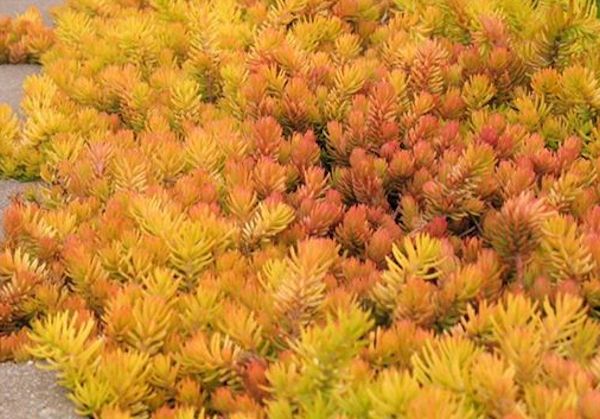
Hardy in USDA zones 6-9, Sedum 'Angelica' is a groundcover succulent known or its golden-yellow foliage and delicate yellow blooms that come about in mid-summer. Foliage is evergreen in warmer climates and turns to a copper-orange before dormancy in colder climates. Plant Sedum 'Angelica' in a location with full sun and a well-drained soil. This perennial is an excellent addition to rock gardens, waterfalls, borders and hard to grow places and is drought tolerant once established.
Sedum 'Aurea'
Sedum 'Aurea' is yet another variety of low maintenance succulent. Sedum 'Aurea' is hardy in USDA zones and forms a 2-4 inch high carpet of tiny pale yellow leaves followed by yellow star-like blooms in summer. Plant this perennial in full sun to partial shade in a well-drained soil. Propagation is easily accomplished through stem cuttings and this perennial can easily be used in hard to reach places, as in between crevasses on a waterfall or rock wall.
Sedum 'Lime Twister'
Hardy in USDA zones 4-9, Sedum 'Lime Twister' is a low maintenance succulent groundcover excellent for rock gardens, containers and borders. Two-tone lime green foliage edged with creamy yellow leads to the production of soft pink flower clusters in late summer. Plant 'Lime Twister' in full to partial sun in a well-drained soil. This perennial is drought tolerant once established. Average size is approximately 4 inches tall by 18 inches wide.
Dwarf  Golden Sweet Flag
Acorus gramineus ‘Minimus Aureus’ (Dwarf Golden Sweet Flag) is not a true grass but grows in tufts of golden grass-like leaves, forming a dense carpet of bright golden semi-evergreen foliage. Sweet Flag is hardy in zones 5-9 and prefers to be grown in partial sun to dense shade in a moderately moist soil. This dwarf variety slowly spreads by rhizomes and reaches a height of just 4 inches tall with a spread of 8-12 inches or more. Sweet Flag serves nicely in a pond setting, rock garden, or foundation planting, or as a ground cover under the canopy of trees.
Variegated Golden Sedge
Carex oshimensis ‘Evergold’ (Variegated Japanese Sedge) is a grass-like evergreen perennial forming low clumps only 6-8 inches tall by 9-12 inches wide. It prefers to be grown in part sun to full shade in a moist, loamy soil. Carex ‘Evergold’ is hardy in zones 5-9 and displays a green-yellow variegated foliage.  It serves nicely in a rock garden, foundation planting or perennial border.
Vinca minor (Periwinkle)
Last, but not least is Vinca minor, also known as Periwinkle. Vinca minor is a popular evergreen groundcover, hardy in USDA zones 4-8, that forms a dense carpet of trailing stems with dark evergreen foliage. Tubular lavender-blue flowers are produced in spring and early summer, which last for several weeks into fall. Vinca minor prefers a location with full sun to part shade in a dry to medium soil. Plants grow to a height and width of approximately 4-6 inches tall and spread to a width of 18 inches and more. This perennial is deer resistant and drought tolerant once established.
Sedum Groundcover Mix

12 Groundcovers for Your Garden
I hope you enjoyed This Month in the Garden-12 Groundcovers for Your Space. Be sure to stop by on the 1st. and 15th. of each month as I continue to share gardening tips, information and horticultural adventures! (Linking with: Floral Fridays, Macro Monday 2, Ruby Tuesday and Image-in-ing Weekly Photo Link-Up.

 For gardening info and tips: Visit my Author Page/Purchase My Books  ðŸ˜Š
Author: Lee @A Guide to Northeastern Gardening,© Copyright 2010-2021. All rights reserved.