Wednesday, October 19, 2011

Planting Fields Arboretum Long Island, NY

Planting Fields Arboretum Late August

I recently experienced some of the most beautiful gardens I have ever seen.  The Planting Fields is a 409-acre public arboretum and historic site that is one of the few remaining famous Gold Coast estates located on the north shore of Long Island.  Located in the town of Oyster Bay, the estate including a mansion and meticulously kept grounds, was the former home of William Robertson Coe and his wife Mary (Mai) Huttleston Coe in 1913.   Planting Fields retains its original historic buildings and landscapes and can be visited year round.


Coe Hall Planting Fields
The property's first mansion burned down to the ground in 1918 and the present Coe Hall, a 65 room Tudor Revival seen here was constructed between 1918 and 1921.  William and Mai Coe had an interest in collecting rare species of plants that formed the gardens existing on the grounds of the estate.  Mr. Coe sold his estate to the State of New York in 1949 for a sum of $1 so that the site could become a historical landmark and arboretum for visitors to enjoy.
Weeping Blue Atlas Cedar Living Arbor


Beautiful mature evergreens such as this single Weeping Blue Atlas Cedar are the pride of the property. Four trees were trained to form an arbor leading to one of the greenhouses on the estate.

Dahlia Garden (late August)
A walk to the Dahlia garden on the other side of the estate proved to be quite rewarding.  Dahlias of almost every variety imaginable grace this plot and are in full bloom at summer's end.  There were so many that it was difficult to choose a select few to show here. Their beauty is indescribable. William Coe had admired Dahlias because of their variety of texture and bold colors.  The present day garden constructed in 1998 is maintained by the Mid Island Dahlia Society and is one of the largest and most spectacular dahlia gardens in the northeast.  I am thrilled that it is here on Long Island.  Over 400 varieties of dahlia are tended to and Dahlia Society members donate over 2000 hours a year maintaining the gardens.


Main Greenhouse


This is the main greenhouse on the premises housing tropical plants such as hibiscus, orchards, ferns, bromeliads, Bird of Paradise, Banana trees and succulents nestled in a tropical gardener's paradise


The 'Italian Garden'


This is one of the reflecting pools on the estate known as the Italian Garden. Mai Rogers Coe originally created the site back in 1913 as one of her favorite places to stroll.  There are over 40 varieties of perennials that bloom sequentially throughout the year to produce a vibrant display of color.


Camellia Greenhouse


This is the Camellia Greenhouse constructed in 1917 that houses the largest collection of camellias in the northeast with over 300 plants on display. In the center of the greenhouse is a beautiful reflecting pool and fountain and in the backdrop is a miniature grotto.

This was certainly a special day for an overly exuberant gardener.  It turns out that while on our August Sunday drive we ended up here at the arboretum on a whim and it became a day to remember.  I did not have my camera so being a very determined gardener I used my cell phone to take these photographs.  I will be sure to visit Planting Fields again next summer and will bring the good camera so that I can engage in some better photography.  If you are ever on Long Island and would like to see these magnificent gardens you will not be disappointed.  They are a welcome sight for the gardening enthusiast or for anyone who appreciates the beauty of nature along with a little bit of local history!

                                                As Always...Happy Gardening!

Author:Lee@ A Guide To Northeastern Gardening Copyright 2011. All Rights Reserved


Saturday, October 15, 2011

Garden Blogger's Bloom Day October 2011

The northeastern garden is beautiful in the fall with plumes arising above grasses and shades of gold, crimson and tan emerging in the landscape. It is a transition from summer to winter. The air has a crispness and freshness about it and there are sights and sounds of busy insects and wildlife preparing for the colder months. Thanks to Carol at May Dreams Gardens we are here again to appreciate all that nature has to offer. Come with me as we take a tour of my northeast zone 7 October garden.  

Montgomery Globe Spruce, Hosta and Grasses
The reason I am a gardener is because the garden is constantly changing and there is always something to look forward to. As we walk along the perennial garden the once green foliage of the hosta has turned to amber and the grasses display their delicate wispy plumes against the blue of the Montgomery Spruce in the backdrop.

Salvia 'Maynight' and Visitor

A busy bumblebee gathers pollen from the last of the salvia.


Sedum 'Brilliant'

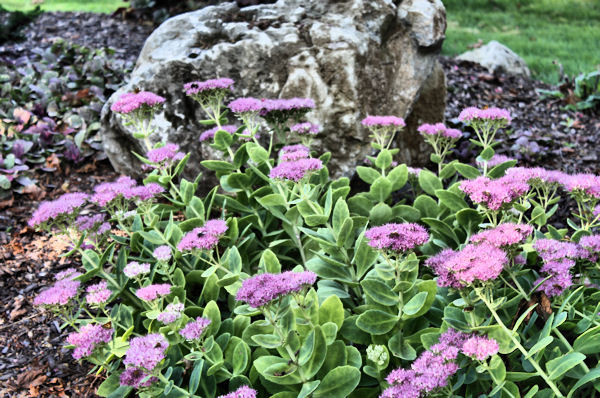
The Sedum 'Brilliant has turned from bright pink to orange which is a nice touch for fall.


Stachys (Lambs Ear)
After pruning off the spent flowers of the Lamb's Ear its soft white foliage has rejuvenated which adds interest to the perennial bed border. In the backdrop the brilliant golds and reds from the Gold Flame Spirea shine through.   
Perennial Garden in fall
Here is a combination of grasses, hosta, astilbe and lamb's ear along with Montgomery Blue Spruce, Spirea and Blue Star Juniper. It is really starting to look Fall-like.
Hosta Flower and Spirea 'Gold Flame'
A lone hosta flower emerges in front of the Gold Flame Spirea in the garden. 


Heuchera 'Caramel'
The Heuchera 'Caramel' is showing a display of new fall foliage.  'Caramel' is a new addition to my garden this year and is definitely a favorite!

Crape Myrtle in fall

The flower of the Crape Myrtle is done for the season but the beauty of this tree continues as it produces perfectly shaped seed pods on its branches.  The Crape Myrtle keeps its leaves longer than most other trees and soon they will be a vibrant fiery red.

Weeping Blue Atlas Cedar, Rosy Glow Barberry, Gold Mop Cypress

This section of the garden has a blend of of gold, crimson and blue. The arching branches of the Weeping Blue Atlas Cedar are really starting to cascade like a waterfall over the Gold Mop Cypress.

Dwarf Fountain Grass 'Hameln'
Here is a close up of a 'Hameln' fountain grass plume...so delicate. The ornamental grasses really make October a time to look forward to.  They are so whimsical in the garden.

Cherry Laurel and Hakonechloa Grass
The rain and mild weather here has sparked some blooms on the Cherry Laurel for an unexpected surprise.

Fall Color:  Grasses, Sedum and Weeping Norway Spruce

More fun with macros with my camera.  This is a close up of grasses and sedum in front of a Weeping Norway Spruce.

Weeping Birch in Fall
The Weeping Birch (Betula pendula 'Youngii') has a delicate weeping habit and its white bark adds interest in all seasons.  This one is already going into fall mode but the branches will display a nice framework in winter.

Blue Star Juniper, Heuchera and Sedum
Here are blue star juniper, sedum and heuchera.  This garden is visible from my outside patio and there are subtle changes each day as the seasons change.
 
Hydrangea 'Endless Summer'
Last but not least is the 'Endless Summer' Hydrangea.  There are many varieties and each one has its own uniqueness.  The blooms even look nice well into the fall.  They surely add a highlight to this gardener's day!
I hope you have enjoyed the tour of my garden and will come back to visit.   Thank you for stopping by and please be sure to visit our hostess Carol at May Dreams Gardens who has made Garden Blogger's Bloom Day possible on the 15th of every month throughout the year.   I am also thrilled to be celebrating my 50th blog post on this wonderful Garden Blogger's Bloom Day! 

Happy GBBD and Happy Gardening!

Winter is an etching, spring a watercolor, summer an oil painting and autumn a mosaic of them all."- Stanley Horowitz


Author:Lee@ A Guide To Northeastern Gardening Copyright 2011. All Rights Reserved


Sunday, October 9, 2011

Labyrinth in the Landscape - Story of A Prayer Garden

Labyrinths have become popular in the design of landscapes in recent modern times.  The history of labyrinth goes back thousands of years as a symbol of salvation and enlightenment.  It is a one way path leading to the center and back again where one can find solitude and peace within.  It is a place for prayer.    As a landscape designer I had the opportunity to design a prayer garden for a local church and it was one of  the most enjoyable and fulfilling projects I have  ever done.  Here is the story of the labyrinth.

I was approached back in 2010 to design a memorial prayer garden where parishioners could go to meditate and pray and enjoy the beauty of nature all in one place.  At the start of the project, I encountered an empty slate of lawn area with a gazebo in the center surrounded by a group of walkways.  The area ended up being the perfect fit for a 30 foot round labyrinth and the gazebo was able to be reused as an additional sitting area on the left corner.   I also felt it was important that the design included benches for guests who would prefer to have a place to rest and partake in prayer.  Once the design was completed it was time to build the labyrinth.  The structure modeled after the Labyrinth of the Cathedral of Chartres in France was constructed out of grey and charcoal Euro circle pavers with sections of different colored stone as areas of accent along the perimeter.  Bluestone treads were placed from the entrance of the labyrinth to the surrounding walkways that were able to stay intact.

Memorialized seat walls and bricks were added to the the labyrinth for visitors to visit, meditate or pray.  Gardens of colorful, fragrant and drought tolerant shrubs and perennials such as viburnum and lavender will  surround the labyrinth on all sides.

The story of the labyrinth traces back to history thousands of years ago.  The sacred geometry of the labyrinth focuses on the numbers four, seven and twelve, each emerging from separate paths.  The central portion of the labyrinth represents a cross surrounded by four sections representing the four gospels and seven is the number of 180 turns there are in each quarter of the labyrinth, also representing the seven liberal arts of medieval education.  Twelve is the number of paths going to the center of the labyrinth representing the twelve month calendar.  As one walks the labyrinth it is meant to be the path of life...a journey to the center of oneself and back out into the world.  Walking into the center of the labyrinth is a symbol for realization and "letting go". Time in the center symbolizes clarity, insight and illumination. Finally, the journey out symbolizes union, initiative and taking control of one's life.  The labyrinth in all is a metaphor for "life's journey".

It has been such a wonderful experience being involved in such a project and seeing the results go from a drafted design to the completed project has been very rewarding.  One can say the whole experience has been both spiritual and enlightening and I know the labyrinth will bring fulfillment to the lives of all those who encounter it.  I know it has certainly brought fulfillment to mine.

Author: Lee@A Guide To Northeastern Gardening Copyright 2011. All Rights Reserved.


Friday, September 23, 2011

Landscaping with Daylilies

Lillium Oriental 'Stargazer'
Lilies are a long-blooming welcomed addition to any landscape. They fit beautifully into just about any type of garden whether it is formal, cottage style or traditional. The true lilies or Asiatic lilies are bulb-forming perennials that belong to the family Lillaceae.

Daylily or Hemerocallis belong to the family Hemerocallis that stemmed from the family Lillaceae. The botanical name for daylily means "beautiful for a day". Daylilies grow forming clumps with continuous blooms throughout the summer and into fall. They can be grown in zones 3-9 ideally in a rich most, slightly acidic soil in full sun. Whether you choose true Lillium or Hemerocallis either can be a welcome addition to your garden.

Lillium 'Stargazer' is known for its beautiful coloration and very fragrant blooms. 'Stargazer' grows in clumps that are 12-16 inches in width and reaches a height of 36 inches and blooms from July-August. It is hardy in zones 4 to 10 and prefers to be grown in full sun in a slightly acidic and rich, well-drained soil. 'Stargazer' can be easily divided by digging up bulbs and re-planting (best done in fall). 'Stargazer' is a prolific bloomer that thrives in the garden and is an excellent addition to any landscape. 

Lillium Oriental  'Casablanca'

Lilium 'Casablanca' exhibits beautiful pure white flowers on stalks 24-36 " high. Fragrant blooms emerge in July-August against dark green foliage. This lily is as magnificent as the 'Stargazer' and is a perfect addition to a moon garden. It's striking white flowers and bright red stamens contrast against a deep green background.
Pink Oriental Lily
Pink Oriental Lily displays delicate pink spotted blooms on 24 -36 inch stalks in mid to late June. Grow this perennial in full sun in a slightly acidic and rich, well-drained soil in USDA zones 4-9. 
Hemerocallis 'Stella D Oro'


The next group of lilies belongs to the family Hemerocallis. Daylily 'Stella D Oro' is a compact clumping perennial producing fragrant golden yellow flowers on 18-20" stalks. 'Stella D Oro' prefers a humus, well-drained soil in full sun but will tolerate partial shade giving some flexibility when planting.  Out of all the daylilies it has one of the longest bloom times from late May through fall with little maintenance. Blooms can be extended through October with a late summer pruning to remove spent foliage. 'Stella D Oro' adds long-lasting color to any formal or informal landscape and it a popular favorite in the garden.

Hemerocallis 'Prairie Blue Eyes'


Hemerocallis 'Prairie Blue Eyes' is a knock-out in the landscape displaying lavender-blue flowers with green throats that bloom on 26-28" stalks mid-season in zones 4-10.  'Prairie Blue Eyes' can be grown in full sun to partial shade and will also tolerate a variety of soil types.

Hemerocallis 'Grape Velvet'

Hemerocallis 'Grape Velvet' shows off deep grape purple flowers with yellow throat on 18-24 inch stalks against deep green foliage.  'Grape Velvet' grows in zones 3-9 and blooms July-August.  It prefers to be grown in full sun and tolerates a range of soil types from slightly acidic to slightly alkaline.
Hemerocallis 'Sammy Russell'

Hemerocallis 'Sammy Russell' displays brick-red star shaped blooms with yellow-apricot throats on 24-26" stems. This outstanding hardy perennial blooms from mid-summer through fall highlighting the summer garden in zones 3-9. This perennial prefers to be grown in full sun to partial shade and can tolerate a variety of soils.
 Hemerocallis  'Pardon Me'


Hemerocallis 'Pardon Me' produces ruffled, fragrant cranberry-red petals with a yellow throats. 'Pardon Me' develops new buds over a long-blooming period from July to October and is hardy in zones 4-9.  It is a compact grower reaching only a height of 18 " which makes it easy to plan in the garden border and works well in small spaces.

Hemerocallis 'Joan Senior'

Hemerocallis 'Joan Senior' produces creamy-white blooms with a yellow throat and slightly ruffled petals. This perennial goes through two bloom cycles from early to mid-summer and grows to a height of 24-26" in zones 5-10.

Lilies are a beautiful and versatile plant and are easy to grow. Their hardiness in several zones make them a popular and widely used perennial in landscaping.   Lilies  adapt well to a variety of soil types and conditions and exhibit a long bloom time.  They add color and texture to the cottage garden, formal landscape or perennial border and can be enjoyed for years to come.


Author: Lee@A Guide To Northeastern Gardening Copyright 2011. All Rights Reserved.


Thursday, September 15, 2011

Garden Blogger's Bloom Day September 2011


Sedum 'Brilliant' and Liriope in Bloom
The summer garden is starting its' transition into fall.  There are signs of fall in the northeast garden with the aftermath of hurricane Irene that made landfall here on Long Island on August 28, 2011.  The trees seem to be losing their leaves earlier than usual and there is a degree of crispness in the air as the days grow shorter and temperatures start their decent. There is an unmistakable beauty to the changing garden that all can admire and behold.

Dwarf Fountain Grass, Sedum, Blue Star Juniper and Heuchera
The grasses are developing their wispy plumes and the Sedum 'Brilliant' is extremely vibrant this year.  Here is a combination of 'Hameln' fountain grass, Sedum 'Brilliant', Blue Star Juniper and heuchera (coral bells).  The coral bells thrive in the shadow of the grasses and are complemented by the blue of the juniper and pink of the sedum. 
 
Sedum, Heuchera and Grasses

Here is a close up of the sedum and heuchera combination. I am really enjoying it this year.


Weeping Blue Atlas Cedar, Rosy Glow Barberry, Gold Mop Cypress and Buddlea 'Lo & Behold'
One of my newer Weeping Blue Atlas Cedars is finally sending out a leader branch that cascades gracefully over the gold mop cypress and dwarf butterfly bush.  It has been a good growing season and this piece is turning into a prize specimen.  I look forward to even more to enjoy as this tree matures. It is amazing how each one is so different.

Double Pink Knock Out Rose

I cannot get enough of my new Knock Out Roses.  They have been blooming all summer. It's a toss up between the red and the pink but I think pink may be my favorite!


More Sedum 'Brilliant' in Bloom with Moss Rock Accent

Can't get enough of the sedum this year...so bright!!!


Heuchera 'Citronelle'

Heuchera 'Citronelle' is the newest member to my garden added just this past September.  Its' vibrant lime-green glow adds eye-catching color to the shadier areas of the landscape.
Golden Hinkoi Cypress and Boxwood

Here is a more formal section of my gardens that I just noticed while taking pictures looks especially nice in fall.  I think I'll have to look some more!


Perennial Garden:  Grasses, Salvia, Lamb' Ear, Lilies and Astilbe
The perennial garden takes on a new look in September.  Soon the colors will be turning to bright oranges and yellows.

Dwarf Fountain Grass 'Hameln' Plumes

The fountain grasses developed their plumes earlier this year so there has been a little more time to enjoy their interest in the garden.

Sedum 'Brilliant' Flower Up Close
The butterflies and bumble bees just love the sedum at this time of year.

Heuchera 'Caramel'

Heuchera 'Caramel' is displaying its' new growth for fall.

Liriope in Bloom (September)
Liriope is at its prime at the end of August and into September displaying its' bright grape-like purple blooms.

Sedum 'Brilliant'

I know...more sedum...but the garden fairies from "May Dreams Gardens" insisted!!!

Double Red Knock Out Rose

Red or pink....which one is the favorite???


Buddlea in Flower

Dwarf Buddlea 'Lo & Behold' has really proven to be one of my favorite flowering shrubs in the garden.  It has flowered all throughout the summer and is still full of vibrant  purple blooms going into fall.
Weeping Pussy Willow Tree

The Weeping Pussy Willow always presents itself to be so graceful.  Its lovely branches cascade almost to the ground and its fullness supplies a home for many families of nesting birds throughout the summer.  We have enjoyed watching the mother birds feeding their young.  It's funny but we call this particular tree "prime real estate" for our feathered friends!

Double... Double Red Knock Out Rose!

This is a time of transition in the northeastern garden...a time of change and beauty.  As the seasons change I look forward to all the beauty nature has to offer.  

Thank you for stopping by and please also visit our hostess Carol at May Dreams Gardens for more September blooms from gardeners around the world and join all of us in celebrating our true passion and love of gardening.

"A garden is a thing of beauty that constantly changes and can be enjoyed forever..."   Happy Gardening!  Happy GGBD!


Author: Lee@A Guide To Northeastern Gardening Copyright 2011. All Rights Reserved.