Showing posts with label dwarf conifer garden. Show all posts

Monday, May 1, 2023

Springtime at Bayard Cutting Arboretum

Bayard Cutting Arboretum State Park
Bayard Cutting Arboretum-Welcome Spring!
Welcome to This Month in the Garden as we tour the beautiful 691 acre Bayard Cutting Arboretum State Park, located in the town of Great River on the south shore of Long Island. It is the home to numerous collections of plants, including the Woodland Garden Walk, the Four Season Garden, Old Pinetum and Pinetum Extension, Oak Park and Holly Walk, Westbrook Wall Garden, Royce Rhododendron Walk, Paradise Island Walk and the well-known Dwarf Conifer Garden. There is always something new to see at the arboretum, as new plantings are added yearly. I have been wanting to visit Bayard during springtime for the longest time and finally made it!
Bayard Cutting Manor House
Entering the arboretum, is this beautiful 68 room mansion that was built for William Bayard Cutting in 1886 as a country home. Touring around the back of the Manor House are views of  the Great Lawn, where fields of Daffodils can be admired in springtime. 
Looking out onto The Great Lawn
Snowdrops
Strolling along during the month of April, remains of snowdrops, one of the earliest blooming perennials, can also be seen growing in the woodland areas.
View of the Great Lawn from Mansion
A variety of mature trees, including Oak, Maple and Elm, mixed in with Pine, Spruce and other evergreens can be viewed from across the vast Great Lawn...
Beautiful Paths
while winding paths can be followed to view stone walls and sitting areas.
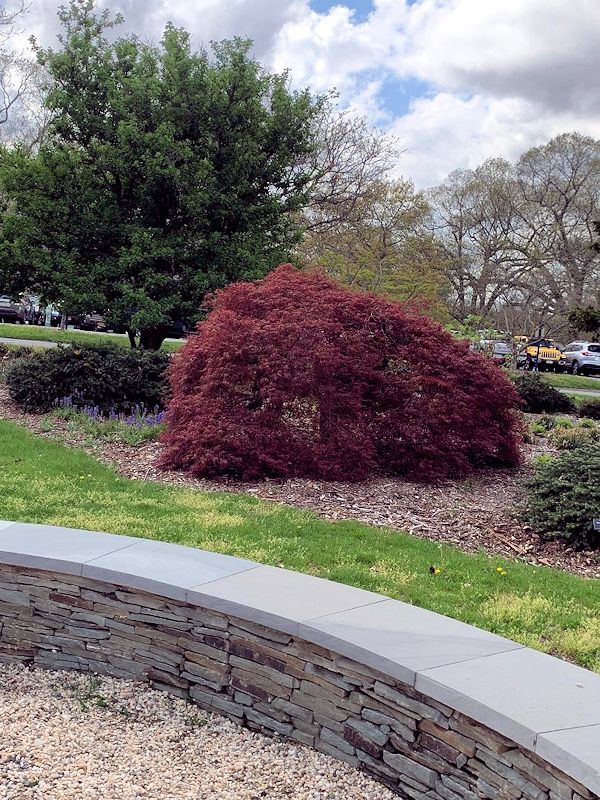
Weeping Red Japanese Maple
With the arrival of spring, deciduous trees, such as this Weeping Japanese Maple, are now vibrant with their new colorful foliage.
Rhododendron 'Nova Zembla' in the Royce Garden
In the Royce Garden are the vibrant blooms of the Rhododendron 'Nova Zembla' along with other varieties of rhododendron, azaleas, dogwoods, Andromeda, groundcovers and other woodland plantings.
Spring Flowering Trees in the New Pinetum
A variety of spring blooming trees including Flowering Crabapple, Cherry and Redbud can be seen bursting with color throughout the grounds.
Spring Views of The New Pinetum
The New Pinetum offers a vast variety of both evergreen and flowering trees including Persian Ironwood, Fragrant Snowbell, Golden Dawn Redwood and rare collections of pine, fir and spruce and cedar.
The Four Season Garden
A favorite of mine is the Four Season Garden Walk, which lives up to its name, with something to offer in every season. Designed in 2011, this mixed border offers an assortment of mature conifers, flowering trees and shrubs and perennials. 
The Four Season Garden
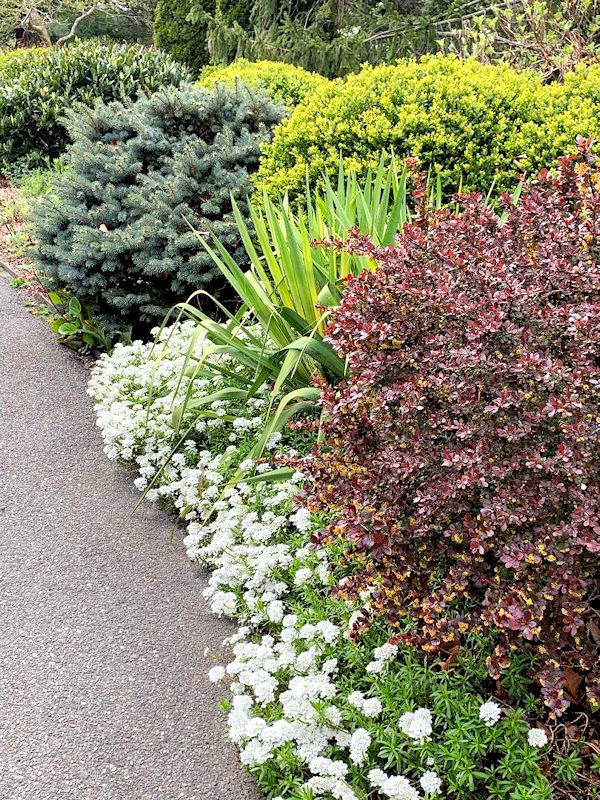
Candytuft (Iberia sempervirens)
The Iberia (Candytuft) along the walkway especially stands out this time of year.
Fragrant Viburnum 'Carlesii'
For some lovely fragrance, Viburnum carlesii cannot be beat!
Eastern Redbud in the Woodland Garden
Eastern Redbud and Fothergilla (Bottlebrush) blooms are also a delight in springtime. Eastern Redbud is a northeastern native, whole Fothergilla is native to the southeast. Each are widely used in native gardens.
Fothergilla (Fothergilla x intermedia 'Mount Airy')
Dwarf Conifer Garden
A well known garden to the arboretum is the Dwarf Conifer Garden. It was donated by the Rezek family in 2018 in honor of Long Islander and horticultural pioneer Ed Rezek. The collection consists mainly of unusual dwarf conifers along with Japanese Maple and flowering shrubs and perennials such as Heather, Japanese Forest Grass and Sedum. Some of the selections in the garden include Dwarf Norway spruce, Dwarf Blue Spruce, Dwarf Cryptomeria, Golden Hinoki Cypress, Hinoki Cypress 'Compacta', Juniperus 'Gold Strike', Mugo Pine and Japanese Garden Juniper.
Dwarf Conifer Garden
Dwarf Japanese Andromeda (Pieris japonica ‘Cavatine’)
Another lovely sight are the bell-shaped white blooms of Dwarf Japanese Andromeda 'Cavatine' and the glorious blooms of  Yellow Magnolia.
Yellow Flowering Magnolia 'Judy Zuk' in the Pinetum Extension
Magnolia 'Judy Zuk' Spring Blooms
Westbrook Walled Garden
Last but not least is the lovely Westbrook Walled Garden planted in 2014, and this statue which was dedicated to the trustee and lifetime friend of the Bayard Cutting Arboretum, Charles D. Webster. It is a comfortable place to sit and relax after walking the gardens.
Tulips in the Westbrook Walled Garden
Here you can wind up the day by viewing more tulips, Japanese Forest Grass, Hosta, Coral Bells, Dwarf Conifers and various flowering shrubs, all which are a delight to the senses!
More Views of the Westbrook Walled Garden
I hope you enjoyed our spring stroll around the beautiful Bayard Cutting Arboretum State Park. Thank for for stopping by for This Month in the Garden and do be sure to stop by on the 1st. and 15th. of each month as I continue to share gardening tips, information and horticultural adventures!

Author: Lee @A Guide to Northeastern Gardening, © Copyright 2010-2023. All rights reserved. 

Friday, July 1, 2022

This Month in the Garden: Summer at Bayard Cutting Arboretum State Park-A Virtual Tour

Bayard Cutting Arboretum State Park
Come along on a summertime virtual tour of Bayard Cutting Arboretum, a beautiful 691 acre state park  located on the south shore of Long Island, New York, about 50 miles east of New York City and bordering the Connetquot River. The park includes numerous theme gardens and continues to evolve yearly as new species of rare and unusual plants are donated. Bayard Cutting Arboretum is also the home of one of the most extensive conifer collections in the region, housing over 1600 specimens. 
Bayard Cutting Arboretum State Park Manor House
The landscape architectural firm of Frederick Law Olmsted designed the grounds for William Bayard Cutting, attorney, financier, real estate developer, sugar beet refiner and philanthropist in 1886. The 68 room mansion, called Westbrook, was designed by architect Charles C. Haight for William, his wife and four children as a summer home. After William's death, the mansion and grounds were donated by Olivia Cutting and daughter in memory of William to the New York State Office of Parks, Recreation and Historic Preservation, which declared the land as a state park in 1912.
Dwarf Conifer Garden
Alongside the mansion is the Dwarf Conifer Garden, with an assortment of evergreens including Dwarf Norway Spruce, Hinoki Cypress, Mugo Pine and rare selections such as Weeping Arizona Cypress and Gold Rush Dawn Redwood. The collection displays a huge diversity of conifers that have been sourced from across the country. Many native species such as Eastern Red Cedar, Pitch Pine, Eastern White Pine and Bald Cypress also reside in the gardens.
New Pinetum: Lilac Tree
There are many paths to take leading to the various collections. Along the New Pinetum, the Lilac tree is in bloom...
River Walk
and the River Walk along the Connetquot  River is so relaxing, especially when there is a gentle breeze.
Conifer Garden
Always an amazing sight are the enormous seed cones on Norway Spruce during the summer months. The female cones are red, while the male ones are brown.
Woodland Garden
For a relaxing walk, stroll down the paths of the Woodland garden and travel the wooden bridge over a babbling brook. There you can explore giant Hosta and ferns, which are indeed happy in their environment.
Woodland Garden
Here is another view.
Woodland Garden: Liquidambar styraciflua 'Variegata' (Variegated Sweet Gum)
On the path, one will come across this glorious Variegated Sweet Gum, which displays leaves that look almost prehistoric in nature.
Woodland Garden-Hosta Curly Fries
Hosta 'Curly Fries' lives up to its name with crinkled narrow golden foliage. Hardy in USDA zones 3-9, it stays small at just about six inches tall by sixteen inches wide.
Woodland Garden
In the woodland garden is a combination of Hellebores, Hosta and Astilbe, with ferns in the backdrop.
Woodland Garden
More ferns along with golden Hosta also make for a nice look!
Woodland Garden: Calla Lily
Here is White Giant Calla Lily, which is being grown in the woodland garden. It is borderline here (hardy in USDA zones 7-9), but can be possibly overwintered in a sheltered area. At three feet high by wide, its blooms are gorgeous! In cooler climates, these rhizomes can be easily dug up and stored in dry peat moss. Keep in a dry, dark location that is no cooler than 45 degrees Fahrenheit.
Woodland Garden
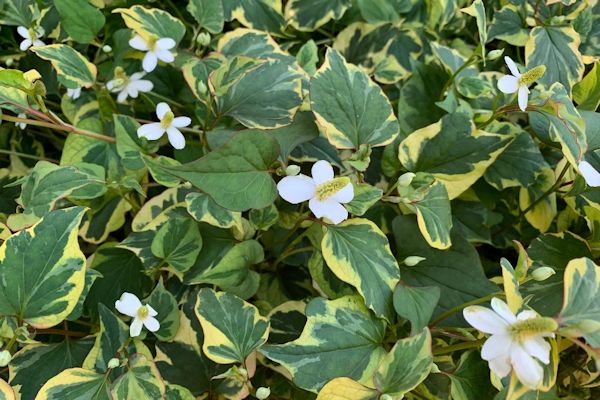
This groundcover really caught my eye and I had not been familiar with it. It is called Houttuynia, also known as fish mint, rainbow plant or chameleon plant and although it is pretty, it is an aggressive groundcover and should be used carefully! It is hardy in USDA zones 4-10, prefers medium to wet soil and produces these showy flowers in summer.  
Mahonia (Oregon Grape Holly)
Welcome to the Holly Walk and view various types of holly, including Oregon Grape Holly, Nellie Stevens Holly, Steeds Holly, and Winter Bounty among others.
Holly Walk
Coming around the Holly Walk, you will come across this more formal garden with manicured circular yew hedges... 
Holly Walk
and blooms of Nepeta and Coreopsis.
Southern Magnolia
This Southern Magnolia is gorgeous when all in bloom and the huge flowers are all so fragrant!
Four Season Garden
Last, but not at all least, is the Four Season Garden, which happens to be my favorite! An accumulation of plants perfectly positioned along a winding path provide blooms and interest for every season of the year. There are benches along the way for stopping and taking in the view.
Four Season Garden
This garden is simply so inviting...and constantly changing.
Four Season Garden
On the way out, a surprise was to be seen. An Osprey's nest along with Osprey overlooked the park as it appeared way up high on the mansion's chimney. It is so nice to see this protected species thriving here on Long Island.
Osprey Nest

I hope you enjoyed This Month in the Garden and tour of Bayard Cutting Arboretum State Park. Be sure to stop by on the 1st. and 15th. of each month as I continue to share gardening tips, information and horticultural adventures! Bayard operating hours are 9-5 Tuesday through Sunday and closed on Mondays and winter holidays. For some views of Bayard in the fall, visit Bayard Cutting Arboretum State Park Autumn. To visit their website, go to Bayard Cutting Arboretum

 For gardening information visit: My Author Page and Books

As Always...Happy Gardening!😊

Author: Lee @A Guide to Northeastern Gardening,© Copyright 2010-2022. All rights reserved. 

Wednesday, December 1, 2021

Autumn at Bayard Cutting Arboretum State Park

Bayard Cutting Arboretum

Welcome to the Bayard Cutting Arboretum State Park, located in Great River, on the south shore of Long Island, New York. This 691 acre state park was designed by Frederick Law Olmsted for William Bayard Cutting in 1886, and offers a wide range of interest from the Great Lawn to the Conifer Garden, Holly Walk, Oak Park, Royce Rhododendron Garden, Four Season Garden, Old and New Pinetums, Breezy Island and the River Walk that winds along the Connetquot River waterway. The parks 13 distinct plant collections continue to grow as new gardens are donated annually.
Common Sage

The gardens hold their beauty all year long, and autumn is the perfect time to explore the grounds as nature puts on a bountiful show. As you enter the park by the mansion, the first plant that will catch your eye is the vibrancy of this common sage along with dried flower heads of Hydrangea and Allium, along with the evergreen foliage of Mugo Pine.
Arboretum Autumn View

Continue further for a stroll along the winding woodland trail for a spectacular view.
Salix babylonic (Weeping Willow)
This Weeping Willow with its changing foliage is almost magical as it grows along the wetland area of the arboretum. 
Pink Mushy Grass
Also along the woodland trail is this Pink Mushy Grass, which is always an eye catcher with its airy pinkish-red plumes! Muhlenbergia capillaris 'Lenca' (Pink Mushy Grass) is hardy in USDA zones 6-9 and thrives in either full to partial sun.
Woodland Garden Walk

Here is another view of the woodland trail with its winding bluestone path and seasonal color.
Callicarpa (American Beautyberry)

This beauty is Callicarpa or American Beautyberry, hardy in USDA zones 5-8. Callicarpa displays beautiful arching branches with lusters of pale lavender-pink flowers in summer, followed by masses of glossy amethyst berries in fall. Callicarpa refers full fun to partial shade and a moderately moist soil.
Ilex verticillata 'Winter Bounty'  (Winter Bounty Holly)
One of my favorite areas of the arboretum is the Holly Walk with more than 100 varieties of holly. This Winter Bounty Holly, hardy in USDA zones 6-8, produces an enormous display of dark red berries which make a spectacular show during late fall and winter. This shrub grows to a mature size of 14-20 feet high by 6-10 feet wide, and prefers a location with partial or dappled shade and a well-drained soil.
Ilex verticillata, (Winterberry)

Ilex verticillata, commonly known as winterberry, is a species of holly that is native to the northeast, that loses its leaves in autumn to display its bright red berries. Hardy in USDA zones 3-9, Winterberry prefers a location with partial sun.
River Walk-Breezy Island
Following along the Connectquot River is a bridge which leads to Breezy Island, where marsh grasses and perhaps some island wildlife, such as osprey can be seen.
River Walk-Breezy Island

The view is quite scenic and relaxing.
Sarracenia (Pitchers Plant or Trumpet Pitchers)
This interesting Pitcher Plant is from the genus Sarracenia, which consists of 15 different varieties of native perennials scattered across North America. Most are hardy in zones 6-8 and thrive best in boggy conditions.
Bridge Crossing
The changing autumn leaves at this time of year are simply beautiful along the bridge leading from the woodland trail.
Mountain Hydrangea Autumn
This hydrangea is still showing off its blooms while the others have already dried out for the fall.
Oakleaf Hydrangea Autumn
Oakleaf  Hydrangea produces bountiful white blooms, but also puts on a wonderful show with its brilliant burgundy foliage before the leaves drop.
 Scotch Heather-Caluna vulgaris 'Boskoop'
Here is Scotch Heather. It is hardy in USDA zones 5-7, prefers full sun to partial shade and grows to a mature size of approximately 1.5 feet high by wide. It bears pale mauve flowers in mid-summer along with bronze-yellow foliage that deepens in autumn. 
Perennial Walk (Four Season Garden)
Another one of my favorite areas of the arboretum is the perennial walk, also known as the Four Season Garden. At this time of year, Asters and Chrysanthemum are the highlight. 
Ajania pacifica (Pacific Chrysanthemum)
I love this variety of  Chrysanthemum  (Ajania pacifica) with its variegated foliage and bright yellow blooms that last well into autumn. Ajania pacifica is hardy in USDA zones 5-9, grows to 1-2 feet, and prefers a location with full sun to part shade.
 Asters
These colorful Asters are a wonderful fall addition to the Four Season walk. These perennials are generally hardy in USDA zones 3-8 and prefer full sun to partial shade. I love the interest they supply while complemented by hydrangea, ornamental grasses, astilbe and  variegated yucca.

Betula Jacquemonti (White-barked Himalayan Birch)

Here is White-barked Himalayan Birch along the Woodland Trail. It is hardy in USDA zones 4-7 and known for its beautiful peeling bark. I especially enjoy its character in the fall.
Old Pinetum: Horse Chestnut
Along the Old Pinetum trail is this Horse Chestnut, which is an eye-catcher during the autumn months!
Dwarf Conifer Garden
Back around towards the Manor House is the Dwarf Conifer Garden, hosting an array of beautiful conifers from around the world, including numerous varieties of Chamaecyparis (Hinoki Cypress), Lawson’s Cypress, spruce, cedar, juniper and pine. Among the conifers are hydrangea, heather and various perennials mixed in, providing all season interest.
Pinetum Extension-American Sycamore
American Sycamore shows off its beautiful bark...
Native Woodland
while the fall season offers an array of color!
Community Supported Agriculture (CSA) Farm

An important aspect of the arboretum is this three acre Community Sponsored Agriculture Farm, which was established in 2012. A portion of the land to the right is now used for growing herbs and vegetables, which can be purchased by members. There are also egg-laying chickens, which are a hybrid cross between a White Rock female and a Rhode Island Red male.  
Cornell Cooperative Extension Farm 
This attractive trellis adds some character to the spot.

Manor House

Back around to the front entrance, this 68 room mansion was designed by architect Charles C. Haight, and built for William Bayard Cutting in 1886 as a country home. Mrs. Cutting specified that the arboretum should “serve as an oasis of beauty and quiet… a source of pleasure, rest, and refreshment.” I hope you found your visit to be just that.
Arboretum Map and Park Information

Bayard Cutting Arboretum, Long Island

I hope you enjoyed This Month in the Garden as we toured the Bayard Cutting Arboretum. Be sure to stop by on the 1st. and 15th. of each month as I continue to share gardening tips, information and horticultural adventures! (Linking up with: Floral FridaysMacro Monday 2Ruby Tuesday and Image-in-ing Weekly Photo Link-Up.)