 |
| Bayard Cutting Arboretum State Park |
Welcome to Bayard Cutting Arboretum State Park. Established in 1886, this 691 acre state park is located in the hamlet of Great River, on the south shore of Long Island, New York. Running along the Connetquot River, this beautiful place is known for its various plant collections and is a haven for native plantings and wildlife.
 |
| Dwarf Conifer Garden |
Entering the park and looking out onto the Great Lawn is the Dwarf Conifer Garden. Planted in 2016 and relatively new to the arboretum, this collection hosts a huge variety of conifers that were sourced from around the country. In 2018, an "extremely rare" dwarf conifer collection was donated by the Rezek family and added to the garden in honor of Long Islander and horticultural pioneer Ed Rezek. Rezek was the founder of the American Conifer Society and it was he who popularized dwarf evergreens as we know them today.
 |
| Dwarf Conifer Garden |
The garden provides interest year-round with an assortment of dwarf upright and weeping species of conifers, heaths, heathers, Japanese maples and colorful perennials.
.jpg) |
| Moss Sawara Falsecypress (Chamaecyparis pisifera 'Squarrosa') |
Towering above along the main walkway is Moss Sawara Falsecypress.
 |
Moss Sawara Falsecypress (Chamaecyparis pisifera 'Squarrosa')
|
This fast-growing needled evergreen (hardy in USDA zones 4-8) generally grows to 12-18 feet but can reach a mature height of 30-65 feet tall in the right conditions. In the arboretum, its twisted branches look like artwork!
 |
| Galanthus (Snowdrops) |
Snowdrops are a sure sign of late winter going into spring, as they are one of the first spring flowers to bloom. Here they are showing off their delicate white blooms along the River Walk. Being one of the first flowers to bloom towards spring, Snowdrops have acquired a very special meaning, as they symbolize purity, new beginnings, hope and renewal.
 |
| Sedum Collection |
Also adding interest in late winter is this groundcover sedum collection with various varieties of low growing Sedum, including Sedum 'Angelina' and 'Blue Spruce'.
 |
Golden Columnar English Yew (Taxus baccata ‘Fastigiata Aurea’)
|
Hardy in USDA zones 6-8, I admire this Golden English Yew every time I visit the arboretum. It's golden margins stand out even more in the wintertime. This plant grows to approximately 10 feet tall by 2 feet wide, but a mature plant is capable of reaching up to 30 feet tall by 8 feet wide over time. This one is relatively new to the park.
 |
| Holly Walk-Mahonia (Oregon Grape Holly) |
Along the Holly Walk, you will view various types of holly, including this Oregon Grape Holly, Nellie Stevens Holly, Steeds Holly, American Holly and Winter Bounty among others. Oregon Grape Holly is known for its bright yellow blooms early in the season, that lead to deep blue fruit later towards fall. The fruit can be stewed with sugar to make jams and jellies.
.jpg) |
| Holly Walk-American Holly (Ilex opaca 'Dan Fenton') |
Here is American Holly with its bounty of bright red fruits, which are an attraction for birds in winter. Added to the collection in 2015, American Holly is hardy in USDA zones 5-9.
.jpg) |
| Weeping Sargent Hemlock (Tsuga canadensis Pendula 'Sargentii') |
Located along the Old Pinetum is one of the showpieces of the arboretum. Hardy in USDA zones 4-7, this Weeping Sargent Hemlock exceeds 25 feet in width! The Pinetum is known to house the largest collection of conifers on Long Island.
.jpg) |
| London Plane Tree (Platanus x acerifolia) |
London Plane Tree, which reaches a height of 75-100 feet tall and a spread of approximately 80 feet at maturity is known for its interesting multi-colored shedding bark. It is now accepted as a hybrid cross between Oriental Sycamore and North American Sycamore and is hardy in USDA zones 5-9.
 |
| London Plane Tree (Platanus x acerifolia) |
Here is a closer view showing the variation of colors in its bark.
 |
| London Plane Tree (Platanus x acerifolia) |
Looking up, this London Plane towers over other trees in the park!
 |
| White Barked Birch |
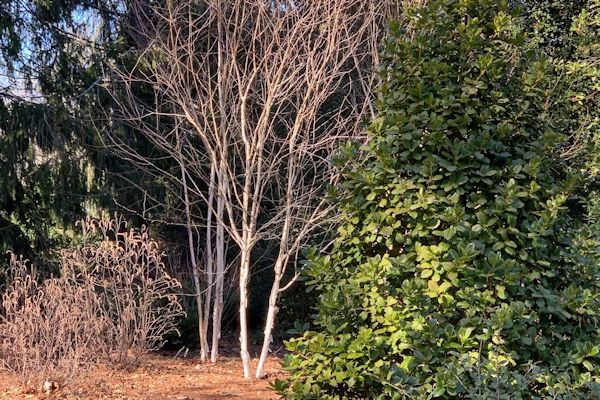
Nestled in the All Season Garden is 'Whitespire' Clumping Birch. Hardy in USDA zones 3-7, it's chalky white bark is a highlight during the winter months. |
| Coral Bark Maple (Acer palmatum 'Sangu Kaku') |
The vivid eye-catching red bark of this tree will certainly catch your attention. The newer growth of Coral Bark Maple glows in the midst of winter. It is even more prominent on this younger tree, new to the arboretum.
 |
| Cabana and Seating Area |
Stop, sit and relax for a while under one of the cabanas at the arboretum...
 |
| River Walk |
then tour the River Walk along the Connetquot River. A mild winter's day is perfect for a stroll.
 |
| Walkway Towards Breezy Island |
Follow the path towards Breezy Island, which is the perfect lookout point.
 |
| Breezy Island and Mrs. Cutting's Tea House |
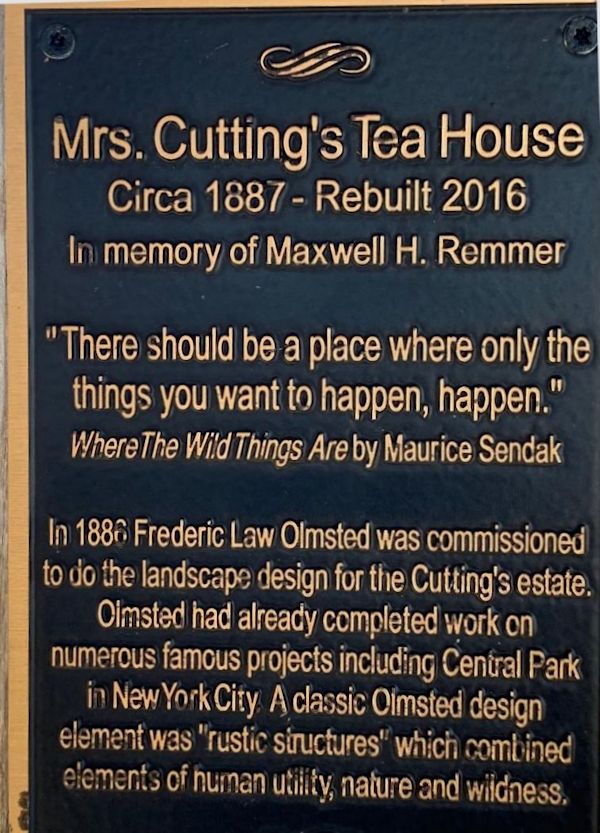
Breezy Island was constructed from soil dredged from the Connetquot River in the 1890's to help with the passage of William Bayard Cutting's ship to his Idle Hour estate further upstream. A Tea House was constructed for Mrs. Cutting back in 1887 as a place for her to enjoy her morning cup of tea. Being declared as structurally dangerous, the Tea House was demolished in 1965 and in 2016, a restoration project began to eliminate invasive bamboo from the island. The Tea House was rebuilt in 2016, keeping its integrity in place, along with the planting of several native species.
 |
| Mrs. Cutting's Tea House |
The plaque reads, "There should be a place where only the things you want to happen, happen."-Maurice Sendak.
 |
| Typha latifolia (Broadleaf Cattail, March Bulrush) |
Along the River Walk, you will encounter Typha latifolia, also known as Broadleaf Cattail or Marsh Bulrush. Typha latifolia is a North American marshland native, hardy in USDA zones 3-10. The white cottony material at this time of year are its seed hairs. Besides being important to wildlife, Typha latifolia has been to known to have many construction and medicinal uses. The stems and leaves have been used for rafts and boats, and to produce paper, while the roots medicinally as cotton balls to treat wounds, cuts and burns, and the flowers to treat abdominal pain.
.jpg) |
| Wildlife at the Arboretum |
Bayard Cutting Arboretum is the home to many forms of wildlife, including approximately 170 species of birds, red fox, racoons, chipmunks, squirrels and aquatic mammals. There are a number of Osprey platforms as well around the park in which birds tend to return to the same nesting area year after year.
 |
| View of Connetquot River and Marshland From Breezy Island |
One last glance of the view of the river and marshland from the Tea House is exceptional, and on the way back you may even have an encounter with some of the local wildlife!
 |
| A Greeting Visitor! |
I hope you enjoyed This Month in the Garden and a winter stroll around Bayard Cutting Arboretum State Park. Be sure to stop by on the 1st. and 15th. of each month as I continue to share gardening tips, information and horticultural adventures! Also visit the top navigation bar of this blog to view Bayard at other times of the year, along with other botanical and community gardens and parks. If you are looking for some gardening inspiration, be sure to visit my author page and books, as I share my experiences and knowledge as a lifetime gardener and landscape designer for over 26 years.
"As Always...Happy Gardening!"


.jpg)


.jpg)
.jpg)
.jpg)





.jpg)


.jpg)


.jpg)
.JPG)


