Showing posts with label blue star juniper. Show all posts

Tuesday, January 29, 2013

Drought Tolerant Landscape Plants for the Northeast

Drought Tolerant Plants for the Northeast
In some cases landscape design calls for plantings which are more "drought tolerant". Plants defined as 'drought tolerant" require watering until established and then can survive on minimal water from natural rainwater and occasional irrigation in hotter climates. The goal is to create a space which is both aesthetically pleasing and low maintenance at the same time.  In this article I am going to focus on "drought tolerant" selections that I have found to be most productive here on Long Island (Zone 7) and that are hardy in a range of zones from 3-9. 
Coreopsis 'Zagreb'

The first in a line of drought tolerant perennials is Coreopsis 'Zagreb'.  This daisy-like flower grows on fine stalks and displays yellow blooms from June until late September. Coreopsis grows to approximately 15 inches in height and prefers a well-drained, slightly acidic soil and full sun.
Sedum 'Aurea' and Daylily
  Next is Sedum 'Aurea'.  Sedum is very drought tolerant and serves nicely in rock gardens as seen here.  It is accompanied by Daylily 'Stella D' Oro', which is drought tolerant once established.  Sedum 'Aurea' only grows to approximately 4 inches in height while 'Stella D Oro' grows to 12-18 inches in height.  Both prefer a well-drained soil and full sun.
Gaillardia (Blanket Flower)
  Gaillardia or Blanket Flower is known for its drought tolerance and display of vibrant yellow-red blooms lasting from June until August. Gaillardia grows to a height of 12-15 inches and prefers a slightly acidic, well -drained dry soil in full sun.  Here on Long Island I have found Gaillardia to be reliable once established but not as long lived as the other perennials mentioned (average lifespan three to four years).
Perennial Geranium
Perennial Geranium tolerates a variety of conditions (full sun to partial shade) and displays violet blue flowers from June until frost and grows to a height of approximately 15-18 inches. Once established it seems to thrive on neglect.
Rudbeckia 'Goldstrum'
Rudbeckia is another drought tolerant perennial that seems to thrive on neglect.  Plant it in an area where there is plenty of space.  Rudbeckia is perfect for informal mass plantings such as along and woodland border and prefer full sun to partial shade and a well-drained slightly acidic soil.  Rudbeckia will re-seed themselves and spread quickly. Bloom time is from late summer into fall.
Nepeta 'Mussinii'
 Nepeta is available in a number of heights ranging from 18-36 inches and is very hardy to zones 3-8. It displays lavender-blue flowers from June to fall. For smaller spaces, 'Walkers Low' is a newer variety only growing 12-18 inches tall. Nepeta thrives in a range of conditions, prefers full sun to partial shade and is drought tolerant. 
Sedum 'Brilliant' (Pink)
Sedum forms clumps of orange-pink flowers on large heads in late summer into fall and require little watering.  The variety shown here is Sedum 'Brilliant', a more compact variety that grows to approximately 12-18 inches tall. Sedum is complemented nicely by ornamental grasses.
Barberry 'Rosy Glow' 

Barberry is a deciduous drought tolerant shrub with deep burgundy foliage that lasts from spring into fall.  There are many varieties of Barberry ranging from 'Royal Burgundy' which grows to 2-3 feet in height to 'Rosy Glow' (shown above) that reaches to 5-6 feet.   Barberry requires full direct sun and a slightly acidic, well drained soil. It is nicely complemented by some of the perennials listed here such as Coreopsis and Nepeta.  *Update (2015):  Barberry has been labeled as invasive in some states.  Alternatives for dwarf barberry are Dwarf Weigelia 'Spilled Wine', 'Wine and Roses', 'Midnight Wine', 'Dark Horse' or Fine Wine.  Alternatives for regular sized Barberry are Eastern Ninebark (Physocarpus opulifolius) 'Summer Wine' or 'Diablo' or Smoke bush (Cotinus coggygria). 
Fountain Grass

Ornamental grasses add movement and grace to any landscape. Ranging in a number of varieties and sizes, fountain grasses are hardy to a range of zones from 5-9 and prefer full sun and a dry, well-drained soil. Grasses are often used in xeriscaping, requiring little irrigation.
Juniperus 'Blue Star'
    Juniperus 'Blue Star' is a beautiful blue-green evergreen that thrives in a slightly-acidic, well drained soil.  Once established it requires little to no watering and it serves nicely in either a formal or informal garden.   This small juniper grows to a mature height and width of 2-3 feet.
 Pinus 'Mugo'

 Mugo Pine is another evergreen that stays relatively compact (mature height and width of approximately 3 feet) and thrives in a slightly acidic, well drained, dry soil.  It is drought tolerant once established and serves nicely in a rock garden planting. 

 Other "drought tolerant" plantings not mentioned above include Spirea 'Vanhoutte' (Bridal Wreath), Buddleia (Butterfly Bush),Vibernum 'Carlesii', Lilac, Lavender, Liatris, Stachys (Lamb's Ear), Yarrow, Salvia, and Russian Sage. With the movement towards sustainable landscaping these drought tolerant varieties are colorful and low maintenance additions to either the residential or commercial garden.

As Always...Happy Gardening!

Links:
https://www.facebook.com/landscapedesignbylee

https://landscapedesignbylee.wordpress.com/  
https://twitter.com/NEGardening

A Guide to Northeastern Gardening: Journeys of a Garden Designer Zones 3-9


Author: Lee@A Guide To Northeastern Gardening, Copyright 2013. All rights reserved

Wednesday, January 25, 2012

Colorful Evergreens in the Landscape-Part II: Blue Evergreens

Blue Evergreens in the Landscape
Are you looking to add permanent vibrant color to your landscape?  Well look no further. In the previous segment I discussed the implementation of colorful golden evergreens into the backbone or foundation of the landscape. There are also several varieties of blue evergreens that can act as a stand alone piece or complement the golden evergreens in your garden.  These varieties are hardy in a number of areas including USDA hardiness zones 2-8.
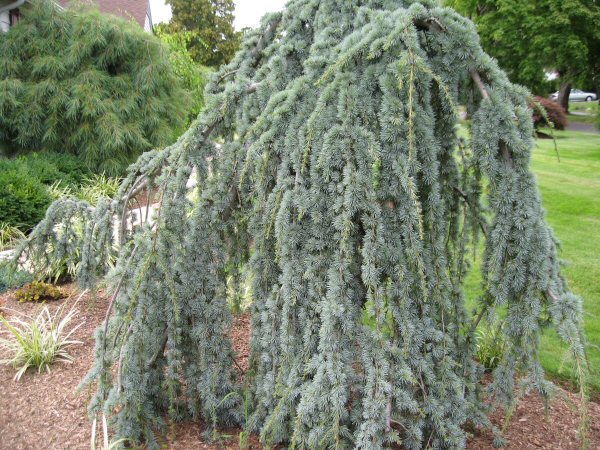
Cedrus atlantica glauca 'Pendula' (Weeping Blue Atlas Cedar)
The first in our series is among the most popular of the blue evergreens. Known for its graceful pendulous silvery-blue branches, Weeping Blue Atlas Cedar (Cedrus Atlantica 'Glauca Pendula') is an outstanding specimen.  Weeping Blue Atlas Cedar is hardy to USDA Zones 6-8, prefers an acidic-slightly to alkaline well-drained loam soil and location in full sun (6-8 hours sunlight). They are tolerant of many soil types but will not fare well in soils with poor drainage such as clay.  These magnificent trees can be trained as an upright or spiral trunk and can be maintained at a desired size through selective pruning.   Depending on the structure of your tree it can reach a height of 10-15 feet and a width of 8-10 feet across and would be difficult to transplant once established. Be sure to give it room to grow.  As your tree matures its cascading branches will drape down to the ground giving your tree grace and charm. 
Cedrus atlantica 'Glauca'
Belonging to the same genus, Upright Blue Atlas Cedar (Cedrus atlantica 'Glauca') is the upright larger form of blue cedar.  Reaching to a height of 40-80 feet this pyramidal evergreen is a wonderful stand alone piece.  This specimen enjoys a moist, well-drained acidic-slightly alkaline soil in full sun and is hardy to USDA zones 6-8.  Majestic in every way, Cedrus atlantica is one of the true cedars named after its native area, the Atlas Mountains of Algeria and Morocco.  Blue Atlas Cedar rapidly grows upright over its first ten years then spreads to a width of 10-15 feet in the landscape.  Give it plenty of room preferably on its own berm and allow this showpiece to shine.
Picea pungens 'Montgomery' (Globe Blue Spruce)
For a smaller area in the garden add some blue by incorporating Picea pungens 'Montgomery' or Montgomery Globe Spruce.  Dwarf in stature, this globe-shaped evergreen exhibits compact bright blue needles on a flat-topped and densely branched shrub.  This specimen is excellent in tight spaces since it only reaches a height and width of 2-3 feet.  Globe spruce prefers to be grown in a moist, well-drained acidic soil and is hardy in zones 2-8.  Use this beauty as a focal point in the garden.  It serves nicely as a foundation planting or as an accent in an evergreen-perennial garden.

Picea pungens 'Fat Albert'
Used as an anchor in a foundation planting or as a privacy screen, Colorado Blue Spruce 'Fat Albert' is definitely a beauty.  'Fat Albert' is a slow grower, reaching to a height and width of 10-15 feet and gets its name from its wider appearance.  It is hardy in USDA zones 2-7 and prefers full sun and a moist but well-drained acidic soil.   Avoid planting this tree in a heavy clay soil as the roots will suffer from poor drainage.   Also it is very important that this tree receive  "full" sunlight meaning 6 or more hours of daylight daily in order to thrive and prevent fungal disease.   Give it this tree plenty of space to grow and it will provide color and structural interest to your landscape.  Picea pungens 'Hoopsi' is a narrower pyramidal form of this tree growing to a height of 15-18 feet.  

Picea pungens 'Bakeri'
Next is a more compact form of blue spuce-Picea pungens 'Bakeri' or Bakeri Spruce.  'Bakeri' spruce is hardy to USDA zones 2-7 and stays more pyramidal at a height of 15-18 feet and width of 6-8 feet.  This blue-green spruce prefers to be grown in full sun in a slightly acidic, well-drained soil.   This beauty also has a wide variety of uses such as a focal point in a foundation planting or as an accent tree in an informal garden.

Juniperus squamata 'Blue Star'
For a little blue along the perimeter of your garden try Juniperus squamata 'Blue Star'. Juniperus 'Blue Star' exhibits bright silver-blue foliage on low branching needles and grows to a maximum height of 2-3 feet making it an excellent foreground planting. This welcome member is hardy to USDA zones 4-8 and prefers to be grown in full sun in a semi-moist well drained slightly-acidic soil.  Once established this evergreen requires minimal watering.  Juniperus squamata 'Blue Star' works well as a mass planting, rock garden plant, seacoast planting or as an accent in a perennial border.


Next time you are looking to add some everlasting color and interesting texture to your landscape try adding a little bit of blue.  Complement the blue color of these fabulous evergreens with a little bit of gold, burgundy, purple or yellow.  The mixture of cool and warm colors will create a dramatic impact in your garden that will bring much enjoyment to your landscape.


Author:Lee@A Guide To Northeastern Gardening Copyright 2012. All Rights Reserved

Sunday, February 21, 2010

Thinking Spring-Color in the Garden Part I: Evergreens

Hinoki Cypress 'Crippsi'
The snow is finally starting to melt here in the northeast and thoughts of spring and returning to the garden are going through my mind.  Since evergreens are the "foundation" of the garden I am going to start with these wonderful all season interest plantings.  Evergreens of course are known for their ability to screen, add privacy to a spot and serve as the ultimate backbone of the garden.  Evergreens can sometimes be underestimated with the misunderstanding that they lack color and variety of texture but quite the opposite is true.  These dependable additions can add variety and color twelve months of the year.  The varieties I will be discussing do apply to zone 7 but are quite versatile and can be used in a number of climate zones.

Some of my favorite evergreens for brightening up any garden include the genus picea (spruce), chamaecyparis (cypress), juniperus (juniper) and cedrus (cedar).   In the spruce catergory-the Colorado Blue Spruce 'Hoopsi' is a favorite which grows to an average of fifteen feet in 10 years, stays at smaller size than an ordinary spruce and exhibits a characteristic  blue color throughout the year.  A smaller globe variety shrub form of the blue spruce is the 'Montgomery' Globe Spruce, another nice addition to any well lit garden. 

'Gold Mop' Cypress
The genus chamaecyparis includes my favorite golden additions to the garden including chamaecyparis pisifera 'Gold Mop'-an evergreen shrub growing to approximately three feet in height over time, much smaller than its predecessor the 'Gold Thread' cypress which can reach an eventual height of fifteen feet.   The 'Crippsi' Cypress is a lovely larger form of  chamaecyparis reaching fifteen to thirty feet over time and the dwarf golden form of hinoki cypress chamaecyparis obtusa 'Nana Aurea' only reaches about four feet and is a prize in the landscape.   I must not forget to mention another golden variety - a personal favorite of evergreen which is not a cypress but rather the genus picea (spruce) which I have recently added to my garden.   If you area a spruce enthusiast then the Oriental Gold Spruce, picea 'Skylands' is by all means one of the most beautiful evergreen trees imaginable and makes a grand stand alone statement to the evergreen-perennial garden.  

Juniperus 'Blue Star'
In the genus juniperus there are so many selections as well but the two I favor for instant color are juniperus 'blue star' - blue in color as the name indicates and juniperus 'gold lace'-not as golden as the 'gold mop' cypress but rather a mix of green and gold and bit more whispy in the garden.    Those of you who would like a little gold in the garden but not too much would prefer this particular evergreen. 


Deodara Cedar
Last but by no means least are the Cedars.  Cedrus deodara 'Aurea' is  magnificiant golden cedar which steals the show for any area where you have good lighting and plenty of space. This beauty can serve as an "anchor' plant for a foundation planting but allow it enough area to grow and make sure the center portion of the tree is planted an average of seven to ten feet away from the foundation (the further the better) to ensure proper distance from the exterior of your home- then enjoy this beauty.  Two other stand alone pieces in the genus cedrus are cedrus atlantica 'Glauca Pendula'  and cedrus atlantica 'Glauca'-both blue in color similar to the blue spruce however less of a "bottle brush" look to the needles as in the genus picea.  The weeping form (pendula) can be used as a foundation planting or in any garden and the later upright form can be used as a stand alone piece where they is plenty or room as it can also reach up to eighty feet in height under optimum conditions.  
Cedrus atlantica 'Pendula'
 (Weeping Blue Atlas Cedar)


I am hoping you have found the information in the above segment both informative and useful. This is the first in a series of three articles on color in the garden.  Parts II and III will focus on the usage of flowering shrubs and perennials to add everlasting color and interest to your landscape.


Author:Lee@A Guide To Northeastern Gardening Copyright 2010. All Rights Reserved