Showing posts with label conifers. Show all posts

Saturday, January 15, 2022

Garden Bloggers' Bloom Day & Foliage Follow-Up: Long Island Wintertime Garden

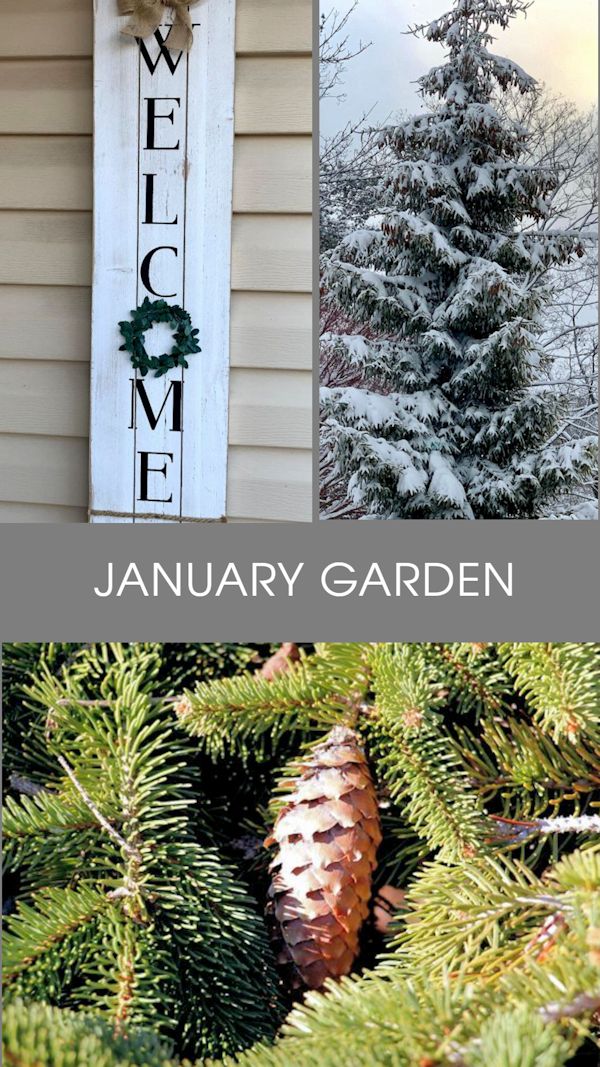
January Garden
Happy New Year and welcome to my south shore, zone 7 Long Island garden! After a relatively quiet December with the first dusting of snow on Christmas Eve day, Long Island was hit with its first significant snowfall on the 7th with 6-8 inches of snow across the island with deeper amounts on the north shore. The garden became a winter wonderland until it was washed away by rain a few days later, followed by a record high of 19 degrees on the 11th. The forecast calls for slightly warmer temperatures today, so come along with me on a tour of my January garden. You better bundle up because its cold outside!
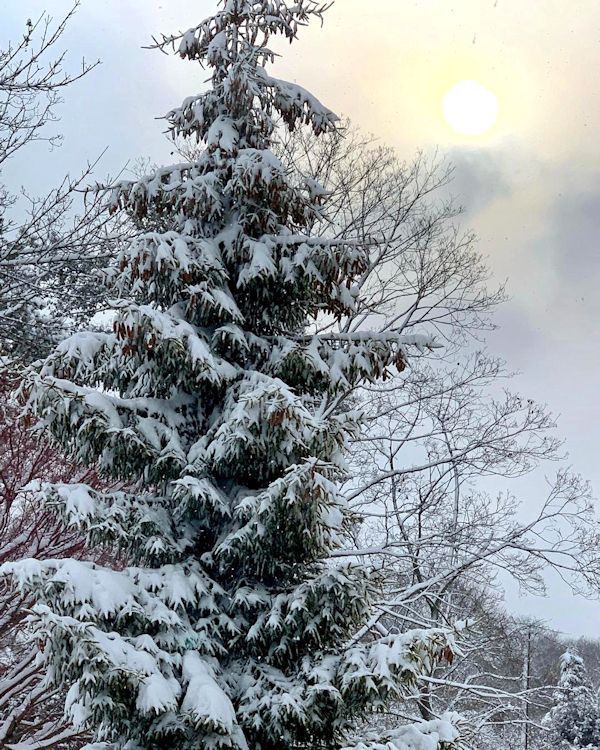
First Winter's Snow!
The beauty of a virtual tour is that I am able to share some snowy views from one week ago. This was the morning of the 7th after the snow, with the sun just trying to peek through the dissipating clouds.
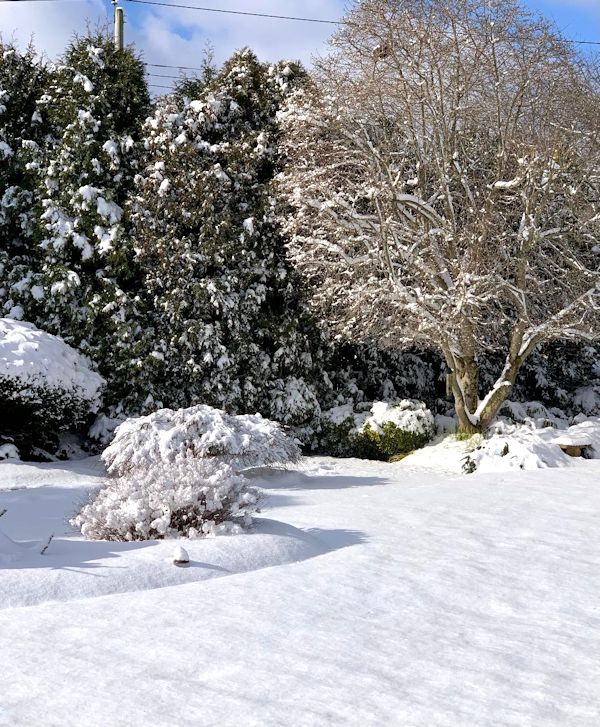
Snow Covered Garden
The backyard pool surround was covered in a layer of glistening white snow, making for a winter wonderland. I do love the seasons and first snow gracing the landscape. There is always something so magical about it; however, that statement may have a different tone by the end of the winter!
Blue Jay Visitor
It's wonderful getting to see visitors each morning, especially in winter. The birds hid for a bit after the snow, but a few days later this Blue Jay came out of hiding for a snack.
Skyland's Oriental Spruce Seed Cone
Along the driveway border, the seed cones on the Skyland's Oriental Spruce are in abundance this winter. We are able to get a view of this lower one up close.
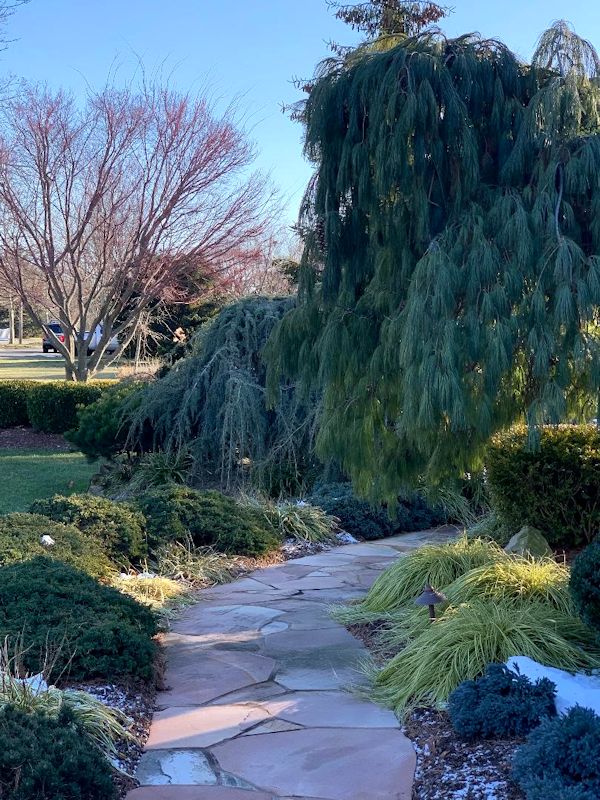
Front Entrance Garden
Here are Weeping White Pine (front right), Weeping Blue Atlas Cedar (middle) and Coral Bark Maple (back left) with Japanese Garden Juniper, Blue Star Juniper and Golden Sedge along the walkway. You can see the branches of the Coral Bark Maple are starting to glow red with the colder temperatures.
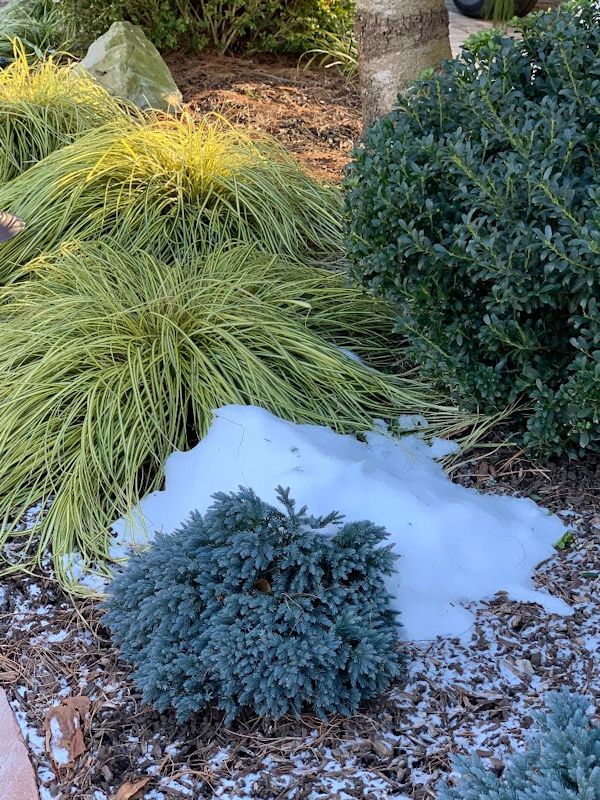
Winter Structure
Here is a closer view of 'Blue Star' Juniper and Golden Sedge, with Hoogendorn Holly, which reside along the foundation. I do depend on evergreens for winter color and structure and am always looking for new cultivars. Another benefit is that these selections are slow growing and low maintenance.
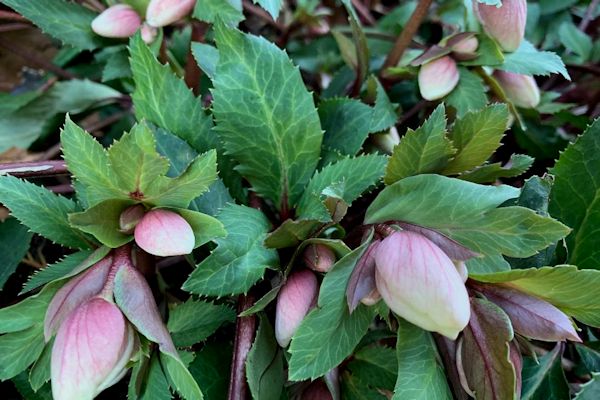
Hellebore 'Shooting Star'
Yes...there can be blooms in winter! Hellebore 'Shooting Star' is getting ready to open its buds to expose pale pink blooms with cream and green highlights! It should be any day now.
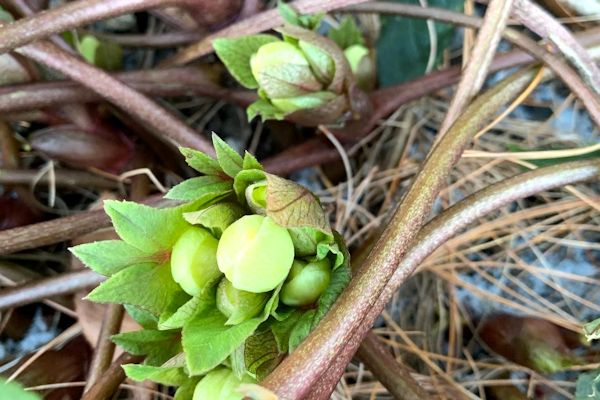
Hellebore 'Champion'
Here are the buds of Hellebore 'Champion', which displays greenish-yellow blooms. I have two other varieties as well, so look out for more buds and blooms as the winter progresses!
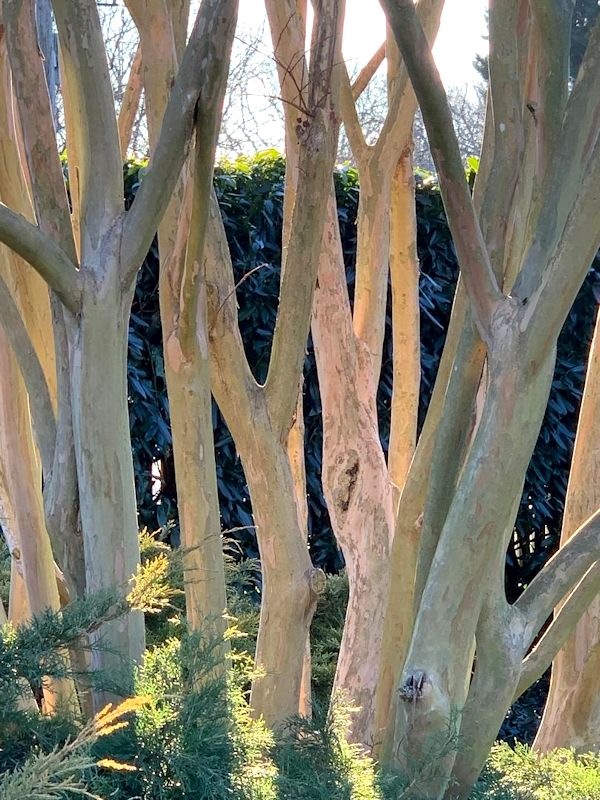
Crape Myrtle
Crape Myrtle is known for its beautiful blooms that appear July through September, but it has nice exfoliating bark too, which is of interest in the wintertime. It has a bit of an artistic touch.
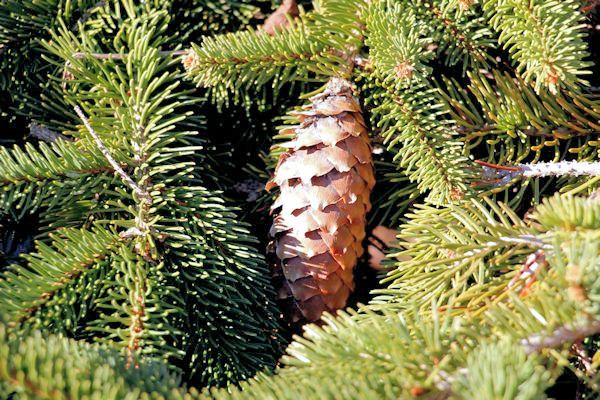
Weeping Norway Spruce Seed Cone
Here is another seed cone, that of Weeping Norway Spruce. I do enjoy looking for them and they have a reddish-pink hue before turning brown.

Hot Cocoa on a Cold Day!
Remember the welcoming committee? Here they are to say greetings!

What Every Gardener Needs!
My dear friend knows me well and surprised me with this door mat as a gift. It's perfect!!! 
Winter Bear
Before we venture onto the indoor garden, here is some more seasonal interest. I do enjoy my garden bears and this one is all decorated for the winter months. Now, since it's freezing out here, follow me inside to warm up and see some more plants!
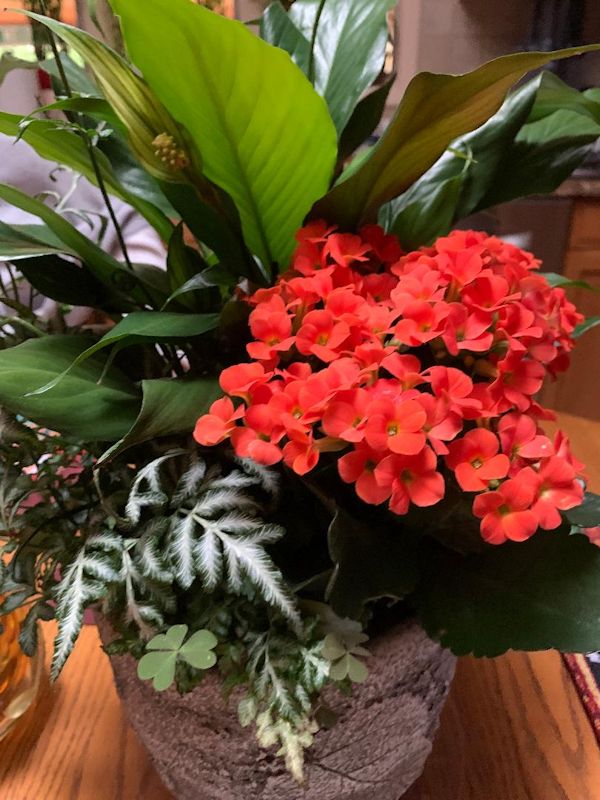
Kalanchoe, Peace Lily and Fern
Welcome to the indoor garden. When the temperatures are cold outside, there's always the indoor garden to depend on for some enjoyment. Here are some selections that are blooming right now.
Hawaiian Anthurium
This collection keeps me smiling year round, but even more so in the wintertime. The blooms on this Anthurium last for months at a time. The orchid is also forming its flower stalks, so blooms should be coming in a couple of months.
Indoor Garden-30 year old Jade Plant
One of my favorite plants in the indoor collection is this Jade plant, which I have had for over 30 years. There is another twin of the same age on the opposite windowsill in what I refer to as the plant room. There are also some succulents and Thanksgiving Cactus that are still producing buds and blooms. I have seen the Jade produce little white blooms over the years, usually around March. Other plants in the indoor collection currently include Spathiphyllum, ZZ Plant, Parlor Palm, Dracaena, Philodendron and Ficus.
Thank you for Visiting!
I hope you enjoyed your visit to my winter garden and as always, I look forward to your comments and seeing what's growing in your neck of the woods! Special thanks go out to our hostess Carol at May Dreams Gardens, who makes it possible to see blooms on the 15th of every month with her meme Garden Bloggers' Bloom Day. Also, special thanks to Pam Penick at Digging who has hosted Foliage Follow-Up for all these years, a meme I will still continue to honor. I am also linking with some other wonderful hosts and hostesses at Floral Friday FotosMacro Monday 2, Mosaic Monday at Letting Go of the Bay Leaf, Nature Notes at Rambling WoodsImage-in-ing weekly photo share every Tuesday with NC Sue and Gardens Galore Link Up Party every other Monday with Everyday Living. I am also happy to join the Weekly Photo Link-Up at My Corner of the World on Wednesdays and Garden Affair at Jaipur Garden

A GUIDE TO NORTHEASTERN GARDENING NEWS:

It's been pretty quiet around here these days, but the good news is that I have started working on a new book for the northeast and Mid-Atlantic garden! I am doing the brainstorming and writing each day while it's cold outside and springtime will bring lots of photo taking, so stay tuned!

I have been enjoying connecting with gardening friends during our regular zoom meetings on GardenComm. It's a wonderful way to get through the winter months and share gardening adventures! 

If you would like to receive post updates for the 1st and 15th of each month, there is a new follow.it subscription widget for A Guide to Northeastern Gardening at the top right side of this page.

If you haven't already done so, be sure to visit My Author PageI have poured a lifetime of gardening love into each of my books. along with experiences, tips, journeys, design inspiration, maintenance advice, guidance and more! Check out A Guide to Northeastern Gardening: Journeys of a Garden Designer Zones 3-9Landscape Design CombinationsDream, Garden, Grow!-Musings of a Lifetime Gardener and Gardening by Month: A Monthly Guide to Planning the Northeastern & Mid-Atlantic Garden

"As Always...Be Well and Happy Gardening”! 😊

Author: Lee @A Guide to Northeastern Gardening,© Copyright 2010-2022. All rights reserved.

Tuesday, February 16, 2016

Book Launching: Introducing A Guide to Northeastern Gardening and the Story Behind It

A Guide to Northeastern Gardening
All my life I have been an avid gardener and my passion for everything green had led to me start up a landscape design business 20 years ago. The idea of writing a book came to me when I decided that I wanted to share my gardening experiences on a much grander scale and have a legacy to leave behind.

I had some extra time in my life starting in the winter of 2013, after retiring from a career as an educator for 32 years. The writing process started off with an online publishing program that offered writing templates and advice. After two years of composing the book, I finally decided it was time to publish and found that the e-book version was doable, but the production costs of the printed version were way higher than I had anticipated. I published the e-book on a website called Blurb and hired a computer technician to convert the manuscript for the amazon kindle, which published in 2015. My frustrations of not being able to produce the book in print continued to eat away at me, as I had already vested so much time into this endeavor. As time went on I would get numerous requests for a hard-copy form, but had to continuously apologize that it was just not doable, and continued to investigate.

Thanks to my stubbornness and determination, I proceeded to entirely re-write the manuscript in a word format which could be published in print at an affordable price. After numerous visits to the mailbox awaiting proofs, stomach dropping moments when I would find that one error, and after an uncountable number of revisions, I finally was able publish my book in print. After the long journey, I am thankful that I had the drive and willingness not to give up, and hope that my readers will find the book to be useful to them in their gardening endeavors.


A little bit about the book:

A Guide to Northeastern Gardening is a comprehensive guide of valuable information on plants hardy in a range of zones from 3-9, and gardening techniques backed up by my own personal experiences as a professional landscape designer, along with answers to frequently asked questions. Learn about landscape design principles, butterfly gardening, deer resistant plants, long blooming perennials, globe and weeping evergreens, flowering trees and shrubs, native plantings, shade gardening and more. Whether you are a novice or experienced gardener, A Guide to Northeastern Gardening will help you to create your own dream garden. Come along on my journey into the world of gardening!

A little bit about the author:

Lee Miller is a professional landscape/garden designer involved in the horticultural industry since 1996. Having started a gardening blog in 2010, she is the author of over 150 articles on general gardening, landscape design principles, gardening tips, planting, pruning, garden maintenance, feature plants and more. Her published book, A Guide to Northeastern Gardening, is an accumulation of information touching on a wide variety of gardening topics, all backed up by her own personal experiences.

A preview of my book is now online at Amazon and it is FINALLY available in printed format as well as kindle edition. I hope you'll take a look and share this with anyone you know who may be interested in this publication. My heartfelt thanks go out to you for your support! Now..I feel published!

A Guide to Northeastern Gardening: Journeys of a Garden Designer on Amazon 

All the best and As Always…Happy Gardening!

Author: Lee@A Guide to Northeastern Gardening,© Copyright 2016. All rights reserved

Friday, December 7, 2012

Dwarf Globe Conifers in the Landscape

 
Dwarf Globe Conifers are a beautiful addition to have in any landscape. Along with their varying colors and textures they are also the perfect size to fit into just about any landscape plan including entrance gardens,  evergreen and perennial gardens, poolscapes, rock gardens, Japanese gardens and more.   The terminology 'Globe' or 'Globosa' refers to any conifer that is "globe-like" or rounded in appearance.  Globose conifers come in a range of colors from blue to green to golden and all tend to stay relatively compact.  The American Conifer Society lists approximately 300 varieties of globe conifer of which 85% are dwarf.  The five species being discussed here today are hardy in a range of zones from 2-9,  are easy to maintain and all serve as wonderful focal points in the landscape. 
Picea pungens 'Montgomery'
  Picea pungens 'Montgomery' (Montgomery Globe Spruce) is a very slow growing dwarf conifer hardy in zones 2-8.    The dense vibrant blue-green foliage of this evergreen shrub provides year round interest and fits in nicely as part of a foundation planting, in a rock garden or poolscape.  Picea pungens 'Montgomery' thrives in full sun and prefers a moderately moist yet well drained slightly acidic soil.   It requires regular weekly watering or more in extreme heat and it is best not to allow this plant to completely dry out.  Picea pungens 'Montgomery' grows to a mature height and width of 3-4' and is known to be deer resistant.  Whether your garden is formal or informal this conifer is sure to make a statement.
 
Cryptomeria japonica 'Gobosa Nana' (Dwarf  Globe Cryptomeria)

Cryptomeria japonica 'Globosa Nana' is a dwarf evergreen conifer hardy to zones 5-7. It prefers full to partial sun and moderately moist, slightly-acidic soil which should not be allowed to completely dry out.   Crytomeria japonica 'Globosa Nana' has a slow growth rate and maintains a compact mounding growth habit.  At maturity this shrub will form a dense mound measuring approximately 2-3 feet in height by 4-8 feet in width.  Cryptomeria japonica 'Globosa Nana' serves nicely as a single specimen planting.  While most varieties of Cryptomeria grow to be quite large this specimen will give you the same beautiful lime green color with a compact plant.  This plant is also deer resistant.
Pinus strobus 'Nana' (Dwarf Eastern White Pine)

Dwarf Eastern White Pine is an evergreen conifer displaying soft delicate blue-green needles on a compact shrub.  Pinus strobus 'Nana' is hardy to zones 3-9, prefers full sun and a moderately moist slightly acidic soil.  Dwarf Eastern White Pine is slow growing reaching an eventual 3 feet tall by 4- 6 feet wide and is deer resistant.  This conifer goes beautifully just about anywhere whether it be a formal or informal garden.  This one is positioned by a poolscape.  No matter where you choose to display this specimen it is sure to be a hit.
Pinus Mugo 'Pumilio' (Dwarf Mugo Pine)

Pinus Mugo 'Pumilio' (Dwarf Mugo Pine) is a popular dwarf conifer displaying dark green needles on compact branches.  It is cold hardy to USDA zones 2-7 and prefers to be grown in full sun in a slightly-acidic well drained soil.  Dwarf Mugo pine is slow growing reaching an eventual size of 3-5 feet tall by 6-10 feet wide.  This shrub is often displayed in Japanese or rock gardens or as an evergreen border.  Dwarf Mugo Pine is relatively low maintenance requiring only occasional watering once established and it is also deer resistant. 
Dwarf Norway Spruce (Picea pungnes 'Pumila)

Hardy in zones 2-8, Picea pungens 'Pumila (Dwarf Norway Spruce) is an attractive slow growing evergreen shrub.  Dwarf Norway Spruce prefers to be grown in full to partial sun in a moist but well drained soil.  This shrubs grows to a mature height of approximately 3-4' and width of 4-6' and keeps a compact rounded form.  Picea pungens 'Pumila' fits in nicely into foundation plantings, rock gardens and Japanese gardens and is also deer resistant. Its dark green foliage interest to the landscape.

Add one or more of these dwarf conifers to your landscape and enjoy the benefits all year long.  Each of these globe conifers are unique in their own way adding much desired color and texture to your outdoor space. 

Visit my Author Page and Books on Amazon:

Dream, Garden, Grow!

As Always...Happy Gardening!

90th post!

Author: Lee@A Guide To Northeastern Gardening, Copyright 2012. All rights reserved


Wednesday, January 25, 2012

Colorful Evergreens in the Landscape-Part II: Blue Evergreens

Blue Evergreens in the Landscape
Are you looking to add permanent vibrant color to your landscape?  Well look no further. In the previous segment I discussed the implementation of colorful golden evergreens into the backbone or foundation of the landscape. There are also several varieties of blue evergreens that can act as a stand alone piece or complement the golden evergreens in your garden.  These varieties are hardy in a number of areas including USDA hardiness zones 2-8.
Cedrus atlantica glauca 'Pendula' (Weeping Blue Atlas Cedar)
The first in our series is among the most popular of the blue evergreens. Known for its graceful pendulous silvery-blue branches, Weeping Blue Atlas Cedar (Cedrus Atlantica 'Glauca Pendula') is an outstanding specimen.  Weeping Blue Atlas Cedar is hardy to USDA Zones 6-8, prefers an acidic-slightly to alkaline well-drained loam soil and location in full sun (6-8 hours sunlight). They are tolerant of many soil types but will not fare well in soils with poor drainage such as clay.  These magnificent trees can be trained as an upright or spiral trunk and can be maintained at a desired size through selective pruning.   Depending on the structure of your tree it can reach a height of 10-15 feet and a width of 8-10 feet across and would be difficult to transplant once established. Be sure to give it room to grow.  As your tree matures its cascading branches will drape down to the ground giving your tree grace and charm. 
Cedrus atlantica 'Glauca'
Belonging to the same genus, Upright Blue Atlas Cedar (Cedrus atlantica 'Glauca') is the upright larger form of blue cedar.  Reaching to a height of 40-80 feet this pyramidal evergreen is a wonderful stand alone piece.  This specimen enjoys a moist, well-drained acidic-slightly alkaline soil in full sun and is hardy to USDA zones 6-8.  Majestic in every way, Cedrus atlantica is one of the true cedars named after its native area, the Atlas Mountains of Algeria and Morocco.  Blue Atlas Cedar rapidly grows upright over its first ten years then spreads to a width of 10-15 feet in the landscape.  Give it plenty of room preferably on its own berm and allow this showpiece to shine.
Picea pungens 'Montgomery' (Globe Blue Spruce)
For a smaller area in the garden add some blue by incorporating Picea pungens 'Montgomery' or Montgomery Globe Spruce.  Dwarf in stature, this globe-shaped evergreen exhibits compact bright blue needles on a flat-topped and densely branched shrub.  This specimen is excellent in tight spaces since it only reaches a height and width of 2-3 feet.  Globe spruce prefers to be grown in a moist, well-drained acidic soil and is hardy in zones 2-8.  Use this beauty as a focal point in the garden.  It serves nicely as a foundation planting or as an accent in an evergreen-perennial garden.

Picea pungens 'Fat Albert'
Used as an anchor in a foundation planting or as a privacy screen, Colorado Blue Spruce 'Fat Albert' is definitely a beauty.  'Fat Albert' is a slow grower, reaching to a height and width of 10-15 feet and gets its name from its wider appearance.  It is hardy in USDA zones 2-7 and prefers full sun and a moist but well-drained acidic soil.   Avoid planting this tree in a heavy clay soil as the roots will suffer from poor drainage.   Also it is very important that this tree receive  "full" sunlight meaning 6 or more hours of daylight daily in order to thrive and prevent fungal disease.   Give it this tree plenty of space to grow and it will provide color and structural interest to your landscape.  Picea pungens 'Hoopsi' is a narrower pyramidal form of this tree growing to a height of 15-18 feet.  

Picea pungens 'Bakeri'
Next is a more compact form of blue spuce-Picea pungens 'Bakeri' or Bakeri Spruce.  'Bakeri' spruce is hardy to USDA zones 2-7 and stays more pyramidal at a height of 15-18 feet and width of 6-8 feet.  This blue-green spruce prefers to be grown in full sun in a slightly acidic, well-drained soil.   This beauty also has a wide variety of uses such as a focal point in a foundation planting or as an accent tree in an informal garden.

Juniperus squamata 'Blue Star'
For a little blue along the perimeter of your garden try Juniperus squamata 'Blue Star'. Juniperus 'Blue Star' exhibits bright silver-blue foliage on low branching needles and grows to a maximum height of 2-3 feet making it an excellent foreground planting. This welcome member is hardy to USDA zones 4-8 and prefers to be grown in full sun in a semi-moist well drained slightly-acidic soil.  Once established this evergreen requires minimal watering.  Juniperus squamata 'Blue Star' works well as a mass planting, rock garden plant, seacoast planting or as an accent in a perennial border.


Next time you are looking to add some everlasting color and interesting texture to your landscape try adding a little bit of blue.  Complement the blue color of these fabulous evergreens with a little bit of gold, burgundy, purple or yellow.  The mixture of cool and warm colors will create a dramatic impact in your garden that will bring much enjoyment to your landscape.


Author:Lee@A Guide To Northeastern Gardening Copyright 2012. All Rights Reserved

Friday, January 20, 2012

Colorful Evergreens in the Landscape-Part I: Golden Evergreens

Golden Evergreens in the Landscape
When planning a garden design it is important to incorporate interesting structure and color into the landscape so that there is eye-catching interest all year long. Golden evergreens will not only add structure but will enhance the landscape with their outstanding show of color. There are a variety of golden evergreens available to the homeowner to implement into the landscape. There are six in particular that I will focus on in this article that have proven to be hardy in the zone 7 northeastern garden and that will thrive in zones ranging from 4 to 8.
Picea orientalis 'Skylands'


The first in this series is Picea Orientalis 'Skylands' or Skyland's Oriental Spuce.  'Skylands' is a slow growing coniferous tree that prefers full sun to partial shade and is hardy in USDA zones 5-8. It is true that younger specimens of this tree can be prone to sun scorch so ideally 4-8 hours of sun is best. I have been successful when planting 'Skylands' in a southeasterly exposure in zone 7. Grow this tree in a moist well-drained acidic soil and apply mulch around the tree to protect the roots.  After ten years of growth Skylands reaches a height of approximately ten feet and a width of four feet and can grow to a height of 35 feet over time in ideal conditions. Being a slow grower and having a narrow stature this tree is ideal for smaller spaces. Its beautiful yellow-chartreuse candles and densely arranged needles make this tree a conversation piece in the landscape.  Mature trees develop small reddish-purple cones that only add to the beauty of this tree. This tree is truly a favorite!
Chamaecyparis pisifera filifera 'Gold Mop'


The next of the gold series is Chamaecyparis pisifera filifera 'Gold Mop' or Gold Mop Cypress. Gold Mop Cypress is a small golden conifer with delicate thread-like textured foliage. This relatively hardy shrub is best grown in full sun in a well-drained acidic soil in zones 4-8. It displays a low mounding mop -like appearance and reaches a height and width of 3 feet making it an excellent accent plant along with other evergreens and perennials. Chamaecyparis 'Gold Mop' retains its yellow-golden color all winter and stays compact unlike its counterpart 'Gold Thread' Cypress which becomes more bronzed and reaches a height of 15 feet over time.

Euonymus japonica 'Aureo Marginata'


Another favorite addition for golden color is Euonymus japonica 'Aureo Marginata' or Golden Euonymus which is not a conifer but rather a broadleaved evergreen. Golden Euonymus is hardy in USDA zones 6-8 and prefers a moist, well-drained neutral-acidic soil and full sun to partial shade. This evergreen displays yellow-green shiny foliage all year round and is fairly slow growing. It reaches a maximum height and width of 4-6' but can be kept compact with regular maintenance pruning. These shrubs serve nicely as either foundation plantings or in an informal garden.

Chamaecyparis obtusa 'Aurea Nana'

Next on the list is Chamaecyapris obtusa 'Aurea' or Golden Hinoki Cypress.  Golden Hinoki Cypress ranges in a variety of sizes from the species 'Nana' which is dwarf in size (2-3' in height) to 'Compacta' which is medium height (10-20 ' in height) to 'Gracillis' (40-60' in height). Hinoki Cypress are hardy in USDA zones 4-8 and display luxurious golden twisted compact foliage throughout all the seasons. These evergreens prefer to be grown in full sun in a moist but well-drained acidic soil.  Some of the more popular varieties are Chamaecyparis obtusa 'Aurea Nana' (seen here), 'Verdoni' which displays a deeper yellow foliage and grows a bit taller to 6-8 feet and 'Confucious' which is a newer slower growing variety with broader yellow foliage on emerald green under layers and growing to 4-6 feet in height. 'Crippsi' is a popular golden variety growing to 15-30 feet and can be used as either a specimen or incorporated into a privacy screening. Each one of these varieties is more beautiful than the next and serve as excellent specimens in the landscape. Hinoki Cypress can be used as a focal point in a foundation planting or as a stand alone piece in a cottage garden, evergreen garden or perennial border. These magnificent beauties will add outstanding interest to just about any landscape.

Cedrus deodara 'Aurea'
Golden Deodara Cedar (Cedrus deodara 'Aurea') is another magnificent focal point in the landscape.  It is one of the larger golden evergreens ranging in size from 15-25 feet in height to 80-100 feet in height depending on the particular species. Deodara Cedar 'Aurea' displays a rich golden-yellow color on graceful wispy branches.  They prefer to be grown in full sun in a moist but well-drained soil and are hardy in USDA zones 6-8. Cedrus deodara 'Gold Cone' (shown here) grows to height of 20-30 feet and displays beautiful pendulous branches covered in green-yellow foliage and grows in a more vertical fashion thus taking up less space in the landscape than some other cedars. Golden Deodara Cedar is often used as an anchor plant or specimen planting in the landscape.


As Always...Happy Gardening.

Author:  Lee@A Guide To Northeastern Gardening, Copyright 2012.  All Rights Reserved.


Tuesday, November 1, 2011

Weeping Evergreens in the Landscape

Weeping Norway Spruce (Picea abies 'Pendula')
Weeping evergreens are beautiful and graceful trees that can add much interest in the landscape. Often acting as a focal point, there are a variety of pendulous trees to choose from, each unique in its own way. An important characteristic of these trees is that several specimens from the same cultivar can range in size, shape and form.  Since no two trees are identical they can become quite the conversation piece in the garden. 


Weeping Norway Spruce (Picea abies 'Pendula') is hardy in USDA zones 2-8 and exhibits dark green cascading branches.  Picea prefers a moderately moist well-drained soil and will tolerate a range of soil pH from strongly acidic to mildly alkaline. Weeping Norway Spruce will tolerate some partial shade but does best in full sunlight. This tree makes a beautiful specimen in the landscape and it also deer resistant. Weeping Norway Spruce is one of the more compact varieties of pendulous trees and ranges in height and width from 4-15 feet. The tree is quite versatile in that the branches can be trained while young to any desired stature, thus making it possible to use in smaller spaces.

Weeping White Pine (Pinus strobus 'Pendula')
Weeping White Pine  (Pinus  strobus' Pendula') is a larger weeping evergreen in the conifer family displaying graceful soft blue-green needles on cascading branches. This tree thrives best in full sun and is hardy in USDA zones 3-8. Weeping White Pine prefers to be grown in a slightly acidic, moderately moist, well-drained soil. Height at maturity varies from 5-10 feet and width from 4-10 feet. Candles may be pruned in spring to keep this tree compact. This tree fits nicely into a variety of landscape styles ranging from foundation plantings to informal woodland settings. 

Weeping Blue Atlas Cedar (Cedrus atlantica 'Pendula')

Weeping Blue Atlas Cedar (Cedrus atlantica 'Pendula') is a favorite member of the conifer family displaying powdery blue-needles on graceful cascading branches. Weeping Blue Atlas Cedar is hardy in USDA zones 6-9 and does best in full sun in a well-drained soil. They can reach a mature height of approximately 10 feet tall and can span in width to 15-20 feet. Plant this tree where it is shielded from strong winter winds and give it plenty of space to grow for it will become a magnificent specimen and favorite in your garden.
Weeping Alaskan Cedar
(Chamaecyparis nookatensis 'Pendula')


Weeping Alaskan Cedar (Chamaecyparis nookatensis 'Pendula') is a "false" cedar of the genus cypress with graceful hanging dark green foliage on descending branches.  Weeping Alaskan Cedar is hardy in USDA zones 4-8 and prefers a moist, well-drained, acidic soil.   It thrives best in full sun to light shade and prefers moderate humidity. Weeping Alaskan Cedar can reach a mature height of 20-40 feet and width of 15 feet. This majestic evergreen serves well as a screening tree or stand-alone piece in the landscape and develops into a beautiful specimen in its maturity. 

Weeping evergreens can supply lasting color and form to any landscape and even look beautiful in winter as their cascading branches are graced with snow. Their range of form and color makes them very versatile in the landscape and they are reasonably easy to grow once established. If you are able to incorporate one of these majestic weeping evergreens into your landscape, you will not be disappointed. Each one is so unique and elegant that it will quickly become a favorite conversation piece and greatly admired focal point. For more ideas on gardening and design, visit my Author Page.


As Always...Happy gardening!

Author: Lee@ A Guide To Northeastern Gardening Copyright 2011. All Rights Reserved